
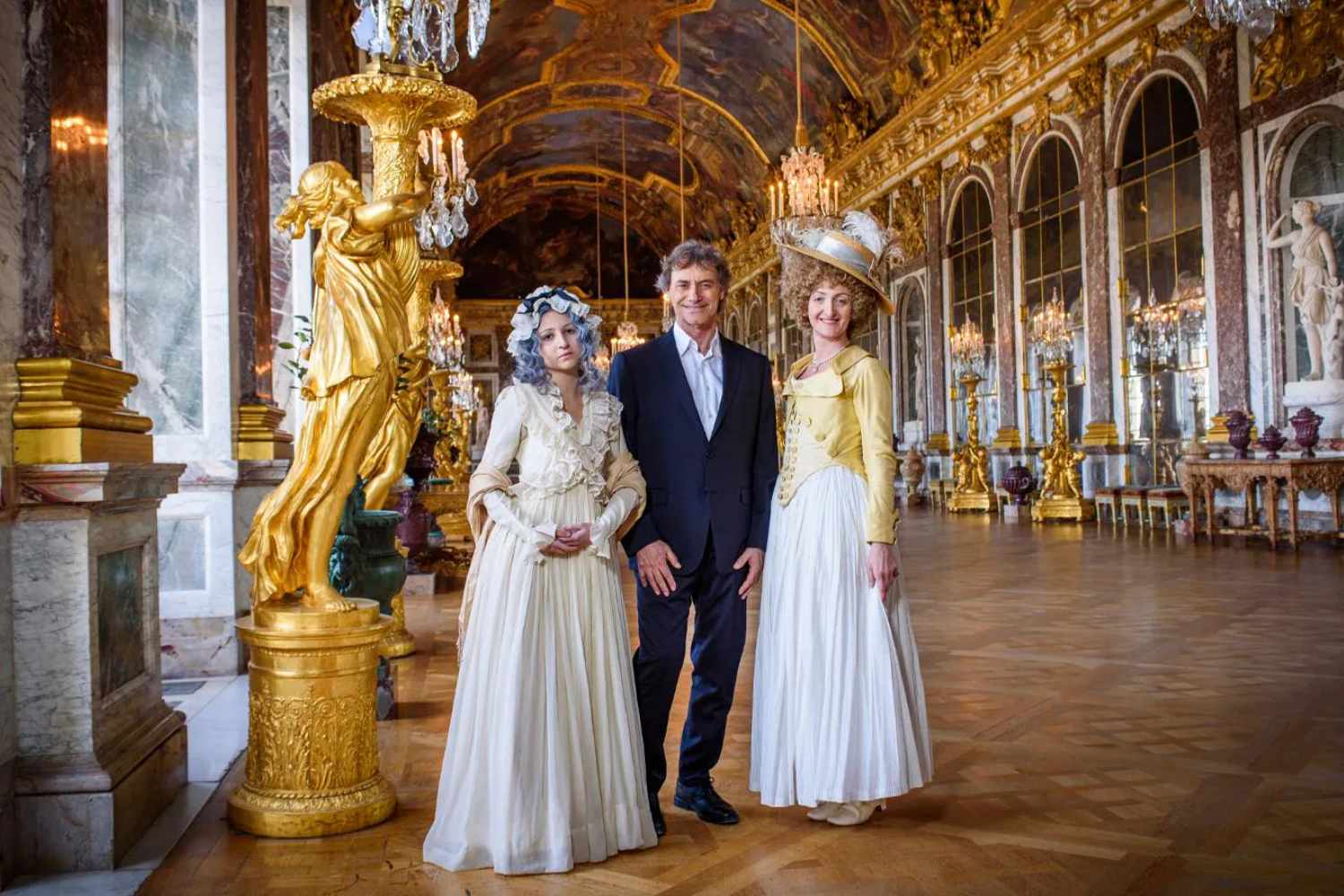
Two hours and twenty uninterrupted minutes inside the Palace of Versailles, without cuts, without hidden cuts, without second support cameras: with the special “Versailles in sequence shot” by Ulysses – The pleasure of discoveryAlberto Angela signs one of the most ambitious operations ever carried out in Italian television dissemination. Broadcast in prime time on Rai 1 and created in collaboration with the Établissement public du château, du musée et du domaine national de Versailles, the project combines historical rigor, technical complexity and a narrative choice that changes the way of traversing one of the symbolic places of European power.
The idea behind the special is as simple as it is radical: to travel through the entire palace as if the spectator were walking next to the host, perceiving the real distance between the rooms, the succession of rooms, the physical weight of the architecture and its political function, without the editing intervening to guide or correct the gaze.
The longest sequence shot ever made for TV
The heart of the operation is a single 140-minute sequence shot, which winds through monumental staircases, gilded antechambers, private apartments and corridors normally closed to the public, requiring the crew to have absolute precision both in technical management and in the coordination of extras, historical re-enactors and scientific consultants.
The choice to give up any cuts implies an enormous logistical complexity: camera movements calibrated to the millimeter, lighting adapted to the historical spaces without altering the atmosphere, microphones and recording systems capable of guaranteeing sound continuity along a path that crosses over two thousand rooms and environments profoundly different from each other in terms of size and light. In this context, the long shot is not an exercise in style, but a tool that allows us to understand how Versailles was designed to influence the gaze and organize power through space.
Inside the heart of absolute monarchy
The path conceived by Alberto Angela has its roots in the transformation of the modest hunting lodge wanted by Louis XIII into a scenographic machine built by Louis XIV to consolidate the absolute monarchy, concentrating the nobility under his control through a system of etiquette as rigid as it is strategic.
Passing through the Gallery of Mirrors, the parade rooms and the private apartments, the special illuminates the daily functioning of the court in the Grand Siècle, when the sovereign regulated the life of the courtiers down to the smallest details, from the morning lever to public ceremonies, transforming every gesture into a political act and every presence into a sign of loyalty. The spectacular dimension of the palace, with its gold, its frescoed ceilings and its perspectives designed to amplify the figure of the king, is intertwined with a structure of power that finds in architecture an instrument of domination.
Marie Antoinette: beyond myth and propaganda
One of the most intense moments of the story is dedicated to Marie Antoinette, who arrived in Versailles very young and was welcomed with distrust as she was Austrian, therefore perceived as a stranger in a closed and suspicious system. Its restored rooms, including the most intimate ones, allow us to follow the evolution of a figure often crushed by the black legend fueled by revolutionary propaganda, but in reality marked by a complex personal journey that passes through youthful frivolities, political pressures, motherhood and a tragic epilogue.
Along the way there is also space for the famous cabinet linked to the presence of the Swedish count Hans Axel von Fersen, whose relationship with the queen continues to fuel historiographical questions, supported by a correspondence that reveals a deep and anything but superficial bond. The story also focuses on the sovereign’s passion for fashion, an element that took on a political and social value at Versailles, accentuated by the presence of a dress created by Milena Canonero for the film Marie Antoinette by Sofia Coppola, included in the itinerary as a dialogue between historical memory and contemporary imagination.
Daily life, etiquette and seduction at court
In addition to the magnificence of the rooms, the special explores the concrete aspects of life in the palace: the heating of immense halls during the harsh winters, the menus of the official and more private banquets, the rituality of meals and ceremonies, the competition between favorites and official lovers which moved within a fragile balance between passion and strategy.
The court emerges as a complex system in which fashion, cuisine, music, games and romantic relationships are intertwined with politics, creating an ecosystem in which every private choice could have public consequences. The objects that survived the revolutionary fury and the delicate restoration work on the tapestries remind us of how much the material heritage of Versailles was exposed to destruction and, at the same time, how much it was safeguarded to become historical testimony.
From the Revolution to the museum of French glories
With the fall of the absolute monarchy and the execution of Louis XVI and Marie Antoinette, Versailles lost its original function, but not its symbolic centrality. It will be Louis Philippe, many decades after the Terror, who transforms the palace into a museum dedicated to all the glories of France, including figures such as Napoleon Bonaparte and redefining the political meaning of the place, which from the sovereign’s residence becomes a space of national memory.
This historical stratification runs through the special like a continuous thread, showing how the palace, despite changing its intended use, continued to embody the very idea of France, with its grandeur and its fractures.
A new grammar of cultural dissemination
Created by the Rai TV Production Department – Naples Production Center – with the scientific consultancy of Mathieu Da Vinha and the direction of Gabriele Cipollitti, “Versailles in sequence shot” demonstrates that generalist television can still experiment with complex languages without sacrificing the depth of content.
Through a single continuous movement, Alberto Angela builds an immersive experience that allows you to cross three centuries of French history, perceiving its density, theatricality and contradictions, offering the public not only a guided tour but a journey into the architecture of power and into the most intimate folds of a court that marked Europe.
You might also be interested in:
