
The word nuclear continues to divide, spark discussions, split families at the table and governments in Parliament. On the one hand the need to abandon fossil fuels, on the other a question that remains there, unresolved, heavy as a boulder: the radioactive waste. Because we can also shut down a reactor, but the spent fuel remains. And it remains for times beyond human imagination.
We are talking about isotopes that remain dangerous until 100,000 years. A time span that crosses civilizations, languages, borders, political systems. A responsibility that does not only concern us, but those who come after us, and after that.
Yet science, silently, is trying to change the cards on the table. And it does it with a tool that seems to have come out of a futuristic laboratory: the particle accelerators.
The challenge of transmutation
When a nuclear power plant ends its fuel cycle, highly radioactive materials remain, including isotopes such as Plutonium-239 and theAmericium-241. They are so-called transuranic elements, capable of continuing to emit radiation for tens of thousands of years. This is where the problem of managing nuclear waste arises: complex, expensive storage, which must be kept safe for periods that no human infrastructure has ever had to face.
The proposal coming from the United States is radical: pairing a subcritical reactor to a high-power particle accelerator. In a traditional reactor the chain reaction is self-sustaining. In this case, however, the system is not able to “stay on” by itself and needs a continuous external impulse, provided by the accelerator itself.
How it works is as fascinating as it is complex. A beam of high-energy protons is aimed at a heavy target, such as liquid mercury. The impact generates a huge amount of neutrons through a process called Spallation. These neutrons hit the longer-lived isotopes present in the waste and transform them into elements with much shorter decay times.
According to estimates by theUS Department of Energyby intervening on the most problematic components, the danger of the waste could be reduced from 100,000 years to approximately 300 years. Three centuries remain a long period, but they are placed within an understandable, manageable and plannable historical horizon.
There is an additional element that makes this technology even more interesting: the reactions produce heat, and that heat can be converted into electricity. Part of the waste then becomes a resource, transforming an environmental problem into a possible energy source.
The NEWTON project
Leading this experimentation is the Thomas Jefferson National Accelerator Facilitywhich received $8.17 million in funding from ARPA-E, the United States’ advanced agency.US Department of Energythrough the NEWTON program, acronym for Nuclear Energy Waste Transmutation Optimized Now.
The goal is clear: to make the transmutation of nuclear waste technically and economically sustainable. The idea of using particle accelerators to “burn” radioactive waste is not new, but so far high costs have held back any large-scale applications.
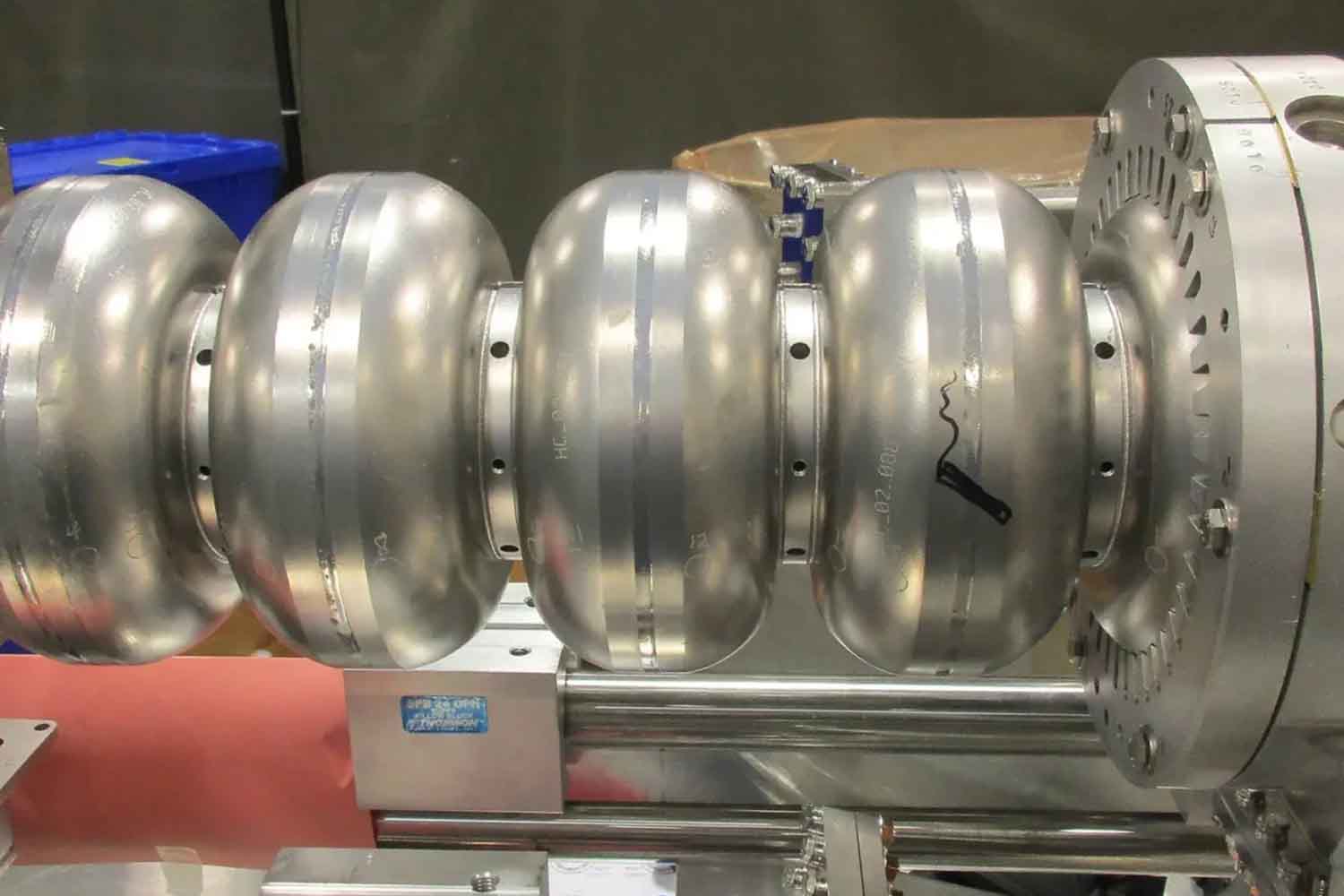
Most accelerators use superconducting niobium cavities, materials that work only at extremely low temperatures and require complex cryogenic systems. Researchers are experimenting with a niobium-tin coating that would allow them to operate at higher temperatures, using commercial cooling systems and reducing operating costs.
The project also involves industrial partners such as Stellant Systems, General Atomics, RadiaBeam and theOak Ridge National Laboratorywith the aim of transferring technology from the laboratory to industrial reality.
At the same time, a second line of research aims to make the accelerator power supply more efficient, studying advanced magnetrons, similar in principle to domestic microwave ovens, capable of operating at the necessary frequency of 805 megahertz with greater energy precision.
Nuclear waste: an ethical question even before a technical one
The theme of radioactive waste It’s not just about technology. It is an ethical, cultural, political question. It means deciding what to leave to those who come after us. It means questioning the weight of energy choices in the long term.
Reducing the danger of waste from one hundred thousand to three hundred years would radically change the perspective of the nuclear debate. It would not eliminate the problems, but it would make them addressable within a human historical dimension, without delegating an almost eternal responsibility to a distant future.
We are still in the testing phase, and the road to concrete application remains complex. But the direction is clear: transforming nuclear waste through transmutation could become one of the most innovative chapters of the energy transition.
And perhaps, in a historical moment in which the climate crisis forces us to make courageous choices, particle physics can also offer an unexpected answer.
