
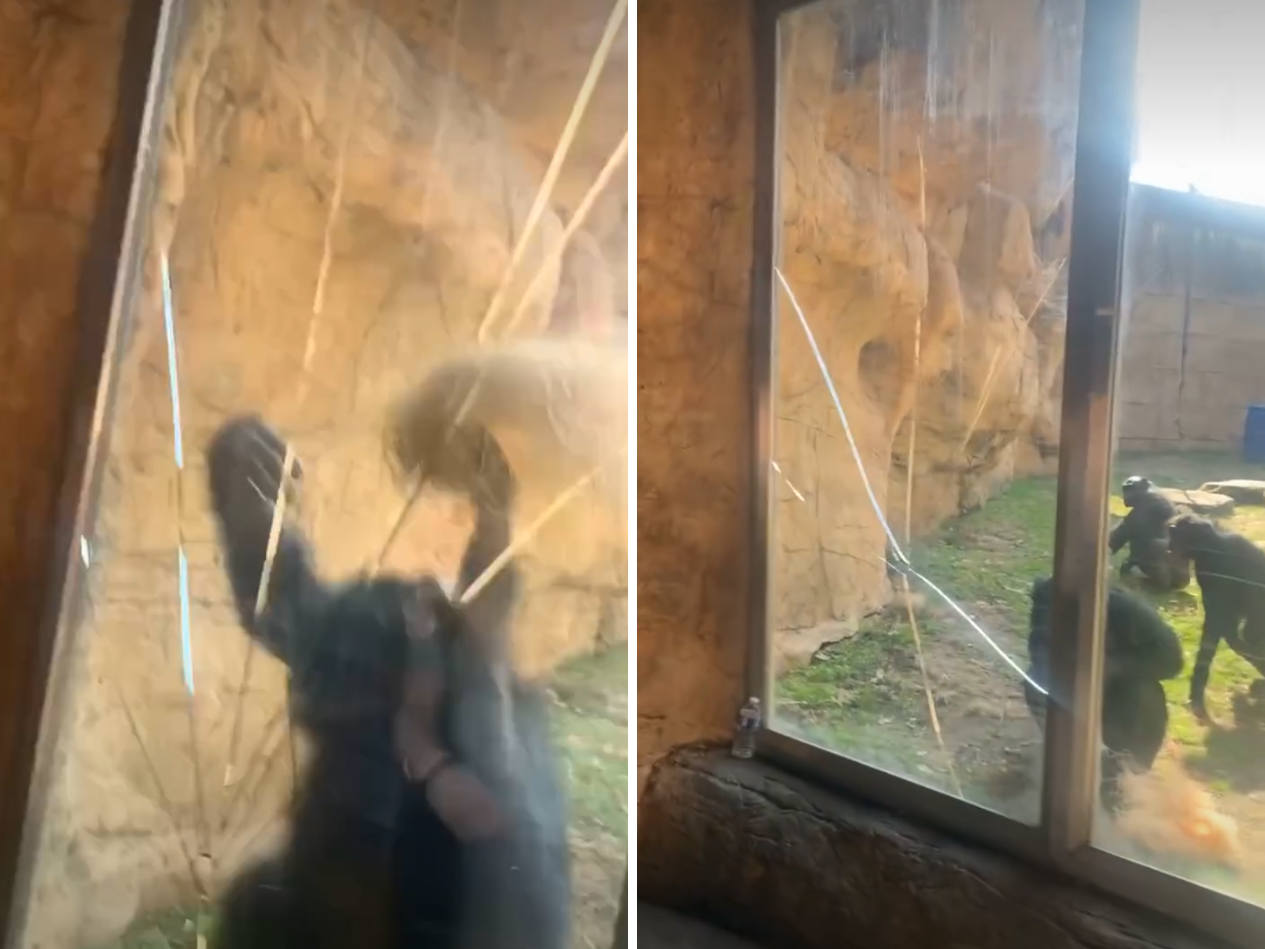
A sudden jump, a lightning-fast run and then the impact. At the Memphis Zoo in Tennessee, a male bonobo forcefully hit the wall of his enclosure, cracking a layer of safety glass as a group of teenagers tried to get his attention. The scene, captured on video, quickly made the rounds on social media, once again sparking debate on the behavior of visitors in zoos.
The episode occurred in the area called Primate Canyon, one of the most popular spaces in the park. According to the management, no one was injured, neither among the public nor among the animals. The barrier, made up of several reinforced layers, withstood the impact: only the first panel was damaged.
View this post on Instagram
An instinctive gesture, not an attack
The protagonist is Mobali, an adult specimen who would have reacted to the gestures and calls of the boys. This was not a planned attack, but an emotional response. Experts point out that bonobos, classified as an endangered species by the International Union for Conservation of Nature, are primates with a strong social sensitivity.
They can experience stress, frustration and anger, especially in a captive context where every external stimulus has an amplified impact like that of zoos. The animal was disturbed several times and reacted by feeling in difficulty: it certainly shouldn’t be pilloried for this reason.
The damaged glass will be replaced with a “special” panel, made to measure. In the meantime, the exhibition will remain closed and the animals will have limited access to some external areas. A necessary measure to guarantee safety and allow work, but which temporarily alters the group’s daily routine.
The thin line between curiosity and disturbance
The management of the Memphis Zoo reiterated a simple concept: observing does not mean provoking. Banging on the glass, screaming or imitating animal behavior may seem like a game, but for those who live on the other side of the barrier it is real interference. Yet episodes like this show how fragile the balance between entertainment and respect is. The fascination of great primates arises from their resemblance to us: for this very reason, however, they deserve an informed look. But the question is much broader: this reaction shows perfectly what it means to live in captivity, constantly observed, photographed, stimulated by the noises and gestures of strangers.
In nature, a bonobo chooses when to show itself, when to isolate itself, when to react. In a zoo, the private dimension practically disappears. The laughter, the blows on the chest, the provocations are part of a context of continuous stimulation. The animal cannot move away completely, it cannot escape the gaze. And when tension exceeds a threshold, it can explode in a sudden gesture, like that of Mobali.
Contemporary zoos present themselves as centers of environmental education and protection of biodiversity. Many fund field projects and contribute to scientific research. But to what extent is the presence of charismatic animals functional to conservation and to what extent does it respond to the logic of attraction for the public? Maybe the real question isn’t why a bonobo hit the glass, but what it means to live behind it every day.
You might also be interested in:
