
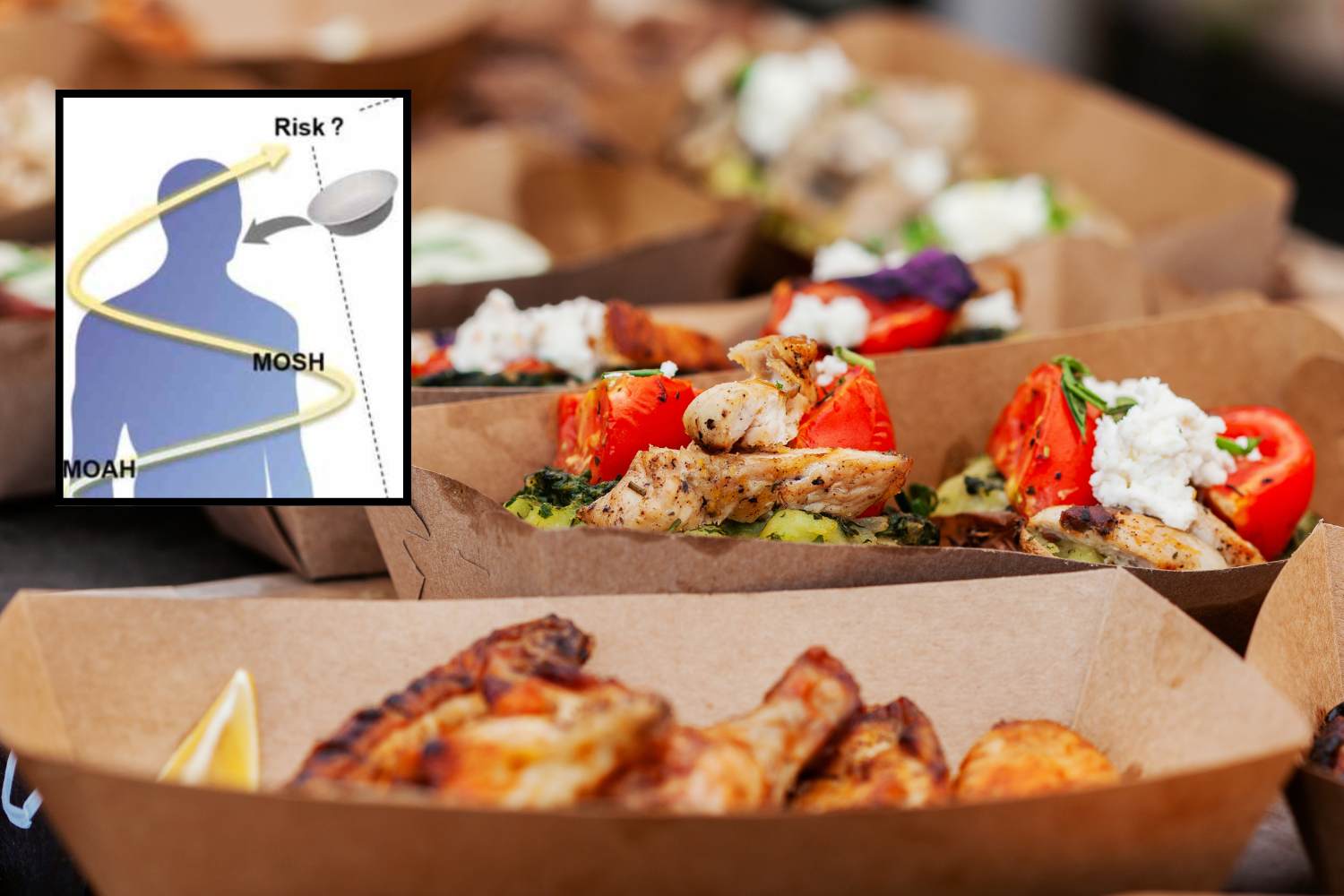
When you order a pizza and the box arrives at your home, or when you sip a cappuccino from a paper cup, you probably don’t think about what could pass – invisible and odorless – from the packaging to your food. Yet every time a fatty food comes into contact with paper and cardboard, a migration of chemical substances can start which in recent years has been increasingly worrying scientists and health authorities.
They are called MOSH and MOAH, two acronyms little known to the general public, but already at the center of a heated debate in Europe and around the world. A recent study published in Journal of Food Composition and Analysis shed light on this phenomenon, analyzing over 500 samples of paper and cardboard packaging purchased in China.
But first let’s clarify what MOSH and MOAH are.
Mineral oil hydrocarbons are complex chemical mixtures that derive from the refining of crude oil and are divided into two families. The first is MOSH, saturated hydrocarbons that can occur in linear, branched or cyclic forms and studies conducted on animals have shown that they tend to accumulate in organs such as the liver, spleen and lymph nodes. The second family, MOAHs, is considered potentially more dangerous: those with three or more aromatic rings are classified by EFSA – the European Food Safety Authority – as genotoxic and carcinogenic, i.e. capable of damaging DNA and promoting the development of tumors.
These compounds enter the food chain through several routes: lubricants used in agricultural and industrial machinery, environmental contamination, food additives and, above all, migration from packaging. Recycled paper is among the most critical carriers, because during the recycling process it is not possible to completely eliminate the mineral oils present in the printing inks, adhesives and waxes of the original materials.
The study
The researchers collected 502 samples of paper and cardboard packaging intended for food contact from supermarkets, local fairs and online shops in five Chinese provinces. In the basket were paper cups, bags, boxes, tubs, bowls, plates, cupcake liners, paper towels, baking paper and steamer liners.
Each sample was tested with three types of food simulants: one acidic (4% acetic acid), one aqueous (10% ethanol) and two fats (isooctane and 95% ethanol), to reproduce the worst conditions of real use.
From the results it was seen that MOSH and MOAH do not migrate in acidic or aqueous foods. Migration occurs exclusively in contact with simulations of fatty foods, whether oils, cheeses, chocolate or baked goods. An important distinction, which suggests where to focus attention.
Not all packaging behaves the same way. Paper boxes showed the highest detection rates (nearly 49% of samples), followed by paper bags, cupcake liners and cups. In contrast, baking paper and steamer liners showed no detectable migration.
Why this such a marked difference? The authors identify two main reasons. The first concerns printing: paper boxes are often decorated with colorful graphics, and the traditional inks used to print them are rich in mineral oils, which can easily transfer to the contents. This is nothing new, previous studies had already indicated printing inks as the predominant source of MOSH and MOAH in paper.
The second reason is the absence of functional barriers, i.e. that insulating layer which, when present, physically blocks the passage of contaminants between the printed exterior and the surface in direct contact with the food. Most of the boxes examined did not have them.
The researchers also compared migration levels by sales channel. The highest values were recorded in samples purchased online, followed by local fairs and finally supermarkets. However, the differences were not statistically significant. In practice, there is no intrinsically “safer” sales channel: the quality of the packaging depends more on the manufacturer than on the point of sale.
Risk assessment
To understand whether the levels found constitute a real danger to health, the researchers used Monte Carlo simulation, a probabilistic statistical method that simulates tens of thousands of exposure scenarios to estimate risk more realistically than traditional assessments.
The result for MOSH is reassuring: the calculated exposure margin – both on average and at the 95th percentile – remained above the safety threshold set by EFSA (MOE > 1200), indicating an acceptable level of risk for the adult population.
But the researchers warn: the 95th percentile value was relatively close to the threshold, which requires continuous surveillance. And for MOAHs the situation is still open: the lack of sufficient toxicological data on compounds with three or more aromatic rings has prevented a complete risk characterization. Simply put, we don’t know enough to rule out dangers.
There is another element that makes this study particularly relevant today. Plastic reduction policies, in Europe and around the world, are pushing companies and consumers to replace plastic containers with paper and cardboard alternatives. A change often presented as ecological and healthy.
But this transition, if not managed carefully, has risks. As the authors of the study point out:
This is particularly relevant in the context of plastic restriction policies, where paper-based materials are increasingly used as alternatives, leading to increased human exposure (to mineral oils, ed.).
So choosing paper instead of plastic is right, but only if the paper is produced safely.
What researchers ask
The study’s recommendations are precise. The researchers ask first of all that functional barriers become mandatory for all recycled paper packaging intended for contact with fatty foods, and that the use of virgin fibres, free of contamination inherited from the recycling cycle, be favoured.
On the inks and adhesives front, they invite producers to choose formulations that comply with food standards, abandoning traditional ones.
They also call for the introduction of specific migration limits for MOSH, which are still absent in many countries, including China, where there is currently no legal limit for either MOSH or MOAH. Finally, they call for the development of more advanced analytical methods, capable of distinguishing genotoxic MOAHs from less dangerous ones through techniques such as multidimensional chromatography.
And in Europe?
On the European front, the situation is a little more advanced: from 2022 there are limits for the MOAH content in foods, which vary from 0.5 to 2 mg/kg depending on the lipid content, and Germany has already proposed the obligation of functional barriers for recycled paper. The specific limits for MOSH, however, still remain to be defined. Even in Italy, as in the rest of the European Union, there is still no specific legislation that establishes limits for MOSH in foods, but the topic continues to be monitored by European and national authorities.
