
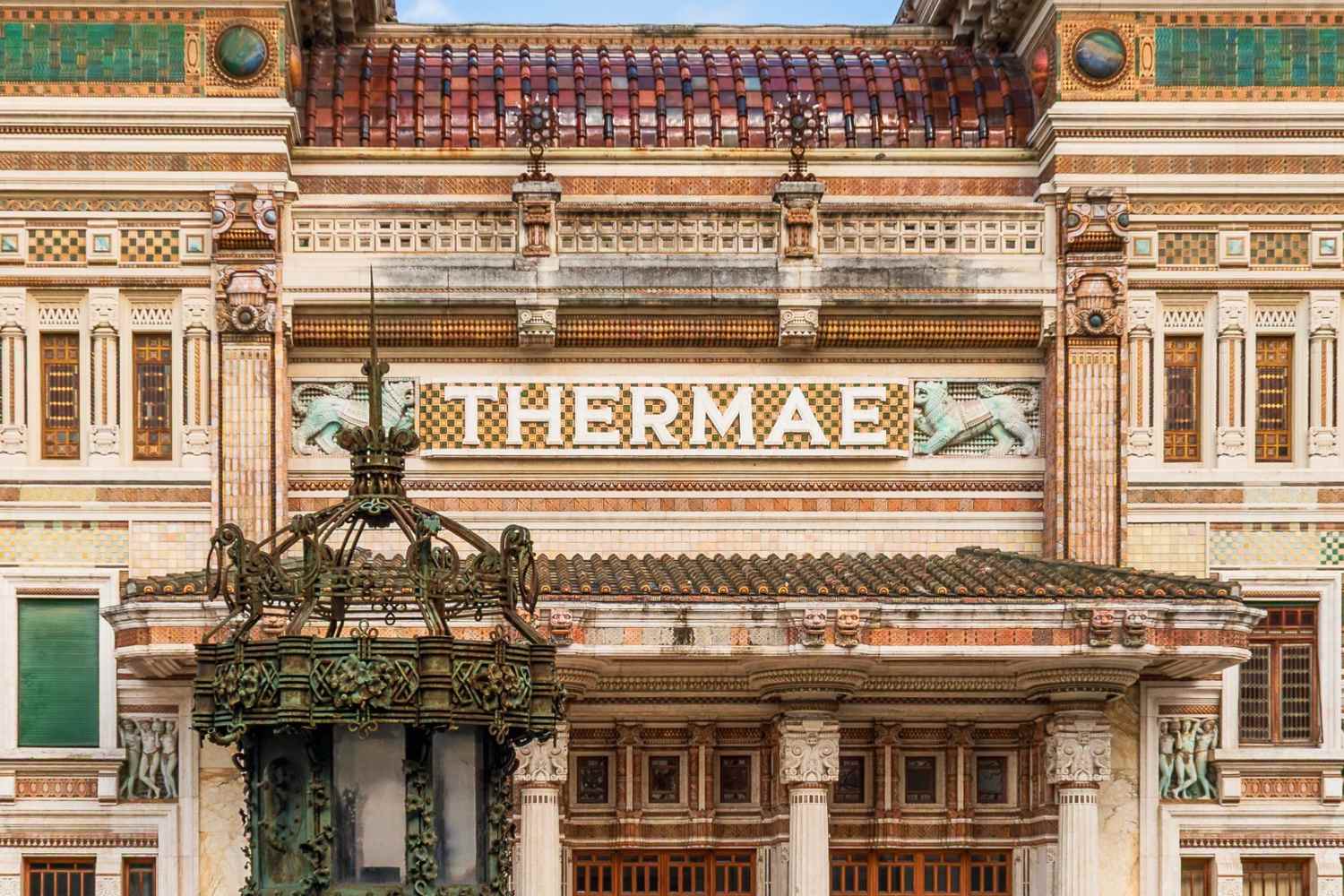
In December 2025, after years of abandonment and unsuccessful auctions, the Terme Berzieri palace in Salsomaggiore Terme reopened its doors. Forty million euros – allocated by the Ministry of Tourism and the Cassa Depositi e Prestiti – financed the complete restoration of a building which in 1923, when it was inaugurated in the presence of fascist hierarchs and ministers of the kingdom, was defined without hesitation as “the most beautiful spa in the world”.
The history of the spa: Galileo Chini and the East that arrived in Emilia
The palace is the result of a long and stratified history, which has its roots in 1839, when Doctor Lorenzo Berzieri discovered the healing properties of the bromine-iodic waters of Salsomaggiore, and reached its creative peak in the early twentieth century, when the artistic direction of the construction site passed into the hands of the Florentine painter and sculptor Galileo Chini.
Chini had just spent three years in Bangkok, from 1911 to 1914, and the frescoes, ceramics and oriental architecture that he had studied in Thailand came back to life on the facade of this Emilian palace, where blue lions guard the monumental entrance, historiated capitals depict ram’s and owl heads, and the writing THERMAE stands out in monumental letters above a canopy covered in majolica.
The architect Ugo Giusti, who took the reins of the construction site after the retirement of Giulio Bernardini, translated these suggestions into a stylistic synthesis that draws on Art Nouveau, the Viennese Secession and Art Deco, with explicit references to Gustav Klimt in the internal decorations of the double-height atrium, entirely covered in marble, gold, stucco and paintings.
The construction site that mobilized an entire artisanal supply chain
Twenty-three million lire of the time, hundreds of bricklayers, marble workers and decorators, the blacksmiths of Antonio Veronesi’s workshop for the wrought iron decorations, the artisans of the Fornaci Chini of Borgo San Lorenzo for the ceramic stoneware and glass – the production of which required the complete renewal of the systems -, and finally the marble workers who worked the reds of Verona, the whites of Botticino from Rezzato, the whites of Carrara, the yellows of Siena and the Rapolano travertines. The Cremonese painter Giuseppe Moroni completed the picture with the large triptych on the counter-façade, which portrays the goddess Hygieia with her maids, while Galileo Chini painted in 1922 the two panels with Autumn and Spring which decorate the walls of the first floor, overlooking a loggia and two bow windows onto the entrance covered by a blue and green glass window.
The crisis, the deserted auctions and the purchase of Cassa Depositi e Prestiti
From the nineties onwards, with the end of assisted spa tourism and the progressive dismantling of the system that brought patients to the spa with reimbursement from the National Health Service, Salsomaggiore has experienced a progressive and documented decline: the 684 thousand presences in the accommodation facilities in 2004 had been reduced to 200 thousand twenty years later, and the company that owns the Terme Berzieri – renamed in 2008 “Terme di Salsomaggiore e di Tabiano SpA” — had been admitted to the composition with creditors in 2015, before putting all its assets up for sale, including the building, in 2018. On 29 June 2021, after a series of unsuccessful auctions, the Cassa Depositi e Prestiti purchased the building and entrusted it to the private group Quadrio Curzio, which started the renovation works in 2023 and then completed by the QC Terme group.
A new beginning
The new QC Salsomaggiore — Spa of Wonders occupies approximately 9,000 square meters distributed between the main building and the former thermal power plant at the back, which the 2025 works transformed into a space dedicated to water, surmounted by three panoramic swimming pools discovered on the roof. Inside, saunas, biosaunas, suspended bridges, double-height terraces, massage lounges and a bistro coexist with Chini’s frescoes, the polychrome marbles of the monumental staircase and the stained glass windows that filter the light onto the landings, where large mirrors with ornate stucco and metal frames multiply the reflections.
The Terme Berzieri building has never been just a building for body care: it has been, since its inauguration in 1923, the center of gravity of a territory, the reason why people chose to stop, to return, to bring friends with them. Now that the building has regained its function, the bet is that that gravitation can begin again.
