
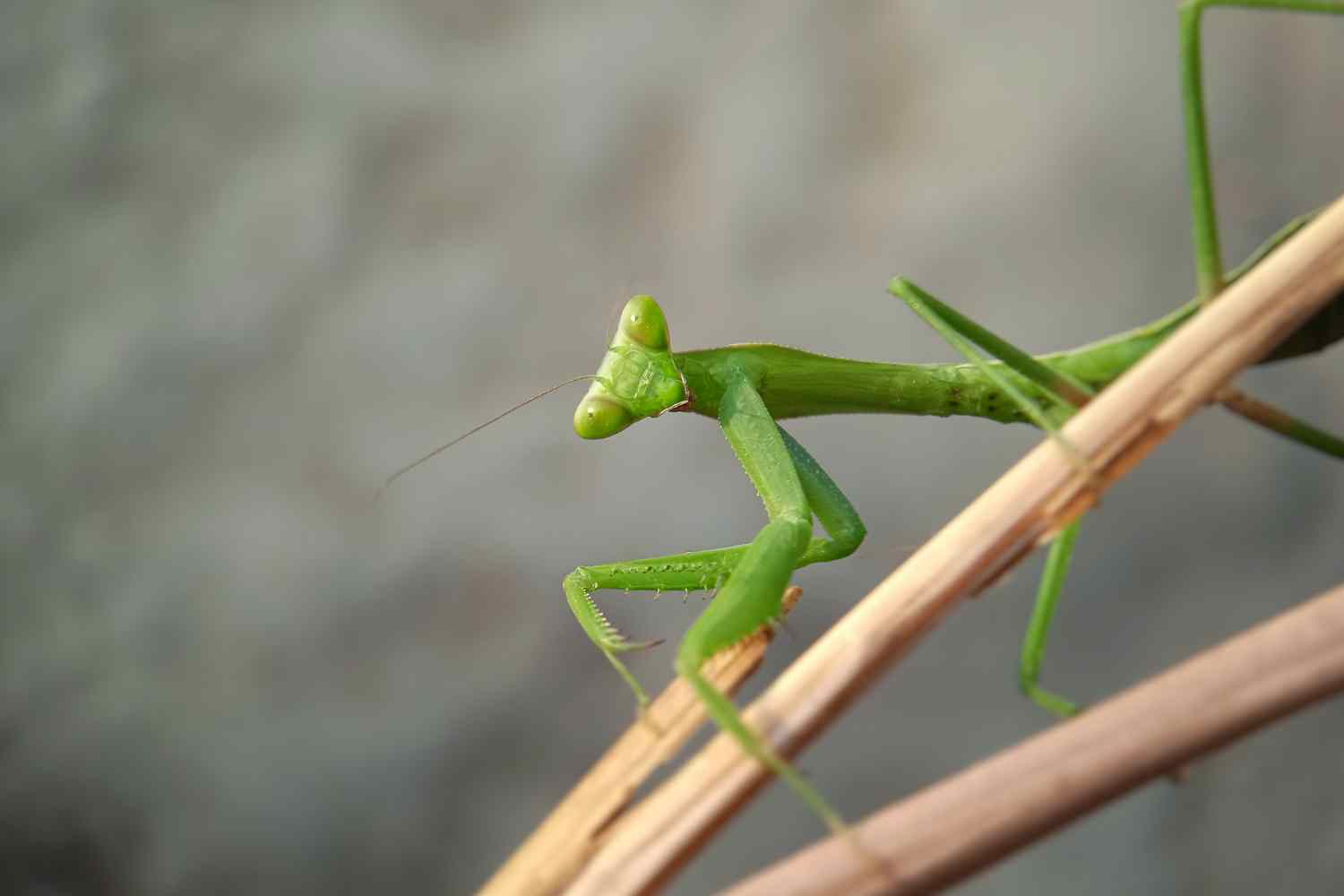
Of a bright green, with an unmistakable and fascinating appearance at the same time. The praying mantis is one of the insects we can encounter in our gardens. If some are enchanted by observing her in the grass, others would gladly do without her visits to green spaces.
Loved as much as hated, the praying mantis – scientific name Mantis religion – is a common species on our continent and belongs to the order Mantodea together with over 2400 specimens. Let’s find out more about this incredible insect, very popular all over the world, whose movements have inspired a style of Kung Fu martial arts.
What is a praying mantis made of?
You will surely know the appearance of the praying mantis also because it is easy to recognize, but do you know, for example, that this extraordinary insect can rotate its head 180°? It is one of its unique features. The praying mantis has a triangular head with two large eyes, two antennae, two front legs with a series of small pointed protrusions that resemble spines.
Its body is slender and long and measures between 6 and 8 cm. Females are larger than males. It has four legs around its abdomen and this is covered by wings.
The praying mantis camouflages itself perfectly in nature thanks to its colors. Although the ones we are used to seeing are a very bright green, there are also praying mantises in shades of brown. These shades allow the animal to camouflage itself among the leaves, ready to attack.
Where does the praying mantis live?
The praying mantis is widespread in southern Europe, Africa and Asia. The species was introduced to North America and is also present in the United States and Canada. On the European continent, the praying mantis is also nicknamed “European mantis” and is easily encountered in our country.
For some years the presence of amusing alien types of mantis has been recorded in Italy, France and other European territories. These are predominantly Asian giant mantis species Hierodula tenuidentata and Indochinese giant mantis Hierodula patellifera. Being non-native specimens, these must be reported so they can be monitored by scholars.
Why is it called that?
The praying mantis owes its name to the Greek mantis, which means “prophet”. In fact, the species resembles a person intent on praying when his front legs are gathered in the “religious” rest phase. In English the praying mantis is commonly known as praying mantis.
What does the praying mantis feed on?
The praying mantis is carnivorous and very voracious. Its diet generally includes flies, moths, crickets, spiders, small frogs and lizards. The insect usually attacks its prey with a surprising technique, launching lethal ambushes with its highly specialized front legs.
Thanks to its ability to camouflage itself, it waits for its prey so as not to leave it an escape. He adjusts his abilities depending on the animals in front of him. As soon as its meal is within a short distance, the praying mantis’ front legs attack prey in milliseconds, piercing them with their “thorns”. It then devours them, bringing them to its mouth.
Why does the praying mantis kill the male?
The praying mantis mates in the cold season around November. The ritual is quite macabre and is characterized by disturbing sexual cannibalism. In the midst of mating, the females attack the males, eating their flesh starting from the head.
Mating continues until the female is satisfied and has recharged her energy. Post-nuptial cannibalism of the praying mantis is well known. However, some males have devised a stratagem to escape decapitation, trying to defend themselves from their partner.
Praying mantis oothecae and what to do if you see them in the garden
Once copulation is completed, the female produces a mass called the ootheca in which the eggs are protected. Each ootheca is rounded, measures around 2-3 cm and can accommodate up to 100 – 200 eggs although on average each sac contains 70 eggs. Oothecae can be found in the branches of shrubs, behind leaves or even on walls.
Throughout the cold season, baby praying mantis will develop into adults by midsummer. Not all future mantises survive winter and harsh temperatures. Often the oothecae are removed by people, frightened by the sight of these small sacs.
These should absolutely not be touched in the first place because in this way many small forms of life are destroyed. Furthermore, oothecae are not harmful to plant health. Let’s leave them where we see them and not use fertilizers and pesticides in the garden.
Is the praying mantis dangerous to humans?
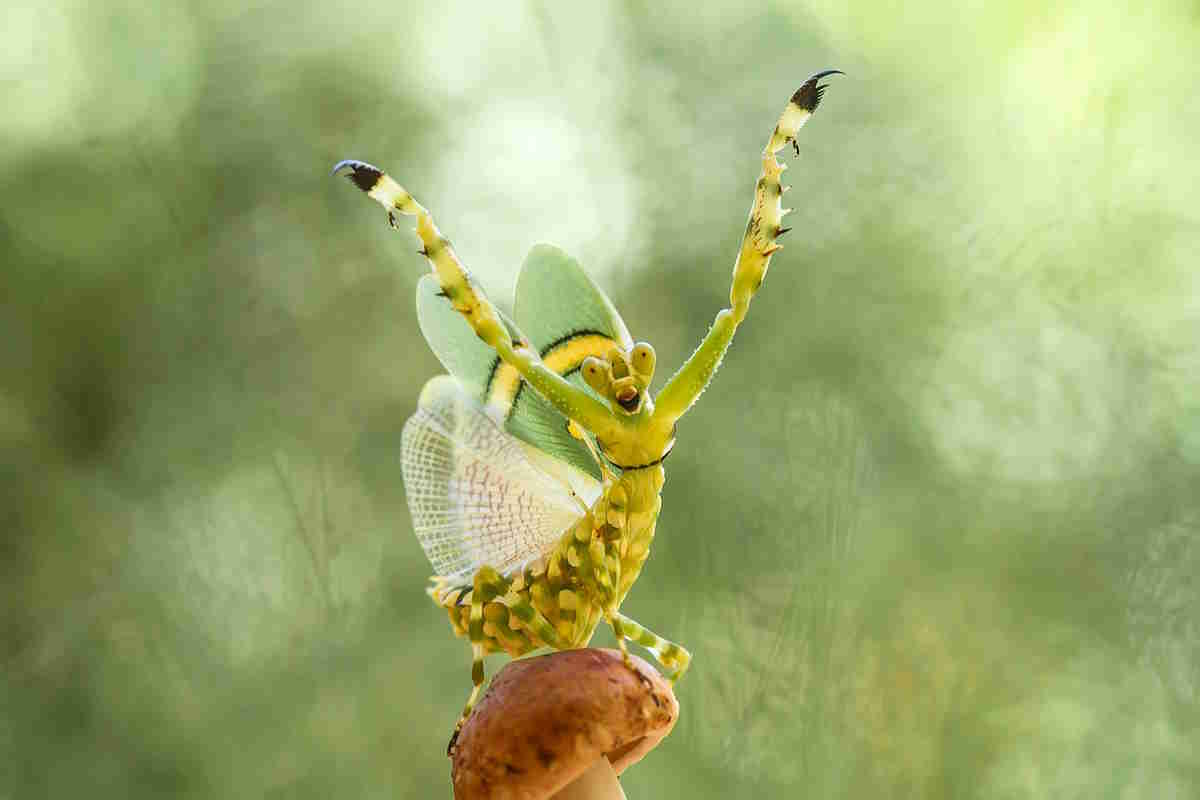
As we have seen, the praying mantis is a ruthless hunter, but is not at all dangerous for humans. If annoyed it can bite, but its bite does not cause concern or cause itching. Furthermore, the praying mantis does not inject poison (as some popular beliefs said), in short it is a completely harmless insect.
Why isn’t everyone appreciated?
The praying mantis is a predator and when it feeds on its prey it makes no difference between insects that are harmful to the soil and those that, instead, are considered allies in the garden because they fight parasites in the most natural way possible. For this reason, if on the one hand the praying mantis can help by eliminating annoying mosquitoes, wasps and bedbugs, it can also eliminate good insects such as ladybugs.
Praying mantis life cycle: from egg to adult
The life of the praying mantis begins inside the ootheca, the protective sac that the female produces after mating. The eggs spend the entire winter sheltered, protected by a spongy layer that insulates them from the cold. With the arrival of spring and the increase in temperatures, the eggs hatch and nymphs are born, small mantises with an appearance similar to adults but without developed wings.
Nymphs go through a series of moults — typically between six and nine — growing progressively with each stage. During this phase they are already active predators and hunt small insects proportionate to their size. The maturation process is slow and takes several months: it is only with the last moult, generally between July and August, that the mantis reaches the complete adult form, with fully developed wings. However, adult life is short: a few weeks are enough to reproduce and start a new cycle.
How to attract praying mantis to the garden
Having a praying mantis in the garden is a privilege that many gardeners actively seek, especially those who prefer an organic approach to plant care. The first step is to create a hospitable environment, which means giving up chemical pesticides and insecticides which, in addition to decimating the prey it feeds on, can be lethal for the mantis itself.
Preferring tall, thick shrubby plants, such as lavender, rosemary or mixed hedges, offers the mantis the ideal shelter for lurking and hunting. Even leaving less well-kept areas of the garden, with tall grass or accumulated leaves, helps to create that ecosystem rich in prey that naturally attracts it. The presence of water, even just a small fountain or saucer, also promotes the general biodiversity of the environment. The mantis is not invited, it is conquered: a healthy and lively garden is the best possible attraction.
Is the praying mantis active at night?
It’s a question that many people ask themselves, especially those who have spotted one in the evening hours. The praying mantis is basically a diurnal predator: it hunts using its sight and daylight, which allow it to identify prey with millimeter precision thanks to its large compound eyes. At night its activity is significantly reduced and it tends to remain motionless on the vegetation.
However, the mantis is not completely inactive at night. Especially during the autumn reproductive period, males fly at night in search of females, also attracted by artificial light sources. It is therefore not uncommon to spot them near street lamps or illuminated windows on the evenings of September and October. This is a behavior linked exclusively to reproduction, not hunting: an important distinction to better understand the habits of this extraordinary insect.
The Kung Fu style inspired by the praying mantis
The praying mantis’ abilities have inspired a style of Kung Fu named Tánglángquán or Praying Mantis Kung Fu. This type of martial art imitates the movements of the insect in a complete discipline. Many legends circulate about the origin of this style.
However, it remains clear that the monks observed a praying mantis intent on hunting to simulate the moves. Today there are two schools of Tánglángquán, respectively in the North and South of China.
Curiosities about the praying mantis
Fascinated by the praying mantis, many people have chosen this insect as a pet. In fact, some argue that the praying mantis is a good animal as it requires little and simple care. Like others of its kind, the praying mantis has a very short life of 6-8 months. Better to observe them free in nature.
Since 1988 the mantis Stagmomantis carolina or Carolina mantis it is the official insect of the US state of South Carolina and symbol of the United States.
We also recommend:
