
Looking at a map of Italy you can see cities, ports, mountains and civil infrastructures. But there is another map that crosses the Peninsula from north to south: that of US and NATO military bases. A system of installations that in recent days has returned to the center of the political debate after the escalation in the Middle East and the questions about the possible use of the structures present on Italian territory.
Establishing exactly how many there are is not easy. The most cited estimates speak of over 120 installations including operational bases, logistics centers, depots, radars and telecommunications stations. Some are openly known, others remain little publicized or not fully detailed for security reasons. It is therefore not just about military airports or naval ports: the system includes a much broader network of technical and operational infrastructures.
Because there are so many
The American military presence in Italy was born after the Second World War. With the end of the Second World War and the beginning of the Cold War, the Mediterranean became one of the strategic fronts in the confrontation between the Western bloc and the Soviet Union.
When Italy joined NATO in 1949, Washington began developing a network of military infrastructure in the country through bilateral agreements signed in the 1950s. The objective was twofold: to strengthen the defense of Western Europe and to maintain an operational platform in a particularly favorable geographical position.
Even today this position remains crucial. Italy is located at the center of the routes between Europe, the Middle East and North Africa, a privileged observation point for the geopolitical dynamics of the Mediterranean.
The most important basics
Among the most important installations is Aviano, in Friuli-Venezia Giulia, one of the main US Air Force bases in Europe. In recent decades it has been used as a starting point for missions in the Balkans, the Middle East and North Africa.
In Lombardy, however, the military airport of Ghedi represents one of the nodes of the NATO nuclear sharing system: here US tactical nuclear bombs are kept, destined in extreme cases to be used by Alliance aircraft.
Veneto is home to one of the main US Army hubs on the continent. In Vicenza, in the installations of Camp Ederle and the Del Din barracks, US army units participate in NATO operations and missions.
The Mediterranean as a strategic hub
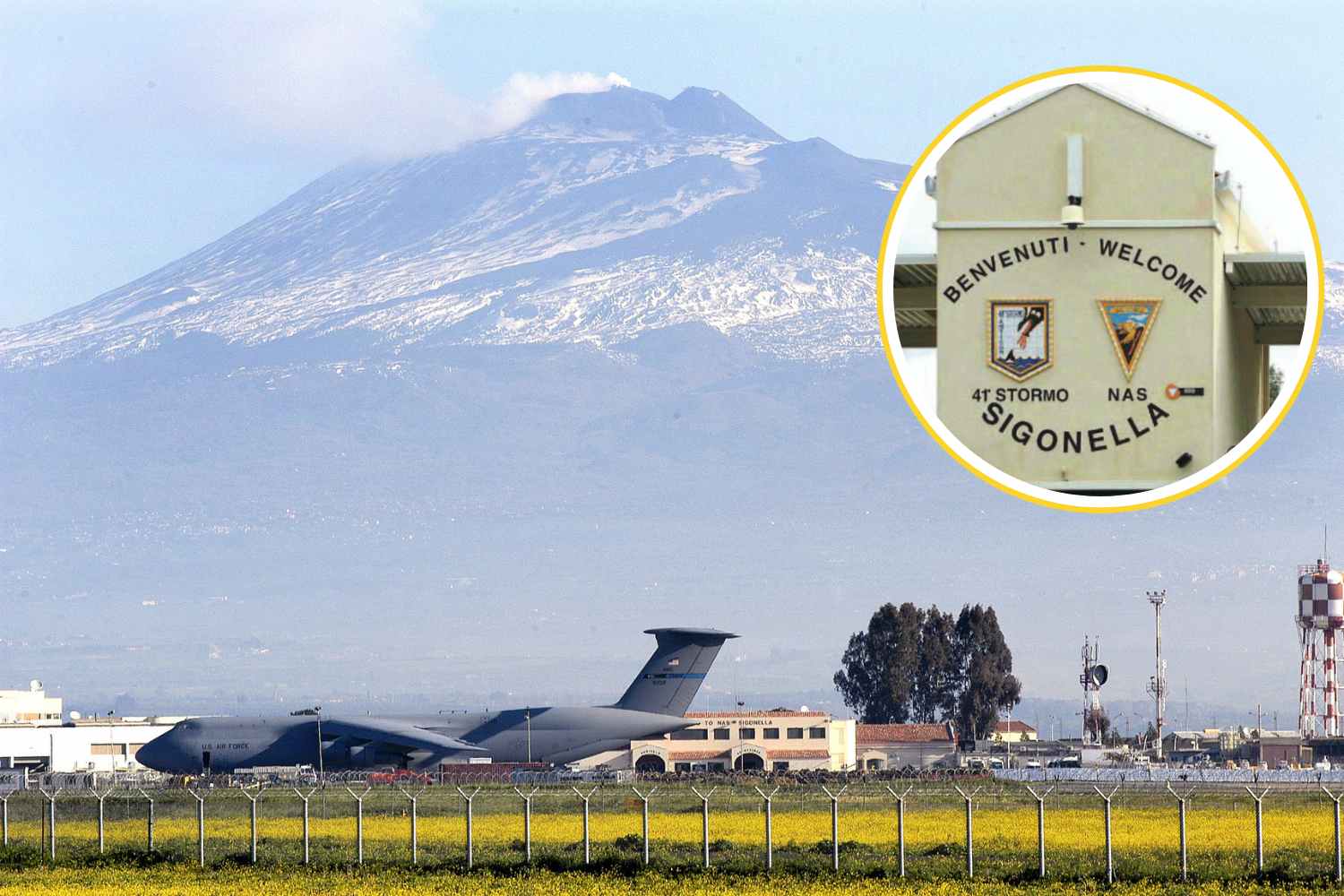
Going south, the function of the bases changes. Sigonella is located in Sicily, often defined by military analysts as “the aircraft carrier of the Mediterranean”. Patrol aircraft and drones used for surveillance missions and support for naval operations of the US Sixth Fleet operate here.
In central Italy, between Pisa and Livorno, lies Camp Darby, one of the largest US logistics depots outside the United States. Munitions, vehicles and military materials pass through this complex before being redistributed to other operational theaters.
Finally, Naples hosts one of the main NATO commands: the Joint Force Command, the structure responsible for planning Alliance operations in different areas of the world.
Collective defense and military projection
According to available data, over 12 thousand US soldiers are stationed in Italy between the army, navy, air force and marines. Their presence does not have a single function.
On the one hand it represents a collective defense system within NATO. On the other hand, it allows the United States to have an operational platform in the Mediterranean, useful for missions ranging from intelligence to logistics to military operations.
A presence that returns to the public debate
For years the network of bases remained in the background of Italian political life. But every time an international crisis approaches the Mediterranean – from wars in the Balkans to interventions in the Middle East – the issue resurfaces.
Because what is often perceived as a distant reality actually concerns Italian territory: a country which, due to its geographical position and political history, continues to be one of the main military hubs of the Atlantic Alliance.
