
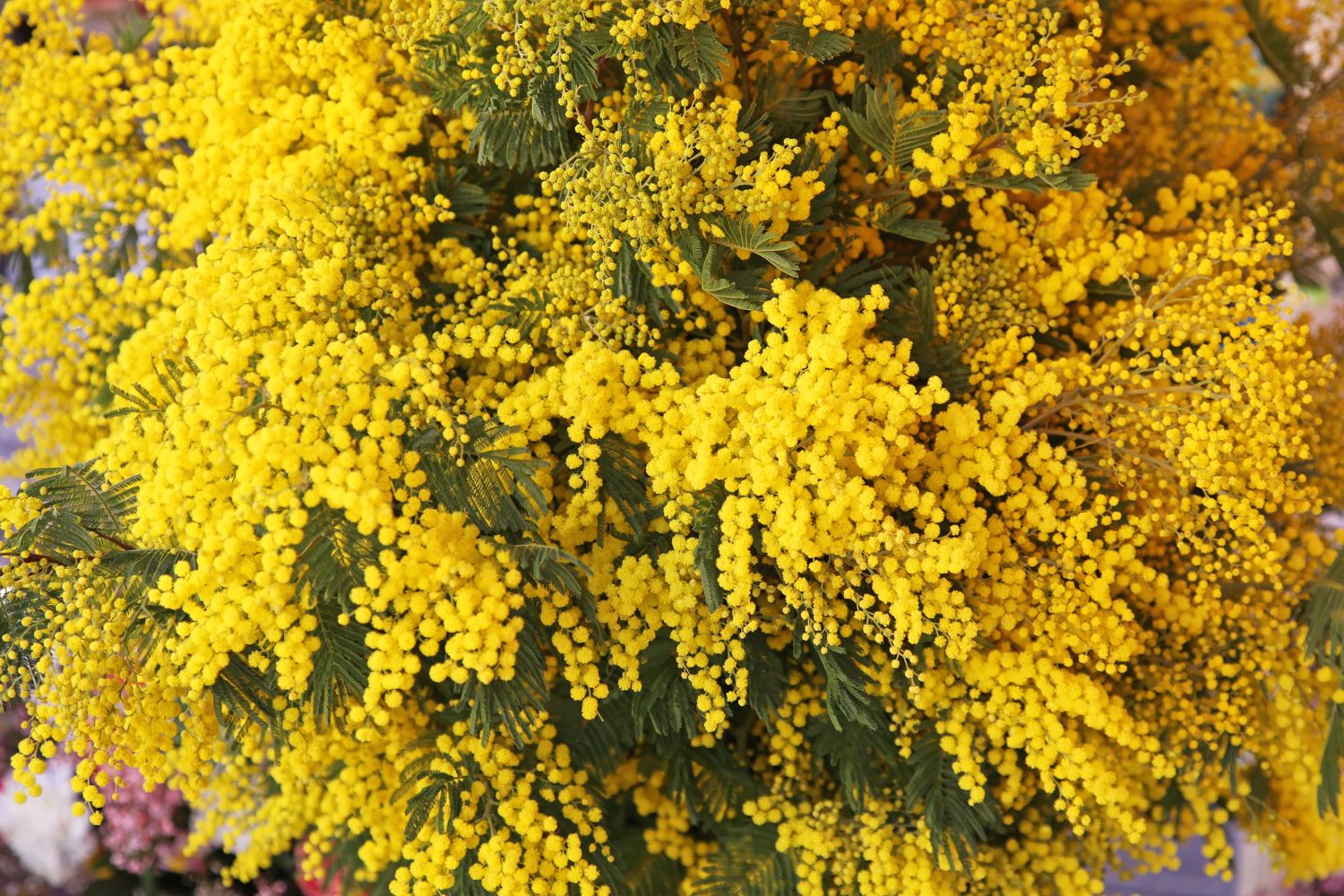
On March 8th it can be found everywhere, wrapped in tissue paper, on the counter of every florist. Yet the mimosa – that same plant with soft yellow flowers that has become a symbol of Women’s Day – is classified by the scientific community as an invasive exotic species, with documented impacts on biodiversity in a large part of Europe, including Italy.
The paradox is not just aesthetic. Behind the early flowering and the scent that smells of spring, theAcacia dealbata — the scientific name of the most widespread mimosa in Italian gardens — hides a diffusion capacity that has worried botanists and ecologists for decades.
Because mimosa is considered invasive
The plant is native to south-eastern Australia, where it grows in wooded and hilly environments, kept in check by parasites and natural competitors. Introduced into Europe at the turn of the nineteenth century for ornamental purposes, it found ideal conditions in the Mediterranean basin without any natural antagonist that limited its expansion.
The result is documented: mimosa spreads far beyond the confines of private gardens, colonizing natural areas and altering the balance of local ecosystems. It can reach 10-15 meters in a few years, creating shaded areas that progressively suffocate the native vegetation. The decidedly extensive root system takes away water and nutrients from local species, a situation that can reduce biodiversity, especially in the most fragile ecosystems.
To complicate management, Acacia dealbata produces large quantities of seeds with hard seed coats each year, capable of remaining viable in the soil for many years. Even after the removal of the adult specimens, the soil retains a reserve of seeds ready to germinate at the first disturbance – a landslide, a fire, tillage. Added to this is the ability to replant with new shoots from the base or roots after each cut, an aspect that makes eradication an arduous undertaking, which requires repeated interventions over time.
Then there is a less visible but equally relevant effect: being a legume, mimosa fixes atmospheric nitrogen through symbiotic bacteria present in the roots. This changes the chemical composition of the soil, enriching it with a nutrient that many Mediterranean species – adapted to poor and arid soil – do not tolerate well. The native flora is thus displaced also on a chemical level, not just a physical one.
The European and Italian regulatory framework
On a legislative level, the main reference is EU Regulation no. 1143/2014, which came into force on 1 January 2015, which introduced bans and obligations at a community level for the management of invasive alien species of EU importance. Italy implemented it with Legislative Decree 15 December 2017, n. 230, in force since 14 February 2018, which identifies the Ministry of the Environment and Energy Security as the competent authority and ISPRA as the supporting technical-scientific body.
For the species included in the EU list, the decree prohibits their introduction into the national territory, detention, transport, trade and release into the wild.
A clarification is worth making: Acacia dealbata does not yet appear in the list of species of EU importance – which instead includes the relative Saligna acaciawhich is also widespread in Italy, in particular in the coastal regions of the South. It should be added that, to date, Italy has not yet adopted a national list of invasive alien species, although the aforementioned Legislative Decree 230/2017 expressly provides for it in Article 5. The classification of Acacia dealbata as an invasive species therefore remains, at present, a consolidated scientific fact – recognized by ISPRA and the botanical literature – rather than a direct regulatory constraint for private citizens.
The European list is updated periodically: the last update dates back to July 2025, with Implementing Regulation 2025/1422 which added 26 new animal and plant species.
