
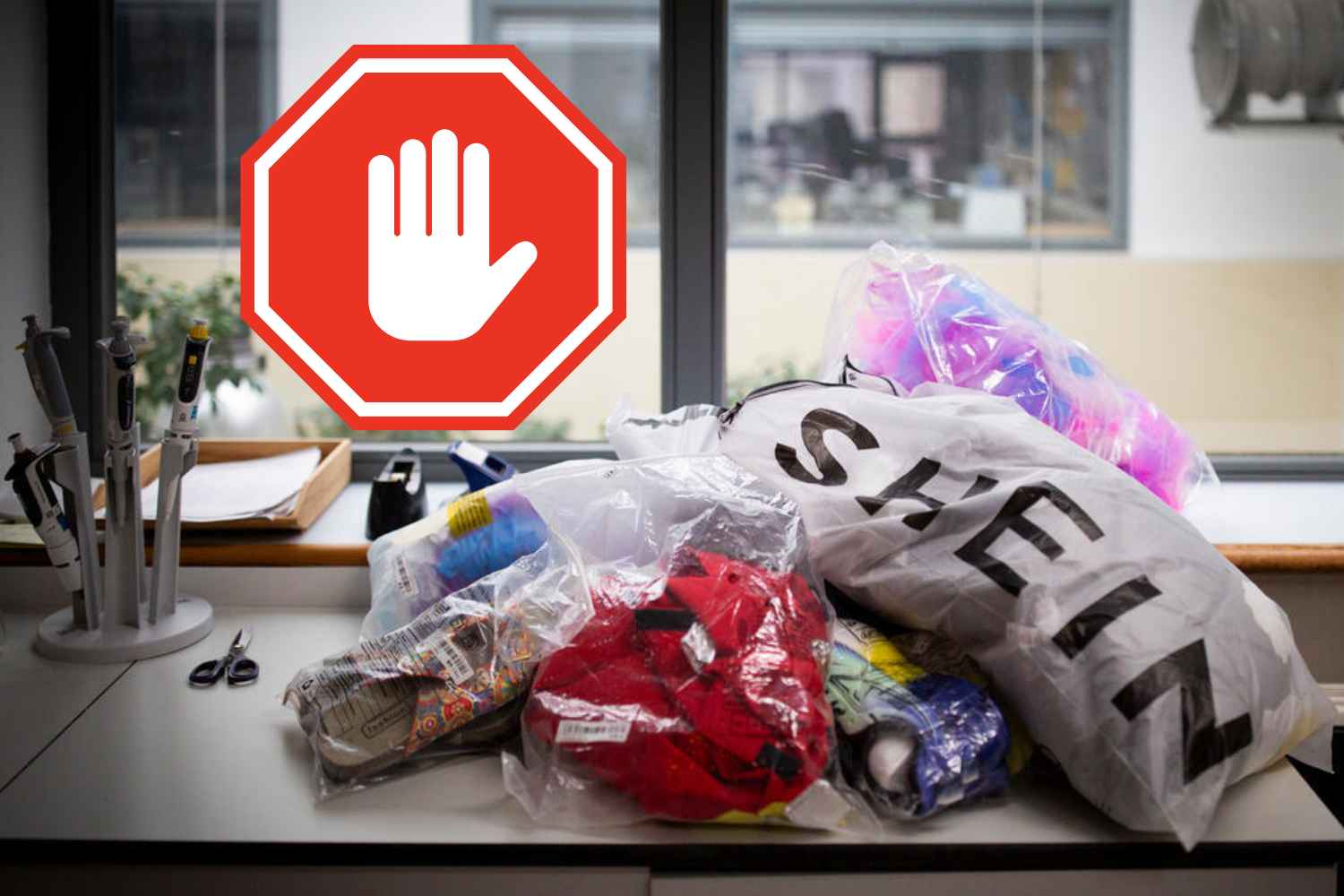
In November 2025, Greenpeace released a report that once again put the spotlight on Shein. What had he discovered? Around a third of the clothes purchased on the platform and subjected to laboratory analysis contained dangerous chemical substances beyond the limits permitted by the European REACH regulation.
It involved phthalates in sandals, PFAS in jackets, formaldehyde in a children’s mermaid costume and more. Faced with these results, the company announced the withdrawal of the offending products, underlining that consumer safety has always been its top priority.
In January 2026, however, a new test showed that the situation had not changed as one would have expected.
The new test on Shein garments
In January 2026, on behalf of Greenpeace Germany, the Bremen Environmental Institute tested another 31 items ordered on Shein. The result was that 25 products out of 31 — 80.6% — exceeded the limits set by the European REACH Regulation, the legislation that establishes safety thresholds for chemical substances present in products on sale in the EU. In some cases the concentrations detected were up to 3,115 times higher than the permitted values.
But the most serious detail is not in the numbers. It’s in the nature of the items found. Four of the contaminated products are identical to those already reported in November. A trekking jacket is sold by the same seller. A disputed sandal model in the black variant is still available in nine other colors, all with the same non-compliant sole. Shein, in fact, removed the exact references reported by Greenpeace, leaving everything else on the virtual shelf.
Moritz Jäger-Roschko, circular economy expert at Greenpeace, said:
In front of the European Parliament, Shein promises to protect consumers, but in reality it simply continues to sell products with high levels of contamination. Shein ignores our warnings and legal limits and mercilessly accepts the resulting harm to people and the environment. This behavior is grossly negligent.
But what exactly did the new German test find?
The Bremen Environmental Institute looked for the same categories of substances already detected in the November investigation, analyzing samples taken from different parts of each product. The results are worrying on all fronts.
Phthalates, plasticizers used to make materials softer and more flexible, were found in 18 of the 22 items tested, with concentrations ranging from 1.1 to 70 times the REACH limit. These compounds can interfere with the hormonal system and impair the fertility, growth and healthy development of children.
PFAS, the so-called “eternal pollutants” used to make fabrics water-repellent, were detected in 9 of the 11 products analyzed, with concentrations up to 3,115 times higher than the permitted limit. These substances do not degrade, they accumulate in the human body and in the environment, and are suspected of being carcinogenic, as well as interfering with the immune and reproductive systems.
Heavy metals also made an appearance: lead and cadmium were found above the legal limits in 3 of the 6 products tested, with concentrations of up to 126 mg/kg for cadmium and 2,110 mg/kg for lead. Lead is particularly dangerous for children because it can impair brain development and lower IQ. Cadmium is classified as a carcinogen and can damage the kidneys, liver and cardiovascular system.
Formaldehyde, a substance used as an anti-wrinkle agent in textile production and capable of causing damage to DNA, was found in 2 of the 3 products tested, with limits exceeded by 2.1 and 8.7 times respectively. Finally, dimethylformamide (DMF), a volatile compound harmful to unborn babies, was detected in one of the two products analyzed, with a concentration 1.3 times higher than the permitted threshold.
Shein, faced with the new accusations, did not deny it. A spokesperson said the products identified in the report were “immediately removed” and that the company is conducting its own internal testing. The same answer, almost word for word, as three months ago.
Enough promises, we need laws
The Shein case shows that the voluntary commitments of these companies are useless – underlines Joëlle Hérin, consumer expert at Greenpeace Switzerland – As long as these brands can profit from fast fashion and these dangerous chemicals, it is essential to impose clear legal limits on them.
Greenpeace calls for European chemicals legislation to apply to all products sold in the EU, including online products from outside the border; that platforms are legally responsible for violations; and that authorities have the power to suspend services in the event of repeated non-compliance. As a model, the organization points to France, which introduced a tax on fast fashion, promoted the circular economy in textiles and banned the advertising of ultra-fast fashion even on social media.
Because the point, in the end, which is strongly criticized by Greenpeace, is that Shein knew. In November 2025 he received the results, made his public statement, and removed some items from the catalog. But in January 2026 the situation was essentially the same. Same products, same seller, same concentrations. Self-regulation doesn’t work. And continuing to wait for it to do so, while millions of people wear these clothes, is certainly not the best choice.
You can read the report “Shame on You, Shein II” HERE.
