

Tell me it’s not true that, after a banner with openly sexist content appeared in Latina on March 8th “Woman, how much we loved you in the good times of patriarchy”, today a man killed another woman.
That it’s not true that you don’t believe it, that patriarchy doesn’t exist, that it’s just a word thrown to the wind by nervous, gullible and hysterical feminists. Also try to tell me that there is no connection between that chilling writing and the killing of Daniela Zinnanti at the hands of her ex.
Which is the eleventh only since the beginning of 2026? This too, prove to me that it’s not true. A number, at least for this reason incontrovertible although brutal.
So let’s try to think like this: that number there, 10+1 since the beginning of the year, is the number of deaths induced by gender violence (not counting the at least 22 other attempted feminicides reported in the online news of national and local media, Not One Less). Among those killed, the youngest victim was 14 years old, the oldest was 85. 14 and 85.
In 3 cases, the man took his own life after carrying out the murder and in all cases the murderer was known to the person killed: husbands, ex-husbands, fathers, sons.
Numbers of a massacre with the flavor of sick and twisted abuse. A massacre led by testosterone convinced that it must excel, that it must prevail with a slap and then with a fist and then with a knife. A rope. A garbage bag. Better to end up in jail than not make my woman “pay” for it.
Homunculus.
But where is it that we can’t get there? What is it that you just can’t understand? Is patriarchal culture really still so rooted? We are afraid so and not only because of the terrible writings that appear on unlikely banners, but also because of recent studies involving what are now our teenagers.
Gen Z increasingly divided on gender equality
That’s right: Gen Z, i.e. young people born between the end of the 90s and the early 2010s, seems to be the generation most divided between men and women when it comes to feminism, gender roles and women’s rights. This was revealed by international research conducted by Ipsos UK together with the GLobal Institute for Women’s Leadership at King’s College London, based on a survey involving almost 24 thousand people in 30 countries.
According to the study, while young people are often thought to be uniformly more progressive on gender issues, the reality is much more complex: the opinions of Gen Z boys and girls diverge sharply on many key issues related to equality.
Feminism is the biggest gap
One of the most evident data concerns identification with feminism.
This is the largest gender gap among all the generations analyzed. In fact, for comparison:
Young women are therefore much more likely than previous generations to identify with feminism, while among men the percentage changes little compared to older generations.
Gender roles
The study also highlights significant differences in the perception of family roles.
When asked whether a man who stays at home to look after his children is “less of a man”:
Among older generations this opinion is much less widespread: for example, among Baby Boomers only 12% of men and 9% of women think this way.
Another point of strong division concerns the role of men in promoting equality. According to research:
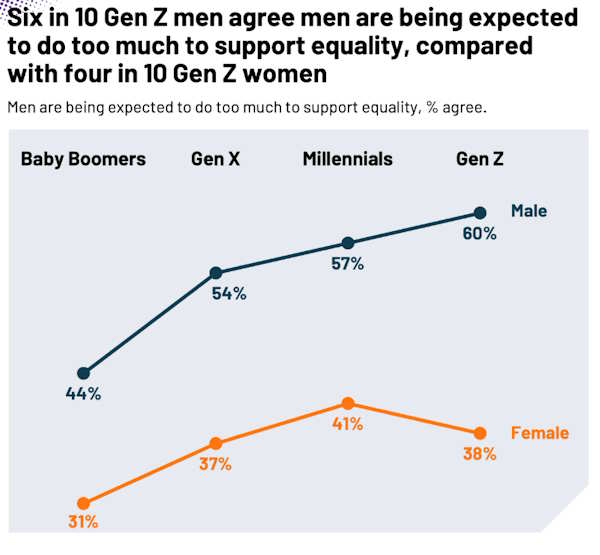
Also on this issue the difference between men and women is the widest of all the generations analysed.
A substantial portion of the young men interviewed also believe that policies for women’s equality have gone too far.
Once again, this is the largest gap between men and women compared to all other generations.
The differences between countries
The study also highlights large differences between countries.
For example:
In general, however, tension between genders is perceived less than other social conflicts, such as those between rich and poor or between immigrants and the local population.
Despite the divisions, an encouraging fact also emerges: the majority of people consider gender equality important.
In the 30 countries analyzed:
This is true in all countries involved in the study, even those with the lowest levels of consensus.
Second Heejung Chungdirector of the Global Institute for Women’s Leadership at King’s College London, these divisions are often fueled by narratives that present equality as a “zero sum game”, that is, as if women’s rights automatically entailed a loss for men.
In reality, gender equality brings benefits to the entire society, improving economic opportunities, the quality of life and the functioning of institutions. For this reason, the authors of the study conclude, it is essential to open a more inclusive dialogue between generations and genders, to prevent this growing divide from slowing down progress towards a more equal society.
And going back to feminicides in the strict sense?
Perhaps the answer lies right there, at the point where we stop treating those numbers as isolated episodes, as private tragedies, as sudden outbursts of madness. Feminicides are alas the last stage of a culture that still today struggles to accept women’s autonomy, their freedom to say no, to leave, to not “belong” to anyone.
When some kids grow up thinking that equality is a loss, that women’s rights are “too many”, that a man is worth less if he doesn’t dominate, if he doesn’t control, if he doesn’t impose, then that culture continues to breathe in their bowels. It doesn’t always turn into violence. But when it happens, it’s because that ground was already ready.
This is why talking about patriarchy is not an ideological fixation of ours nor a linguistic quirk: it is the attempt to give a name to what binds together a joke, a banner, a slap and, too often, a death. Until we see that thread – and we don’t cut it – we will continue to count them. Always one too many.
