
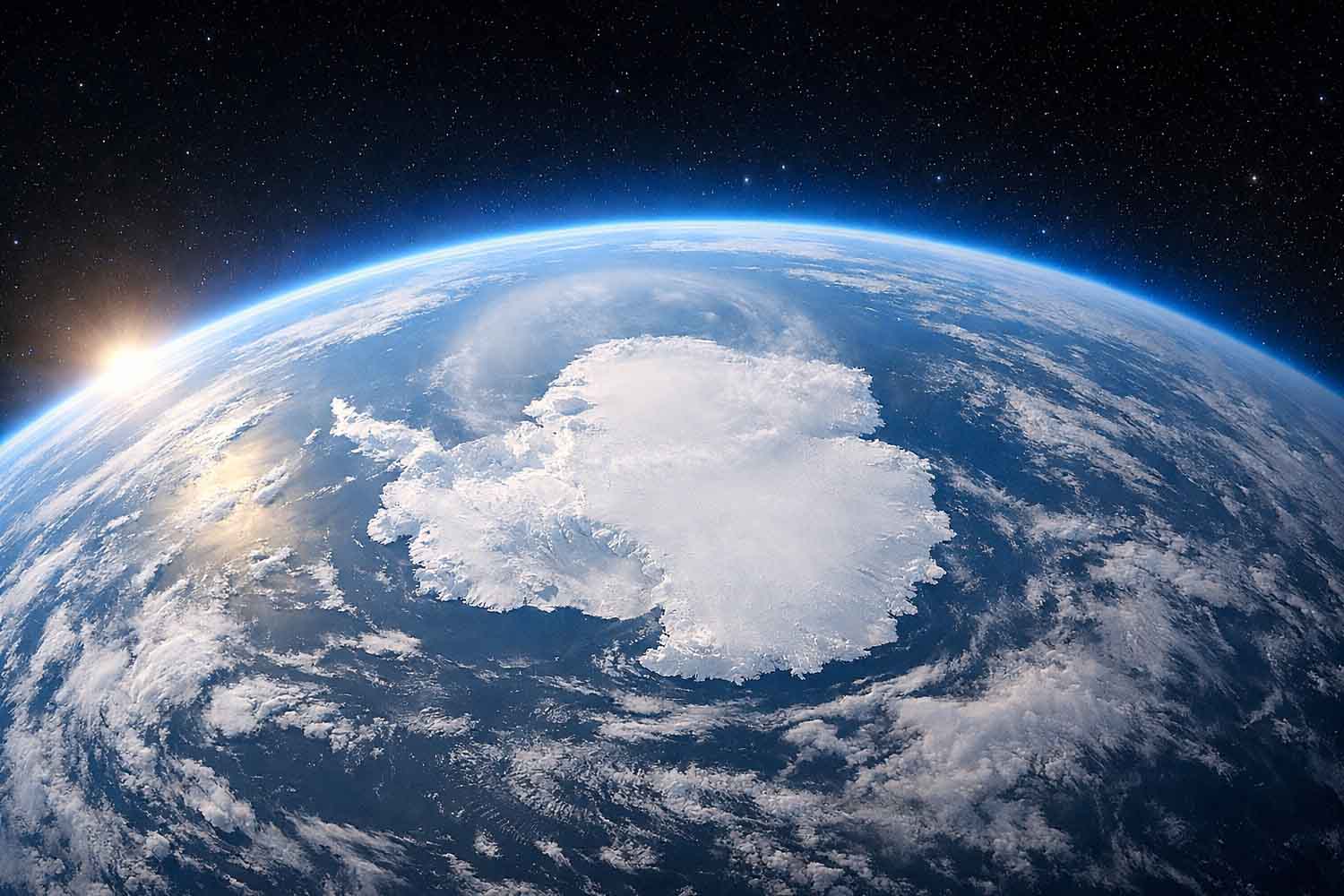
When it comes to atmosphere, time passes at a completely different pace than that of our lives. The events we observe today are often the result of decisions made decades earlier, of very slow chemical processes and delicate balances that move almost imperceptibly above our heads.
The Antarctic ozone hole is one of those phenomena that scientists monitor year after year, with a patience that is more reminiscent of the work of an archaeologist than that of a meteorologist. This is why the data released after the 2025 season attracted so much attention: the hole reached its smallest size in the last six years and closed already at the beginning of December, much earlier than in some recent seasons.
Today, in 2026, these data are read with greater clarity because they are included in a series of broader observations. The picture that emerges is interesting: the reconstruction of the ozone layer proceeds slowly, between natural oscillations and signals that are starting to become more and more coherent.
During November 2025, atmospheric maps over Antarctica showed something that had not been seen with this clarity in recent years: the area of ozone depletion was progressively shrinking, week after week.
Researchers from the Copernicus Atmosphere Monitoring Service (CAMS) observed higher ozone concentrations than in several previous seasons. The comparison with the years between 2020 and 2023, when the hole had reached very large dimensions and a particularly long duration, makes the change recorded even more evident.
One explanation concerns the behavior of the Antarctic polar vortex, the gigantic ring of winds that rotates above the frozen continent and which, under normal conditions, traps cold air within the region. In 2025, this gyre was weaker than usual, allowing ozone-rich air from lower latitudes to mix more easily with Antarctic air.
Temperatures also had their impact. Slightly warmer conditions in the stratosphere have reduced the formation of polar stratospheric clouds, icy structures that facilitate the chemical reactions responsible for ozone destruction.
Measurements taken with balloons over the South Pole recorded a seasonal low of 147 Dobson Units, a value that indicates the total amount of ozone present in the atmospheric column over a given area.
Why the ozone hole over Antarctica appears every year
The Antarctic ozone hole is not a sudden event that appears out of nowhere. It is a seasonal phenomenon that forms every year at the beginning of southern spring, when the Sun returns to illuminate the stratosphere after the long months of polar darkness.
During the winter, the air above Antarctica becomes extremely cold and clouds composed of tiny ice crystals form. Chemical reactions take place on these surfaces that transform some industrial compounds containing chlorine – used in the past in aerosols and refrigeration systems – into highly reactive forms.
When sunlight arrives, these reactions accelerate and the active chlorine begins to destroy ozone molecules much faster than it would under normal conditions. As spring advances, temperatures rise, winds from the polar vortex weaken, and ozone-rich air from other areas of the planet mixes with that over Antarctica. It is at this moment that the hole closes.
In recent years, however, some natural events have altered this balance. The eruption of Hunga Tonga volcano in 2022, for example, pumped huge amounts of water vapor into the stratosphere. This additional moisture promoted ozone-destroying chemical reactions and helped further cool the air, creating ideal conditions to amplify the phenomenon. It is also for this reason that seasons with very large and persistent ozone holes were observed between 2020 and 2023.
The Montreal Protocol
Behind the signs of improvement observed in recent years there is a decision taken almost forty years ago. In 1987, governments around the world signed the Montreal Protocol, an international agreement that began the phase-out of chemicals responsible for destroying ozone.
Since then, the concentration of these compounds in the stratosphere above Antarctica has fallen by about a third compared to levels recorded in the early 2000s. According to Laurence Rouil, director of the Copernicus Atmosphere Monitoring Service, the 2025 season represents an encouraging sign, because it is part of a trend consistent with the reduction of substances that destroy the ozone layer.
These policies have had effects beyond protection from ultraviolet radiation. Some scientific assessments indicate that phasing out ozone-depleting gases will also help avoid a further global temperature increase of between 0.5 and 1 degree Celsius.
Scientific evidence that the recovery of the ozone layer is indeed underway
For a long time, scientists have spoken about ozone recovery with great caution. The atmosphere is influenced by many different factors — temperatures, volcanic eruptions, wind circulation — and a single favorable season is not enough to talk about change.
In March 2025, however, an analysis based on decades of satellite data identified something more solid: a statistical signal compatible with a decrease in ozone-depleting substances. The study estimated a 95% probability that the improvement observed over Antarctica is actually linked to the decline in harmful gases.
For the scientific community this means a very simple thing: what for years was considered a theoretical possibility today increasingly appears as a measurable trend. However, rebuilding the ozone layer remains a slow process. Many of the substances responsible for its destruction remain in the atmosphere for decades, continuing to influence the chemistry of the stratosphere.
According to current projections, maintaining existing international policies, ozone over Antarctica could return to 1980 levels around 2066. In the meantime, the size of the hole will continue to fluctuate from year to year. Winds, temperatures and natural phenomena can amplify or reduce it temporarily.
You might also be interested in:
