
When you think of Ancient Egypt, your mind immediately goes to pyramids, golden sarcophagi and mummies shrouded in mystery. Yet some of the most surprising objects of Egyptian civilization do not only speak of the Earth, but tell a story that begins much further away, among asteroids and fragments of rock wandering in space.
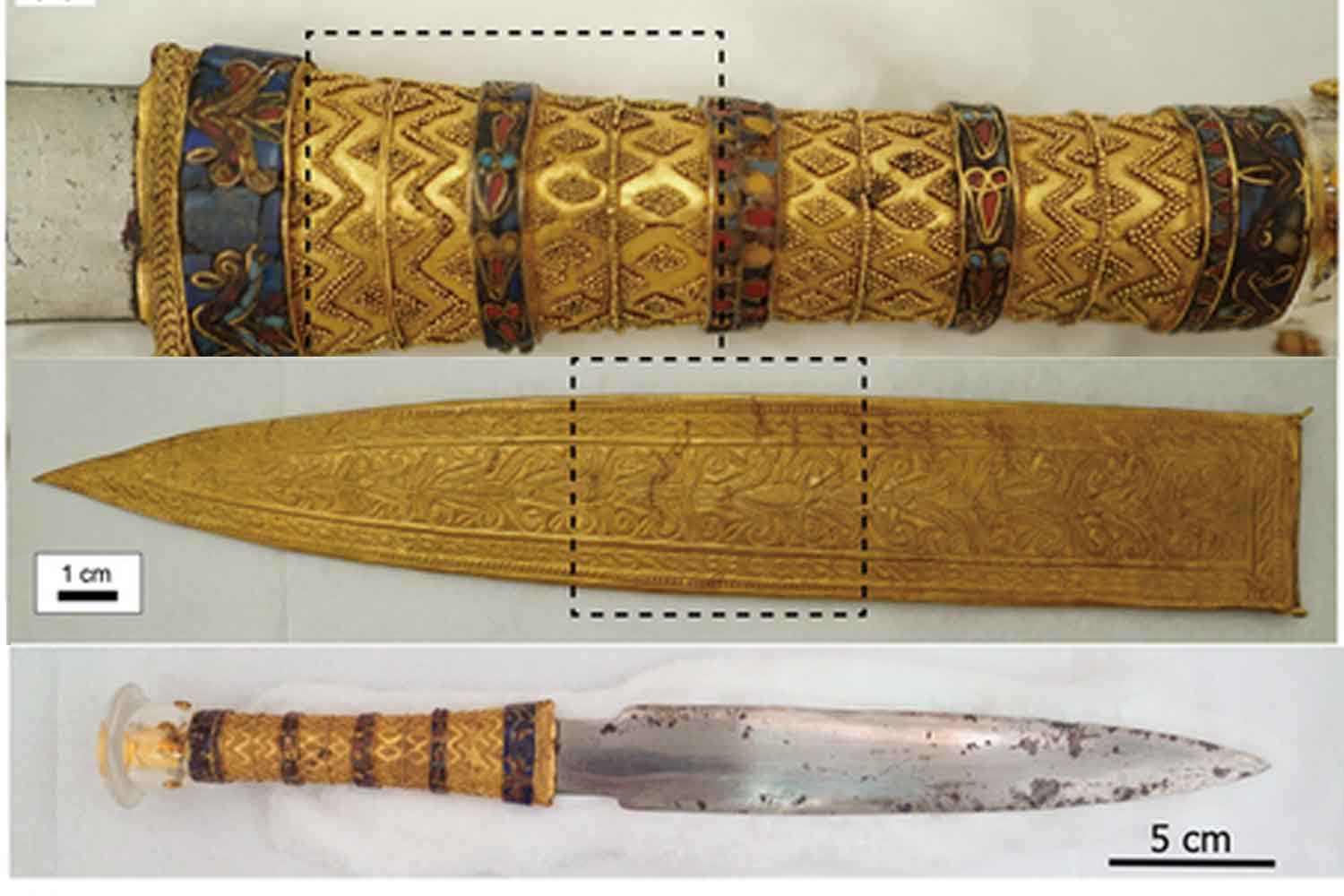
One of these objects is the famous dagger found in Tutankhamun’s tomba blade that has intrigued archaeologists and scientists for decades. Today we know with certainty that that metal was not born underground on our planet. It came from the sky, in the form of a meteorite, and was transformed into a weapon fit for a pharaoh over three thousand years ago.
In recent years, new analyzes have added precious details to this story, revealing how the craftsmen of the time managed to work such a rare material and what the path of that blade might have been before arriving next to the young sovereign in his burial.
An extraordinary treasure hidden in the tomb of the young pharaoh
Tutankhamun’s worldwide fame was born from a discovery that changed archeology forever. In 1922, British archaeologists led by Howard Carter located his tomb in the Valley of the Kings and found themselves faced with practically intact funerary objects.
Inside the tomb there was an incredible amount of objects designed to accompany the pharaoh into the afterlife. Jewelry, amulets, musical instruments, board games, ritual objects and symbols of royal power filled the burial chambers. Among these, two daggers of extraordinary workmanship also stood out.
One had a golden blade, perfectly in keeping with the prestige of an Egyptian ruler. The other, however, had an iron blade accompanied by an elegant handle and a gold-decorated sheath.
At the time this detail seemed almost inexplicable. The kingdom of Tutankhamun in fact belongs to late Bronze Agea time when iron was still extremely rare. The metallurgical techniques necessary to smelt iron ore require very high temperatures, above 1500 degrees, which were difficult to reach with the technologies available at that time.
For a long time the presence of that blade therefore remained a small archaeological enigma. The answer came thanks to modern science. Chemical analyzes and metallographic studies have shown that the iron of the dagger has a composition typical of ferrous meteorites.
Metal contains nickel and cobalt in proportions characteristic of asteroid fragmentsa combination that is virtually impossible to find in iron mined on land. In other words, that blade was made using a meteorite that fell to Earth.
For the Egyptians, such material must have appeared extraordinary. Metallic fragments falling from the sky were not only rare, but were probably perceived as something special, almost sacred. In a culture that saw the pharaoh as a figure linked to the divine, transforming a metal from the sky into a real object had a very powerful symbolic meaning.
The new analyzes that reveal how it was worked
A study conducted in 2016 by researchers from the Polytechnic of Milan definitively confirmed the meteorite origin of the dagger thanks to sophisticated material analysis techniques. But in the following years a group of scholars from the Chiba Institute of Technology in Japan decided to go further, carrying out a new non-invasive investigation using X-rays to better understand both the composition of the metal and the way in which it was worked by the artisans of Ancient Egypt.
The examination identified several chemical elements in the blade, including iron, nickel, manganese and cobaltas well as traces of sulfur, chlorine, calcium and zinc concentrated in the darker areas of the surface. The most interesting discovery, however, concerns the internal structure of the metal. Scholars have identified a particular crossed crystalline texture called Widmanstätten patterna sort of natural signature typical of iron meteorites belonging to the octahedrite category.
Many of these meteorites come from asteroid belt between Mars and Jupitera region of space populated by millions of rock fragments. The presence of this structure also provided a clue as to how the metal was worked. Egyptian craftsmen probably forged the meteorite a relatively low temperatures, below 950 degreesavoiding destroying the crystalline structure of the metal.
A possible diplomatic gift between ancient kingdoms
However, the story of the dagger may be even more fascinating than it seems. Some diplomatic documents of the time, known as Amarna Lettersrecount the exchanges between the great powers of the Near East in the 14th century BC. In one of these texts a very particular gift is mentioned: an iron dagger with gold sheath sent to Pharaoh Amenhotep III by the king of the Mitanni kingdom on the occasion of a royal wedding. Amenhotep III was Tutankhamun’s grandfather.
Since iron was very rare in that era, many scholars believe it is possible that the dagger mentioned in the diplomatic letters is precisely the one found in the tomb of the young pharaoh. If this hypothesis were correct, it would mean that the weapon was not made directly for Tutankhamun, but that it reached him as a precious dynastic legacy passed down within the royal family.
Today that dagger is exhibited at the Egyptian Museum in Cairo and continues to fascinate scholars and visitors. It is one of those objects that demonstrate how human history is intertwined with that of the cosmos. An asteroid fragment that has been traveling in space for millions of years fell to Earth, was picked up by human hands and transformed into a weapon intended for a pharaoh.
More than three thousand years later, that same blade continues to tell us a story that unites astronomy, archeology and human ingenuityreminding us that even the most ancient civilizations looked to the sky in wonder.
