
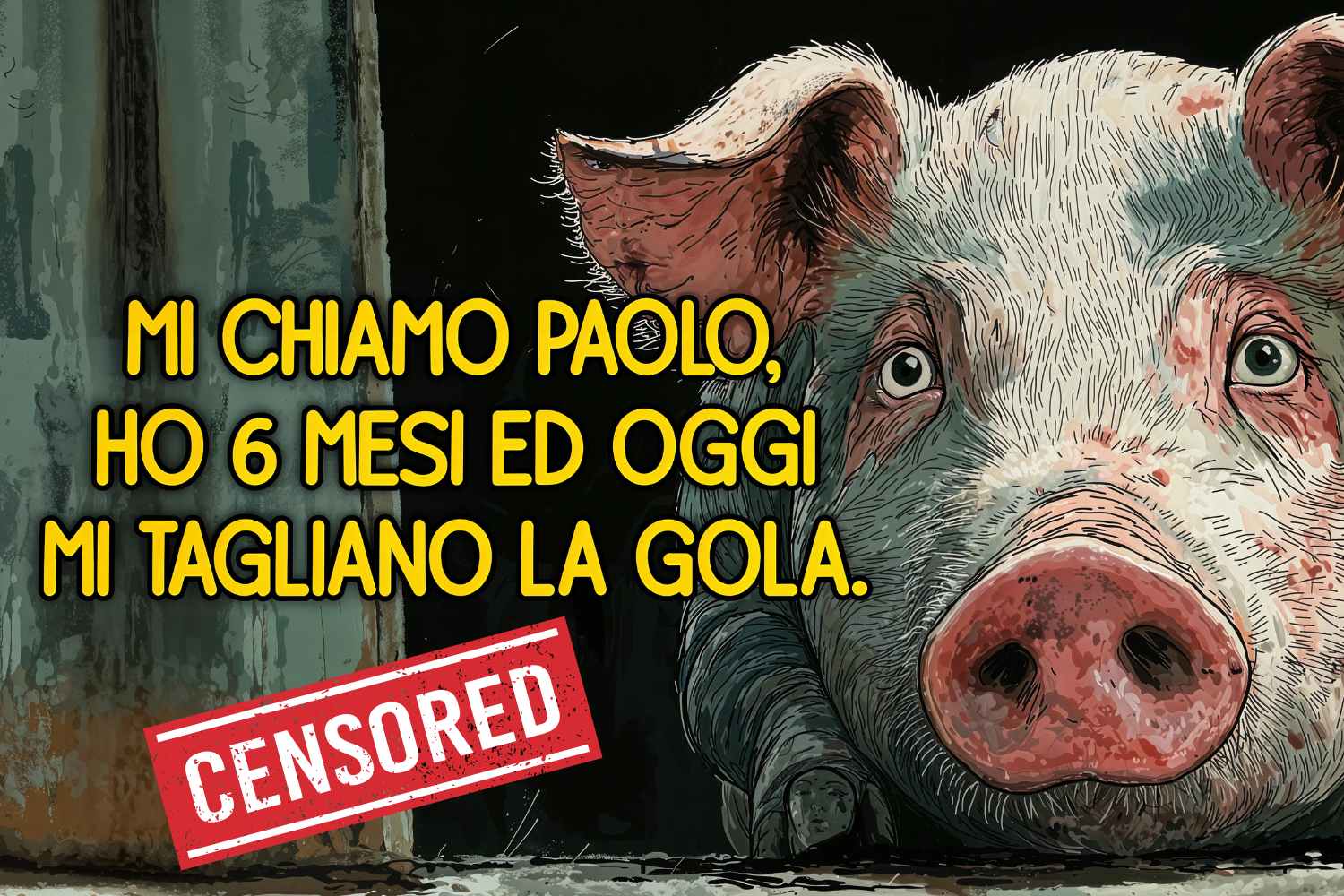
An awareness campaign designed to show the harsh reality of intensive farming was blocked before it even appeared on the city walls. It happened in Bergamo, where the advertising space agency Abaco Spa banned the posting of three posters created by LAV Bergamo in collaboration with Adamo Romano, a well-known Italian influencer who has been working for years on ethical, social and animal protection issues.
The campaign was composed of three distinct subjects, each dedicated to an animal, designed to be displayed simultaneously on the main municipal facilities of the city. The message was direct and deliberately without filters: to talk about the real suffering of animals on farms and in slaughterhouses, those same sufferings that happen legally and silently every day, far from the eyes of the general public.
Among the phrases present in the posters, some have become the heart of the controversy: “My name is Paolo, I’m six months old and today they cut my throat” And “They just slaughtered 60 animals“Crude sentences, sure — but they describe real and perfectly legal practices within the meat production system.
Censorship and the opinion of the IAP
The Control Committee of the Institute for Advertising Self-Discipline (IAP) opposed the campaign, consulted at the request of Abaco Spa. The opinion judged some of the phrases used to be “violent” or “guilty”, therefore sufficient to justify blocking the posting.
LAV Bergamo responded immediately with a request for review, contesting the merits of the judgment received. The central point raised by the association is of a legal and conceptual nature: that campaign is not commercial advertising, it is social communication. Applying the criteria designed to promote products or services means confusing two radically different areas.
As stated in the document sent to the IAP:
The poster is the expression of an awareness campaign on ethical-social issues (…) and does not pursue commercial purposes or promote products or services. It’s not advertising: it’s information. If reality is cruel, censorship cannot be the answer.
Sara Veri, LAV’s lawyer, also spoke and declared:
It is unacceptable that a social campaign is censored because it shows an uncomfortable reality. If animal awareness must be ‘sweetened’ so as not to disturb the wider public, then it is no longer freedom of expression, but control of the message that must be conveyed.
LAV underlines that terms such as “throat cutting” or “throat cutting” were not used to provoke or scandalise, but to precisely describe practices permitted by law. And if these practices are legal, their description cannot be considered an incitement to violence.
Adamo Romano also wanted to intervene publicly in support of the appeal, relying on a quote from Philip K. Dick – the writer of Blade Runner and Total Recall – to explain the profound meaning of the campaign:
Real is what, when you stop believing in it, doesn’t go away. It means that hiding a collective responsibility does not make us less involved. Pretending that animals don’t suffer doesn’t make us any less executioners. Rules should exist to make the world fairer.
What happens now
LAV hopes that the IAP will review its opinion by applying criteria consistent with the social and non-commercial nature of the campaign. If this does not happen, the association has already announced that it will evaluate any useful initiative to protect its right to inform. The stakes, according to LAV, are high: it’s not just about three posters in Bergamo, but about the right to publicly show what happens on farms. A right which, as the association reiterates, “is not negotiable”.
