
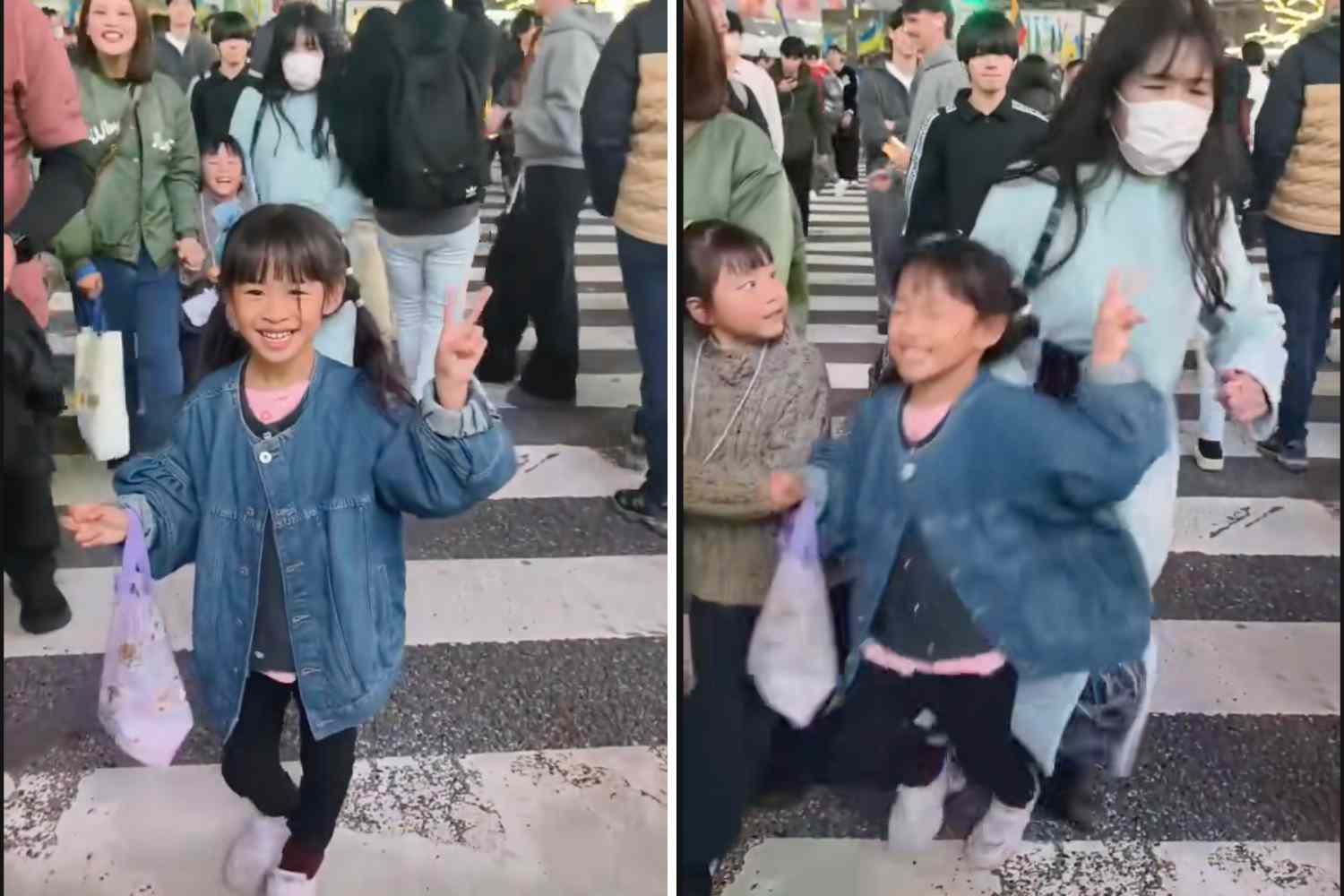
It all begins as a sweet video, a little girl, clearly ecstatic to be in Tokyo, beaming and waving her finger at her mother’s camera. A few seconds later, she is violently pushed to the ground by a woman wearing a surgical mask. The attacker doesn’t stop even for an instant, and disappears from the scene without looking back.
This is not an accidental clash of shoulders in a chaotic crowd. It is one of the most emblematic examples of an increasingly discussed phenomenon in Japan: the butsukari otoko — literally “man bumping” — a practice that involves deliberately hitting passers-by in crowded public places.
@hirokawaguchili Vi “Butsukari Obasan” for the first time. #butsukari
♬ sonido original – hirokawaguchili – Kawaguchi Hiro
The video of the episode, taken last February 25th in the middle of the famous “scramble” intersection in Shibuya, has exceeded one million views on Instagram. The vast majority of comments condemned the attacker’s behavior, while some users questioned the mother’s choice to photograph her daughter in the middle of one of the busiest intersections in the world.
A phenomenon that is not new
The butsukari entered the Japanese collective imagination in 2018, when a slightly blurry video circulated in which a man deliberately attacked several women at Shinjuku station, the busiest in the world.
Last May, a 59-year-old associate professor was arrested in Fukuoka on charges of attacking multiple passers-by by hitting them with his bag as he walked. He faces up to two years in prison or a fine of 300,000 yen (about $1,900). If the attacks cause injuries, the penalties become significantly harsher.
Other incidents were reported near Tamachi station in Tokyo: in one of these, a woman suffered broken ribs due to a particularly violent impact. Local authorities had to install dividing posts to separate pedestrian flows entering and exiting the station.
Not just men
Men seem to be the main culprits, at least according to anecdotal data, but the phenomenon is not exclusively male. Clips are circulating on social media of women also intentionally lunging at passers-by in crowded places, ready to elbow anyone in their path. In one widely shared video, a woman hits a passerby with her purse, stops to pick up something from the ground, and then turns back to insult the victim.
The relative novelty of the phenomenon means that no official statistics yet exist. Perpetrators often take advantage of the confusion to blend into the crowd, and many victims don’t even realize they’ve been deliberately targeted.
A 2024 survey of 21,000 people found that 14% of respondents had been victims of butsukari6% had witnessed it and 5% had had both experiences.
The roots of the problem: gender and frustration
For experts, the phenomenon is a mirror of deeper social tensions. According to Kiryu Masayuki, a sociology professor at Toyo University who specializes in criminal psychology, the butsukari it would be a direct reflection of contemporary Japanese society: a country where antiquated ideas about male superiority still resist, but where the difficult job market and uncertainty about the future have eroded traditional models of masculinity, leaving many men in a state of latent frustration and no outlets.
Deliberately hitting a woman in a crowded place would thus become a low-risk outburst: the confusion of the crowd almost always guarantees impunity, and those responsible seem to be perfectly aware of this.
Tourism complicates things
The tourism boom of recent years has added a further level of tension. Hordes of visitors stopping at the busiest spots in Tokyo, Kyoto and Osaka to take the perfect Instagram photo are causing annoyance and annoyance among locals.
After the incident in Shibuya involving the Taiwanese girl, the Chinese embassy in Tokyo invited its citizens to maintain a safe distance in crowded places and to avoid using smartphones while walking.
It should be underlined, however, that there is nothing to suggest that the attacker was aware of the girl’s nationality: in the frames preceding the collision, the woman is already seen elbowing a man and touching another child.
The Shibuya case is destined to rekindle a debate that Japan has not yet resolved: how to protect people, residents and tourists, from the silent and unpunished aggression of those who use the crowd as a shield.
