
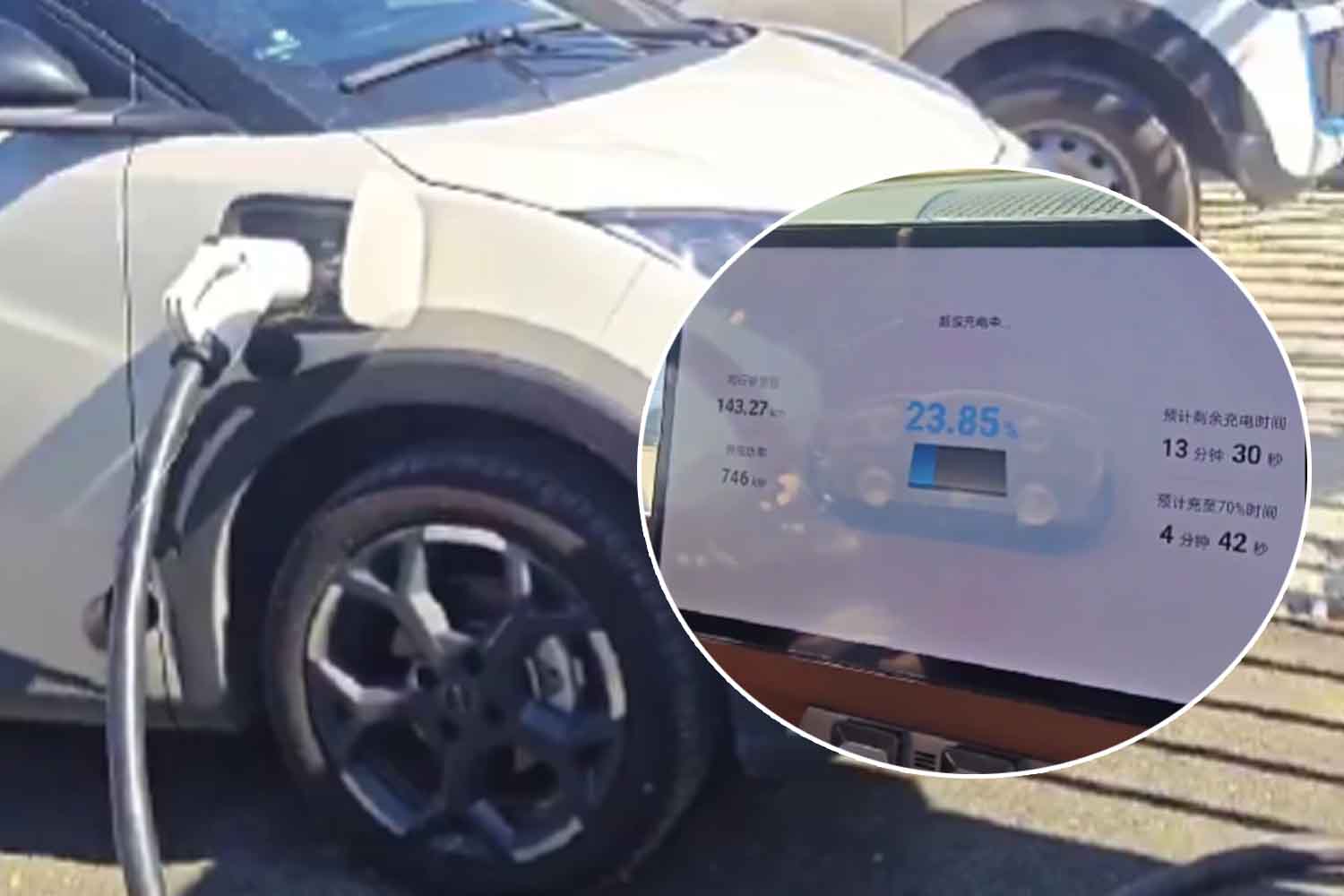
For years this has been one of the main psychological brakes on electric cars: charging times. Too long, not very compatible with everyday rhythms, especially for those who use the car without the possibility of planning each stop. Now, however, something is changing. BYD has presented a battery capable of recharging an electric car in five minutes, giving up to 400 kilometers of autonomy. A time comparable to that of a full tank of traditional fuel.
This is not a laboratory experiment, but a technology already tested on real vehicles, which opens up new scenarios for the spread of electric mobility.
BYD’s Super e-Platform was created to reduce the wait at the charging station
The technology was developed by BYD, a Chinese group that in recent years has focused decisively on batteries, system integration and reduction of environmental impact. The heart of the innovation is the Super e-Platform, a new 1000 volt electrical architecture, designed to handle much higher charging powers than current standards.
BYD explains that the result does not derive from a single component, but from a project conceived as a whole: battery, thermal management, power electronics and vehicle structure work in a coordinated manner. During tests in real conditions, charging peaks of up to 746 kW were achieved, making it possible to reach 70% charge in less than five minutes.
The declared objective is clear: to make electric charging simple and fast, eliminating one of the obstacles most felt by those who look at electric cars with interest, but also with some hesitation.
With five minutes of charging you can recover up to 400 km
From a practical point of view, the new BYD battery allows you to recover approximately 400 km of autonomy in an extremely short time. A feature that makes waiting at the charging station less relevant and more compatible with daily commutes and occasional trips.
According to BYD, this technology could also have important environmental effects. The possibility of very rapid and frequent recharging makes it possible to reduce the need for large and heavy batteries, with less use of raw materials and a lowering of the overall weight of the vehicles. Less weight also means greater energy efficiency and potentially lower consumption.
Looking ahead, ultra-fast charging could promote the electrification not only of urban areas, but also of less served areas and of some segments of light and heavy transport, especially if integrated with renewable sources and adequate infrastructure.
Suitable networks and columns are needed
However, BYD underlines a fundamental aspect: this charging speed is not possible everywhere. The Super e-Platform requires ultra-high power charging stations, robust electricity networks and careful infrastructure planning.
In China, the company has already started installing stations compatible with these power levels and has announced plans to bring the technology to Europe as well. Here the topic is part of a broader debate regarding the strengthening of electricity networks, the integration of renewable energy and the regulation of charging infrastructure.
Meanwhile, the first vehicles are already a reality. In China, two BYD models feature this technology: Han L and Tang L, marketed starting from around 25,000 euros. The Han L sedan goes from 10% to 70% in six minutes and completes charging in about twenty minutes. The Tang L SUV, on the other hand, recovers 370 km of autonomy in five minutes and reaches 100% in about half an hour.
Numbers that show how ultra-fast charging is moving away from promises and slowly but concretely entering reality.
BYD’s charging station in China, 400km in 5 minutes!
Gasoline what? pic.twitter.com/WgWGc5Nd3q
— Dominic Lee 李梓敬 (@dominictsz) December 22, 2025
You might also be interested in:
