
March 17th in Ireland is not just a religious occasion nor a folkloristic event designed for tourists. It is a date that passes through the collective memory of the country. For a few days the island transforms into a sort of choral tale: medieval squares, creative cities and villages on the Atlantic come together in the same script.
Many visitors know the festival through stereotyped images – full pubs, green hats, traditional music – but in the area the atmosphere appears more complex. The celebration becomes an opportunity to explore local identities, landscapes and stories that rarely find space in quick guides.
St. Patrick, after all, functions as a cultural compass. By following the cities and places linked to the festival you discover an Ireland that alternates ancient spirituality, contemporary energy and a strong sense of community. A trip built around this date allows us to get into the rhythm of the island instead of simply observing it from the outside.
How St Patrick’s Day is celebrated in Dublin
The capital represents the natural starting point, here the St. Patrick’s Festival occupies four days and four nights, transforming the center into an urban scenography where art, music and performance mix with daily life.
It’s not just about the March 17 parade, spectacular as it is. The festival involves hundreds of artists and brings street theater performances, installations, concerts and creative workshops to many neighborhoods of the city. The result is a Dublin that seems to be temporarily rewriting its cultural geography.
Walking through the Georgian streets of the center you go from a musical stage to an improvised performance, from a temporary market to a collective dance. The public does not remain passive spectators: families, students and travelers naturally enter the flow of events.
In this scenario the capital shows two faces, on the one hand the dynamic European metropolis, on the other the literary and musical city that continues to preserve centuries-old traditions.
How St Patrick’s Day is celebrated in Armagh, the spiritual heart of the island
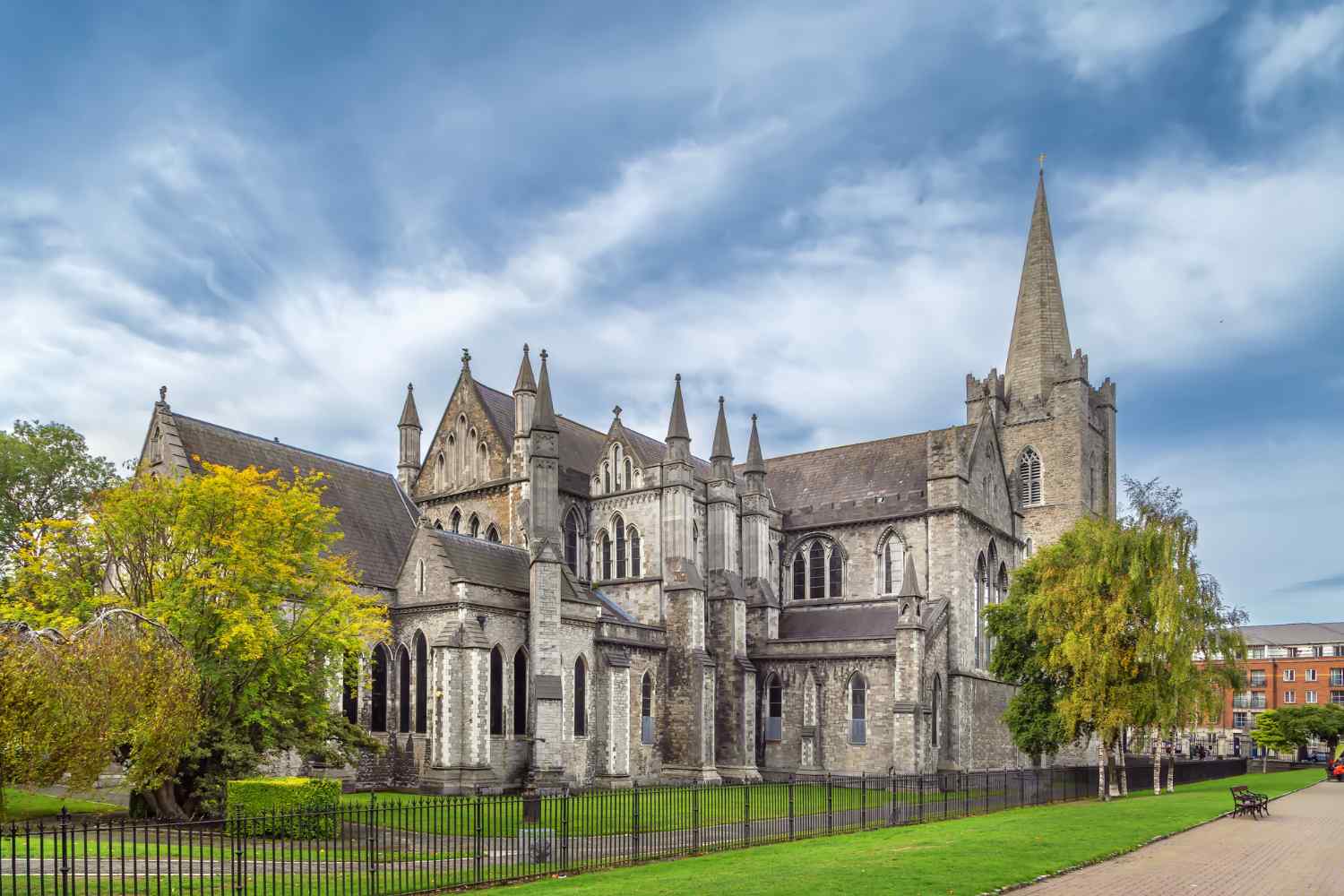
To truly understand the figure of Saint Patrick you need to leave the tourist capitals and reach Armagh, in Northern Ireland. Here the saint founded one of the first stone churches in the country in the 5th century, transforming the city into the ecclesiastical capital of Ireland.
During the local festival, significantly called Home of St Patrick, the spiritual dimension returns to center stage. One of the most intense experiences remains the Vigil Walk, a candlelit night walk that connects the two cathedrals dedicated to the saint.
At dawn on March 17th many participants go up to Navan Fort to witness the “Sunrise” ritual. The sun slowly appears above the hills as the city awakens. The moment lasts a few minutes, but leaves a feeling of continuity with the past.
Armagh also offers a literary surprise: the historic Robinson Library houses a rare first edition of Gulliver’s Travels with handwritten annotations by Jonathan Swift. A detail that reminds us how much religious history and literary culture coexist in this area.
How St Patrick’s Day is celebrated in Cork
To the south of the island, Cork has a different character. If Dublin represents the institutional center and Armagh the religious memory, Cork appears as the creative laboratory of the country.
The local festival revolves around the theme Marsh, Myth & Magic, a combination that mixes folklore, landscape and irony. For a few days the city comes alive with concerts, comedy shows and widespread cultural activities.
One of the most popular events is the Céilí Mór, a large collective dance that brings together hundreds of people in the City Hall. No particular skills are needed: enthusiasm and a minimum spirit of adaptation are enough.
The final parade passes through downtown featuring community groups, international artists and musicians. Among the most surprising presences are samba reggae ensembles, evidence of how the party has taken on a global dimension.
Cork proves that Irish tradition does not live in a museum display case. It continues to change form and language.
How St Patrick’s Day is celebrated in Limerick, where legends take shape
Moving west you come across Limerick, a city which during the festival decides to tell its story through its legendary figures. The chosen theme, Legends of Limerick, recalls popular stories, historical figures and local myths.
The most impressive event is the International Marching Band Championship. Around a thousand musicians from Ireland, Europe and the United States fill the streets with a succession of sounds, uniforms and choreography.
The result resembles a long musical wave crossing the city. Spectators do not follow a single concert: they walk among dozens of different performances, each with a precise identity.
In this context Limerick demonstrates how local memory can be transformed into a contemporary spectacle without losing authenticity.
How St Patrick’s Day is celebrated in Waterford, the Viking town fire
Ireland’s oldest city brings with it an unexpected past. In fact, Waterford was born as a Viking settlement in the 10th century. During the St. Patrick’s Day festival this historical legacy becomes an integral part of the celebration.
The medieval streets of the center host theatre, circus and music shows. However, the event that sticks out the most is the Paschal Fire Show, an outdoor performance that combines fire, dance and music.
The scene recalls an ancient Celtic ritual reinterpreted with contemporary theatrical techniques. The flames illuminate the historic walls of the city and create an almost cinematic atmosphere.
Waterford demonstrates how the party can become a narrative platform capable of merging different eras.
How St Patrick’s Day is celebrated in Kilkenny, the celebration in a medieval city
Those looking for an evocative setting will find one of the most fascinating settings in the country in Kilkenny. The 13th-century castle and St Canice’s Cathedral dominate a compact historic centre, perfect for a widespread celebration.
The chosen theme, Le Chéile – “together” – reflects the community spirit of the city. Over eighty events enliven streets, squares and historic pubs.
During the day, food and craft markets attract residents and visitors. In the evening traditional music invades the premises. Violins and accordions build a spontaneous soundtrack that extends from pub to pub. Kilkenny doesn’t focus on large settings, but prefers the intimacy of a shared party.
How to celebrate St. Patrick’s Day in Killarney, between nature and inclusiveness
In County Kerry the festival takes on a different tone. Killarney is located between lakes and mountains, one of Ireland’s most famous landscapes.
The program revolves around the theme Echoes of Killarney, an invitation to imagine the future of the community. Among the most significant events is AbleFest, an initiative designed to involve people of all abilities.
Music, theater and creative activities allow residents and visitors to share experiences without barriers. The festival thus becomes a social as well as cultural laboratory. Here the landscape plays a fundamental role: the celebrations are intertwined with excursions, walks and panoramas that show Ireland in its most natural dimension.
How to celebrate St Patrick’s Day in Sligo, where mythology meets the Atlantic
On the north-west coast is Sligo, a city linked to Celtic mythology and the poetry of WB Yeats. The local festival revolves around the motto “Legends Live Here”.
The parade features figures from Irish folklore alongside community bands and sports groups. However, the real soul of the party emerges in the city’s pubs.
During the Trad Trail, traditional musicians play live in various venues. Violins, flutes and bodhrán accompany the evening as the audience moves from one pub to another. Sligo shows the most authentic dimension of the celebration: a party that arises from the direct relationship between music and community.
Who really was St. Patrick
At the center of everything remains the figure of Saint Patrick, often told through myths rather than historical facts. In reality Patrick was not born in Ireland. He probably came from the west coast of Britain and arrived on the island as a teenager after being kidnapped by Irish pirates. After a few years of slavery he managed to escape and return home, but then decided to voluntarily return to Ireland as a Christian missionary.
Her real name was Maewyn Succat. Only later did he adopt the Latin name Patricius, meaning spiritual father.
Between history and tradition, hundreds of churches founded and tens of thousands of conversions are attributed to him. Even the famous legend of the snakes chased away from the island probably has a symbolic meaning: it represents the disappearance of pagan practices.
These stories explain why the saint continues to have an enduring appeal. He represents not only a religious figure but a key element of Irish cultural identity.
St. Patrick’s cake
Among the gastronomic traditions linked to the festival, a dessert that has become almost iconic stands out: the Chocolate Guinness Cake. Dark and intense, with a white glaze that recalls the foam of the famous stout, it tells the story of the relationship between cuisine and local culture.
Many travelers discover it abroad, but tasting it in Ireland completely changes your perspective. The dessert appears on the menus of historic pubs, independent cafes and elegant hotels.
One of the most evocative places to try it is on Inis Mór, in the Aran Islands, along the Wild Atlantic Way. Here it is served in a small café overlooking the ocean, a context that combines landscape and gastronomic tradition.
In Cork, however, the cake appears in cafés frequented by students and artists, where local cuisine meets the world of specialty coffee.
The result is a small culinary map that accompanies the journey across the island. March 17th is not a celebration that you watch: it is a celebration that you experience. Each Irish city declines it according to its own memory – spiritual in Armagh, creative in Cork, legendary in Limerick, Viking in Waterford. The result is that there is not a single celebration of St. Patrick, but a constellation of experiences that are held together thanks to a thin thread: the sense that history is not something to be displayed in a case, but to be put in the streets, literally.
Traveling to Ireland in this period means intercepting a country at the moment when it talks about itself most sincerely. Not for tourists, not despite tourists, but through a rhythm that has existed for centuries and continues to change form without losing substance. Those who arrive expecting only green hats and beer will be surprised — and that surprise, after all, is the true legacy of St. Patrick.
