
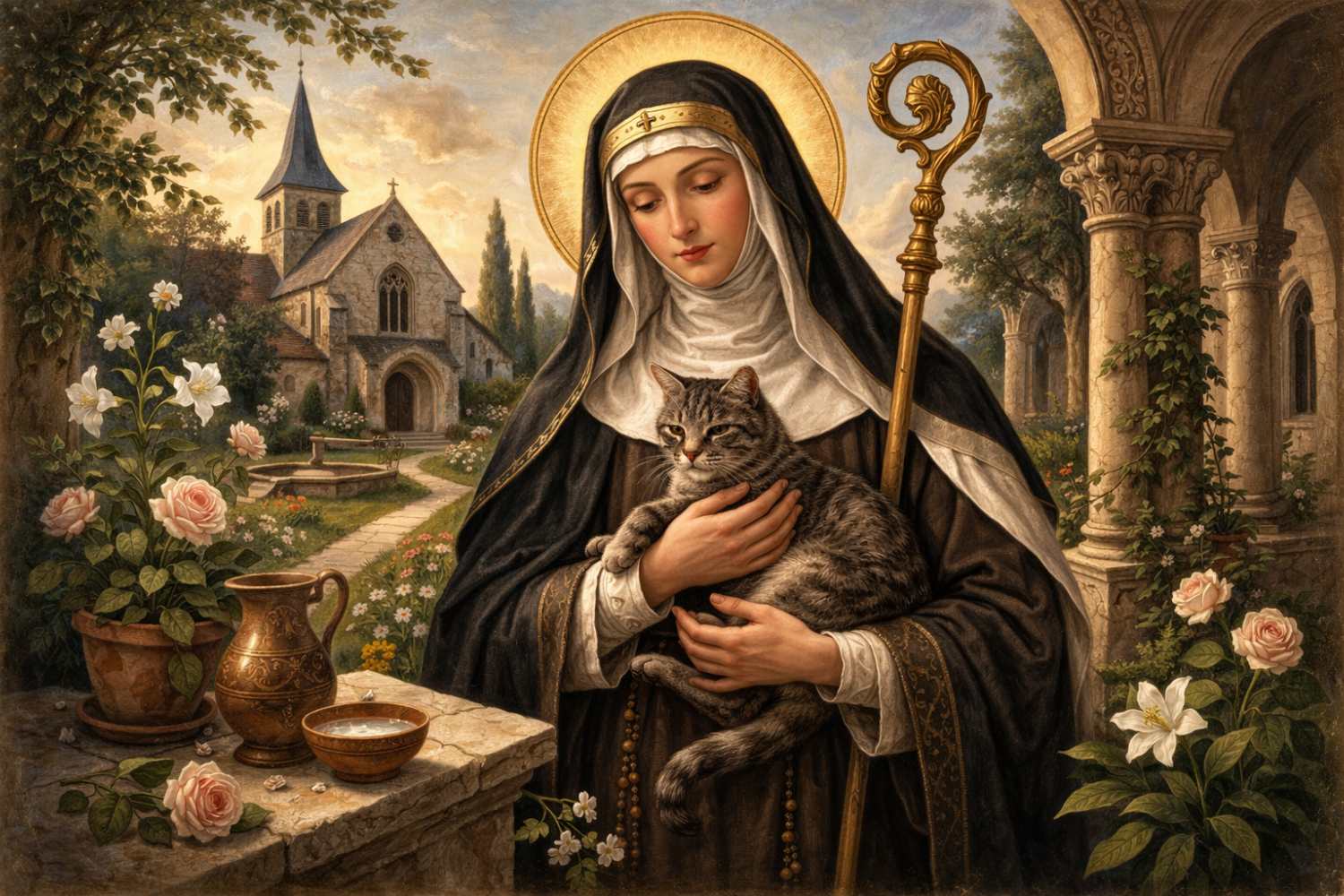
Today, March 17, while half the world celebrates St. Patrick’s Day with beer, the other half – the one with a cat at home – can celebrate something different. It is in fact the liturgical memory of Saint Gertrude of Nivelles, considered the patron saint of cats and protector against rat invasions. And today there are those who invoke it for domestic cats who have fallen ill.
Who was Gertrude of Nivelles
Born around 626, Gertrude was the youngest daughter of Pepin of Landen, butler of Austrasia. A prominent family in the Frankish kingdom: sister Begga would also become a saint, while brother Grimoaldo would inherit their father’s position.
When Gertrude was about ten years old, during a party at court one of the nobles present asked for her hand in marriage to her son. She replied that she would not marry him or anyone else, because she was already promised to Christ. An answer which, in the seventh century, had the weight of a definitive declaration.
After her father’s death in 640, on the advice of her mother Itta, she took the veil of virgins in the monastery of Nivelles in Brabant, founded by her mother herself – the oldest monastic foundation in the Netherlands.
Upon Itta’s death in 652, Gertrude took over as abbess, entrusting the administration of external affairs to the monks in order to dedicate herself more assiduously to contemplation and the study of the Holy Scriptures.
An abbess who is anything but closed in the convent
In a superstitious era, when a lunar eclipse was enough to terrorize the countryside, Gertrude called monks from Ireland, learned in the Scriptures, and sent emissaries to Rome to supply the community with liturgical books. A remarkable cultural operation for a 7th century woman.
Among those he welcomed into the abbey were two Irish monks, St. Foillan and his brother St. Ultan, driven from their monastery in Norfolk by Penda, king of Mercia.
The monastery of Nivelles was, in those years, a point of reference for pilgrims, foreigners and the poor who arrived from all directions.
Gertrude died on 17 March 659, at the age of thirty-three, and was buried in the church of San Pietro in Nivelles. His cult developed soon after his death, with miracles attributed to his tomb, and was among the most widespread of the Middle Ages in Brabant, Germany and Eastern Europe.
The bond with cats: history or legend?
Cat patronage has more practical than sentimental roots. There are no reliable stories directly linking Gertrude to cats during her lifetime, although in the Middle Ages she became the favorite saint to invoke against mice and rats.
The reasoning is simple: Gertrude was credited with the miracle of having kept the mice away from the monastery’s granaries, also thanks to the presence of cats that chased them away. According to legends connected to the saint, not only cats but also the water from the well and the bread baked in the monastery worked as remedies to keep rodents away. Until a few years ago – a practice that was later eliminated – the custodians of the church of Santa Gertrude of Nivelles sold water believed to be capable of protecting houses from the invasion of mice.
In the iconography, Gertrude wears the monastic habit and holds the abbess’ crosier in her hand; she is often depicted with one or more mice climbing on her robes.
A 16th-century painted stained glass window in the diocesan museum of Strasbourg shows her sitting reading, with three mice nibbling at her dress.
Protectress of gardeners and travellers
Cats are not the only area of protection: Saint Gertrude is also the protector of gardeners, the dying, hospitals and travelers (because she offered hospitality to travelers and Irish monks on their way) and is invoked against the invasion of mice (especially in vegetable gardens and gardens) and tumors. The patronage of gardeners is often traced back to the date of his death, which occurred at the gates of spring, when work in the fields began.
His remains are preserved in a reliquary in the Collegiate Church of Saint Gertrude in Nivelles, while the original reliquary – a jewel of Gothic art from the 13th century – was destroyed in 1940, during the bombing of the city.
