
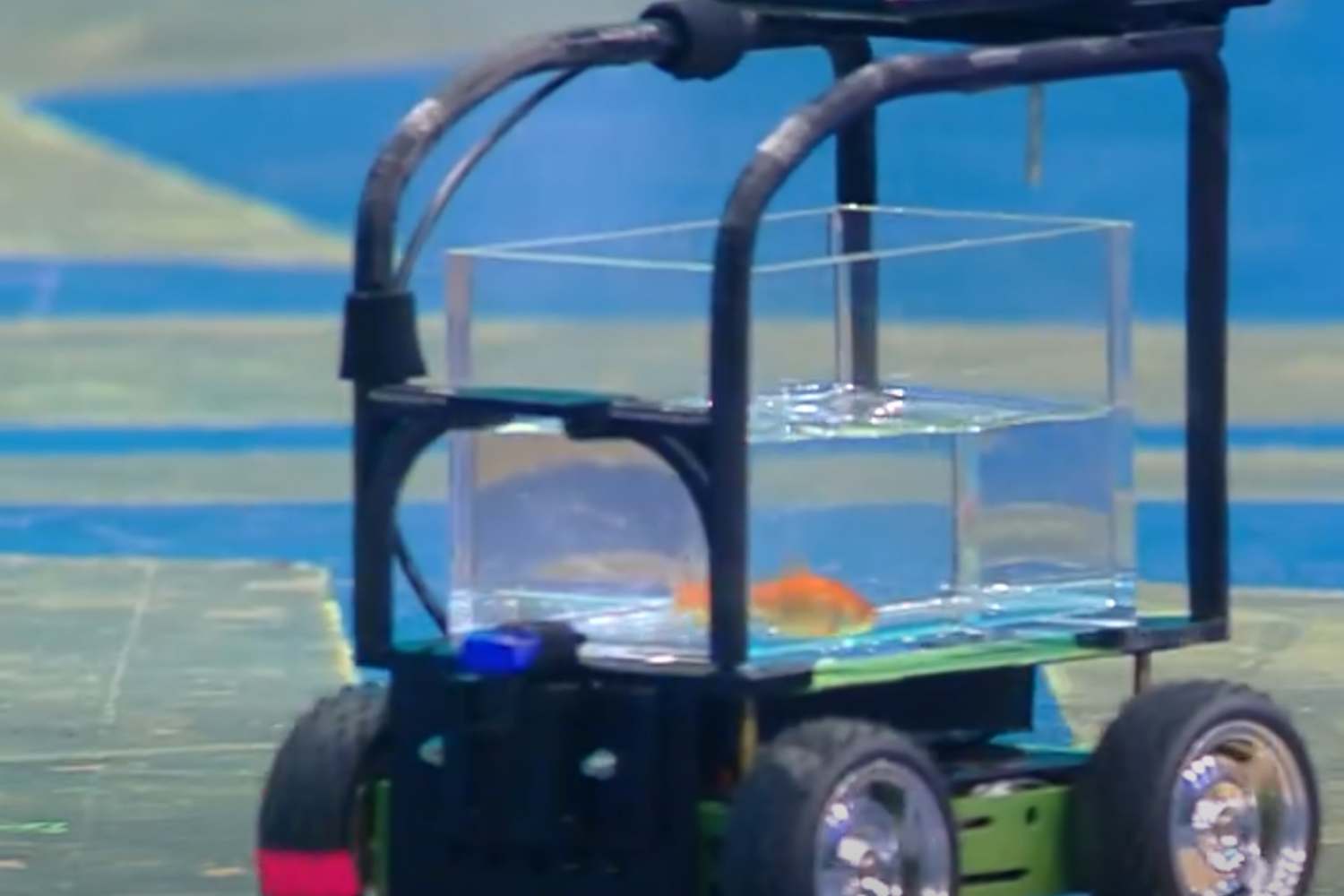
A goldfish behind the wheel is no longer science fiction. Dutch inventor Thomas de Wolf transformed an aquarium into a hi-tech vehicle controlled by the movements of Blub, his fish, achieving the Guinness World Record for the greatest distance traveled by a fish on a motorized vehicle: over 12 meters in just one minute.
How Blub’s car works
The vehicle consists of a four-wheel motorized platform with a small integrated aquarium. A motion sensor camera detects Blub’s position inside the tank in real time. When the fish swims to the right, the car steers in that direction; if it moves to the left, the vehicle follows accordingly. Even forward or backward movement is interpreted by the system, allowing Blub to “drive” in total autonomy within the limits of the pre-established route.
The hardware and software are calibrated to recognize Blub’s bright red color, ensuring precision in reading movements. The platform is stable and safe, designed to avoid shaking that could disturb the fish, and the sensor system was tested several times before the official record attempt. A complex engineering work, therefore, which combines robotics, artificial vision and automatic control systems.
The potential for mobility assistance
The idea began as a playful demonstration, but the underlying technology has real potential. Thomas de Wolf himself said that the system could be adapted for mobility assistive devices, helping people with mobility difficulties to control tools or vehicles with minimal movements. In this sense, Blub becomes a small technological ambassador, showing how sensors and the camera can translate even minimal movements into functional commands.
Let’s not forget animal welfare
It’s hard not to be fascinated by the inventiveness: seeing a fish driving a car seems surreal and futuristic. Yet, looking more closely, an ethical doubt arises. Blub is a small animal, deprived of his natural freedom for a spectacular experiment. Even without apparent suffering, it is impossible not to wonder if the initiative is damaging his well-being.
On the other hand, as mentioned, there is the possibility of using the sensitivity of the sensors for assisted mobility tools, helping people with motor disabilities. The basic idea is laudable, because it puts innovation at the service of social progress, but the spectacular application leaves room for doubts. It is a case where the positive goal coexists with questionable application. You can look at the record with a smile and amazement, but without forgetting that every living being deserves freedom and protection.
You might also be interested in:
