
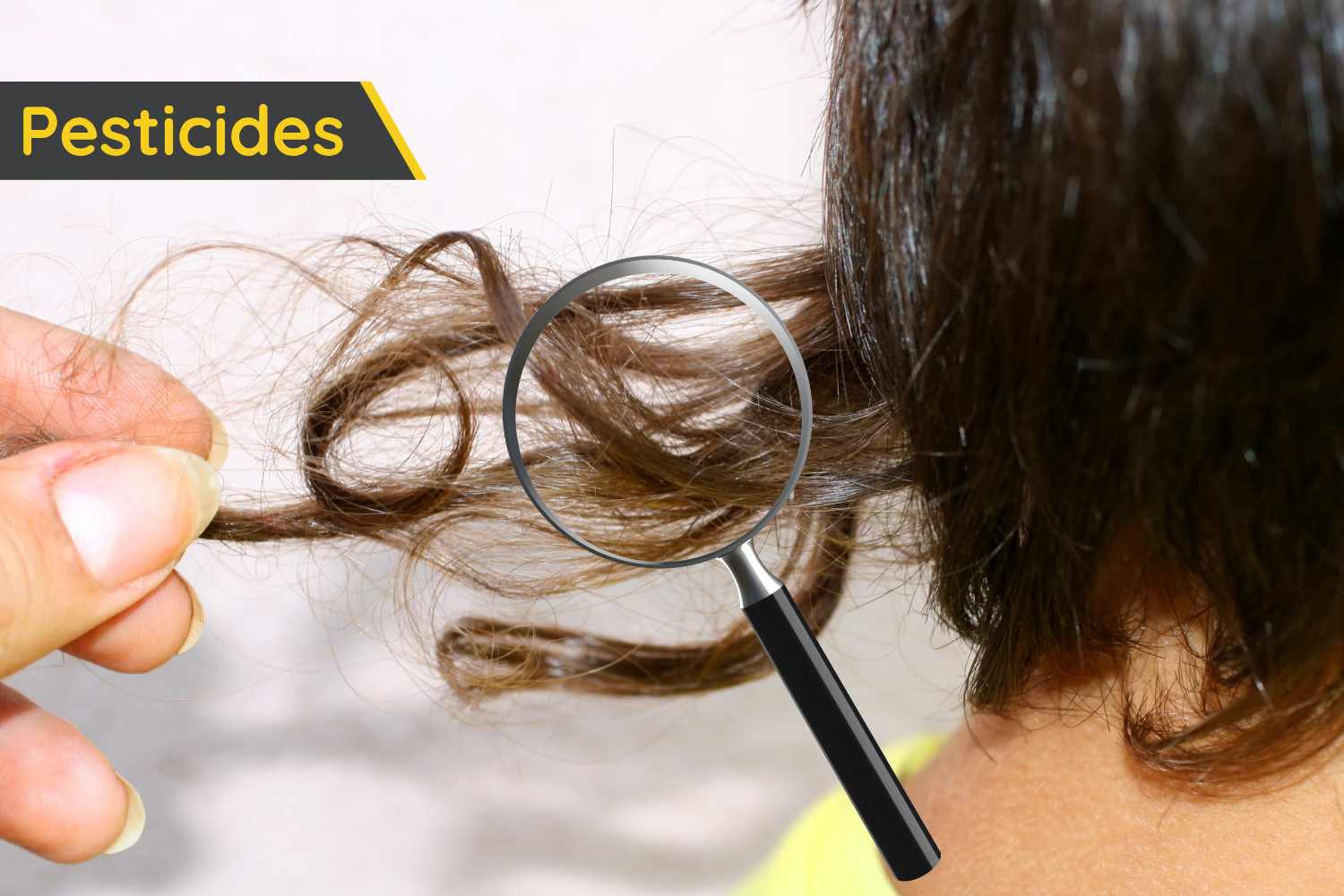
How many pesticides do we literally carry with us every day? More than we imagine. This is what emerges from an investigation conducted by the Swiss public television RTS, which analyzed hair samples from 54 volunteers from all the cantons of French-speaking Switzerland.
The result was unequivocal: only two people did not have any trace of phytosanitary substances. In all other cases, the hair told a story of silent, ongoing exposure.
Hair as a chemical archive
Hair doesn’t lie. Unlike blood or urine, which reflect recent exposure, hair strands are able to record how much we have been exposed to certain substances over the previous few months. Each sample analyzed measured six centimeters – cut flush with the scalp – a length sufficient to reconstruct the last six months of exposure to the 100 most common pesticides.
Some pesticides pass into the blood and are deposited there, while others come directly from the air we breathe – explained toxicologist Aurélie Berthet of Unisanté, in Lausanne.
In the samples analyzed, up to 8 different substances were identified in a single individual, with an average of 2 active ingredients per person.
Pesticides found in hair
Among the 20 pesticides detected overall, one emerges strongly: permethrin, found in 84% of participants. It is a synthetic insecticide widely used in household sprays, insect diffusers, flea products and pet pesticides. A fact that should make us reflect, also because in Switzerland this substance is not authorized for agricultural use and yet it is freely sold for home use.
And it’s not an isolated case. The vast majority of substances found in hair come from the domestic environment, not from the fields. Pesticides of agricultural origin represent just 8% of the total detected. In short, we are exposed above all to what we use or what surrounds us within the walls of our home.
The investigation made it possible to precisely trace the source of some contamination, with surprising results. A participant living in Court, in the canton of Bern, had traces of propiconazole, a fungicide. The explanation? Five years earlier, the product had been used to treat the wooden beams in his garage.
These paints release substances into the air as long as they remain active, sometimes up to ten years – warned ecotoxicologist Nathalie Chèvre of the University of Lausanne – So we are exposed to these substances for a long period.
In practice, exposure to certain products can continue well beyond the time of their use, without our knowledge.
Another emblematic case comes from Geneva, where a participant had used various products against tiger mosquitoes during the summer. Two insecticides were found in his hair, including transfluthrin, banned in agriculture but regularly sold for domestic use. A paradox that highlights a profound contradiction in the current regulatory system.
The fight against mosquitoes poses an ethical and health issue that is anything but simple. As researcher Chèvre observed: do we protect ourselves from insects by using substances that could harm us in the long term, or do we accept the risk of bites from disease vectors? There is no easy answer, but it is a question that deserves to be asked and which is too often ignored in daily purchasing choices.
It is also worth noting that Patricia Bidaux, president of AgriGenève, was also among the participants in the survey. Her hair did not show any residue of the Swiss agricultural pesticide, which she says is testament to the progress made in terms of awareness and sustainable practices in the primary sector.
No threshold value
For now, there are no scientifically validated reference values that allow the concentrations detected in hair to be interpreted in terms of individual risk:
These analyzes do not allow individual risk to be assessed. These studies demonstrate that we live surrounded by chemicals that are toxic to the environment and to humans.
It is a warning that applies to everyone. You don’t need cultivated fields near your home to be exposed to pesticides: an anti-mosquito spray on the balcony, an old protective paint in the attic or an anti-parasitic collar on the family dog are enough. The chemistry we want to keep out the door often comes in through the window.
