
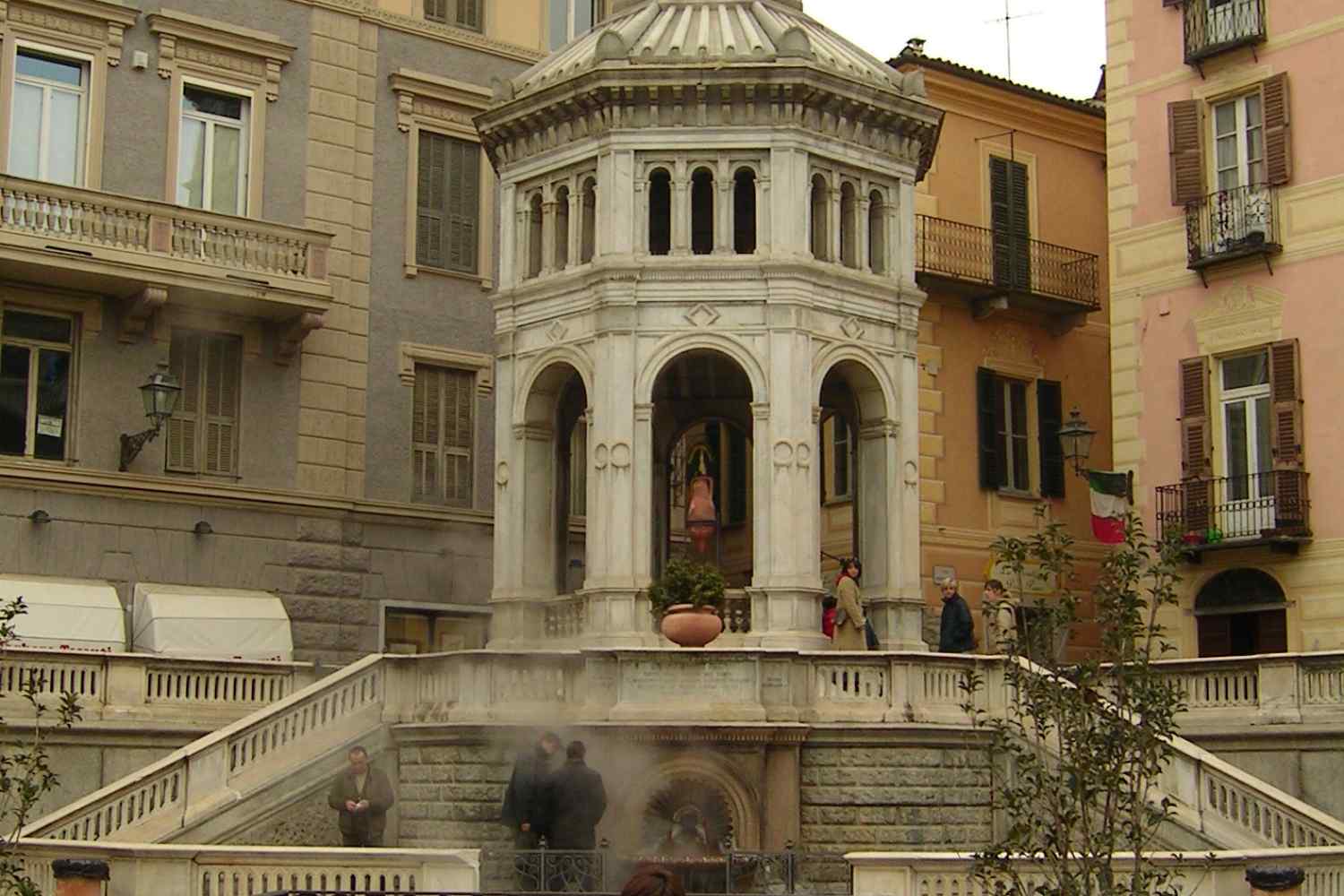
There is something strange and fascinating about Acqui Terme. You walk through the center, turn the corner and find yourself in front of a fountain with steam rising from it. It is not a special effect, it is not an artistic installation: it is real water, sulphurous-salt-bromine-iodic, which flows at 74 degrees centigrade in the middle of the square. One of the few cities in the world where a natural hot spring is literally located in the historic center, accessible to anyone, at any time. We are talking about Bollente.
The octagonal temple and the tower without foundations
The structure that houses the spring is a small octagonal temple of eclectic language, designed by the architect Giovanni Cerruti and inaugurated in 1879. Elegant, solid, with that tone of a nineteenth-century monument that smacks of serious history. At its center the spring delivers 560 liters of water per minute, a remarkable flow rate that has fed the city’s spa establishments for centuries and continues to attract curious people from everywhere. Right next door stands the Civic Clock Tower, nicknamed “tower without foundations” because, incredibly enough, it rests on the surrounding houses instead of on the ground. It was built in 1763 on the foundations of an ancient gate of the medieval city wall, and even today it is well known next to the spring, almost as if it were a sentinel.
Roman roots and mosaics under the porticoes
The roots of this place go back much further than the 19th century. Acqui was already known and frequented in Roman times, when the thermal waters had a recognized therapeutic value and the spas were places of social gathering in all respects. In via Saracco, the road that leads to Piazza della Bollente, under the old porticos you can still see the remains of a mosaic floor dating back to that era, found during the 19th century. In subsequent excavations the remains of a Roman swimming pool, a fountain, other buildings and even the ancient hospital of Sant’Antonio Abate in balneas came to light. A piece of a buried city that came to light by chance, which tells how this corner of Piedmont was already a place of healing and passage.
The properties of water and thermal treatments
Boiling water is not just a visual spectacle. Its chemical composition, rich in sulphur, bromine and iodine, makes it particularly effective in the treatment of various pathologies. In the thermal establishments of Acqui it is used above all for respiratory diseases, but also for rheumatism, arthrosis and skin conditions. Thermal muds, prepared by mixing spring water with selected clays, complete the city’s therapeutic offering. In the underground tank, before mixing with surface water, the temperature can reach 120 degrees: a detail that gives an idea of how much energy there is under the feet of those who walk calmly through the center of Acqui.
The legend of the sgaientò: scalded newborns
Over the centuries, Bollente has also had a decidedly more folkloristic role. Legend has it that the newborns of Acqui were taken to the source immediately after birth and immersed for a moment in boiling water. Whoever survived, and probably everyone survived considering that it was really just an instant, earned the title of “sgaientò”, meaning scalded in Acquese dialect. A bizarre tradition, almost brutal to hear it today, but which tells how central this place was in the life and collective imagination of the community. A rite of passage linked to water, as if the city itself had to recognize its children through its most precious resource.
The Brentau: the man who brought hot water to your home
Then there was another historical figure linked to Bollente that almost no one remembers today: the Brentau. He was in charge of carrying the brenta, a galvanized sheet metal container full of hot water taken directly from the source, to the homes of the people of Acqui on his shoulders. Before modern heating it was an indispensable service, and those who did it lived on it. The brenta had a nail called “broca” on the top, which served as an indicator of the quantity of water transported: it could reach up to 50 liters per load, a considerable weight. The Brentau were well-known people in the city, often recognizable by the nicknames they were called. One of the most famous was the “Caudren”. And some, among the older people of Acqui, still remember a Brentau woman, a figure so rooted in the local imagination that she even ends up on the city’s postcards.
The Brentau Palio: September in Acqui
Today the brente are almost only seen at antiques fairs or during one of the most eagerly awaited events of the year: the Palio del Brentau, which takes place every September in Acqui Terme. It is a real race, complete with participants in costume, in which the competitors compete in transporting water from the source. Whoever brings the most in the allotted time wins. It seems simple, but with 50 liters on your back it becomes a completely different matter. It is one of those moments in which a city chooses not to forget, to keep alive a memory that would otherwise risk dissolving completely between one generation and the next.
Why it’s worth stopping
In short, La Bollente is the symbol of a city that has built its identity around water, care and tradition. A source that has seen Romans, medieval, nineteenth-century and contemporary tourists pass by, which has nourished spa establishments, supplied homes, fueled legends and inspired rites. It’s worth stopping for a moment in front of that octagonal newsstand, watching the steam rise into the air, maybe asking someone local what it means to them. Then enter via Saracco, look for the Roman mosaics under the porticoes and realize that in Acqui history is not in the museums: it is in the street, under your feet, and still boiling.
