
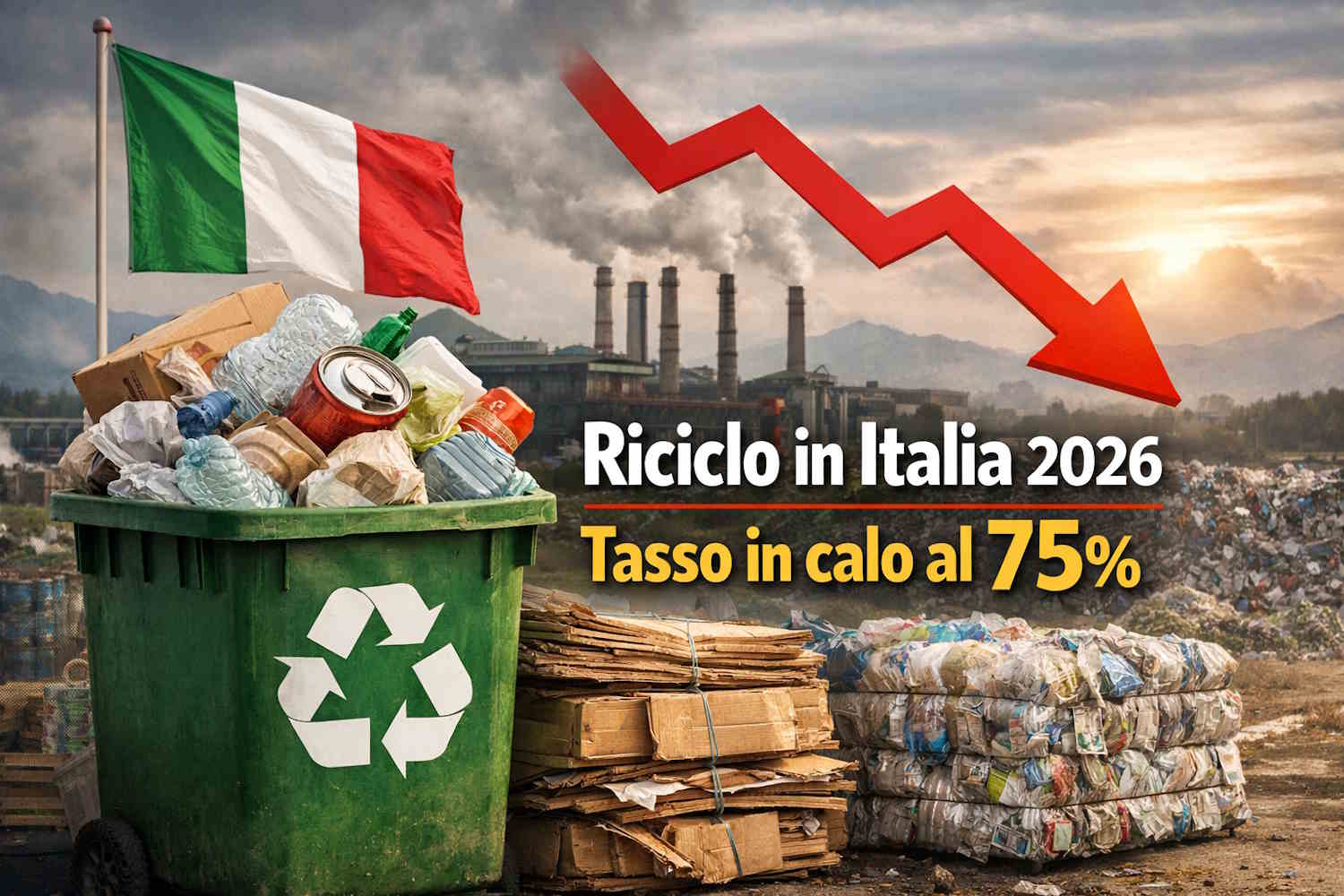
At a crucial moment for the environment and the circular economy, World Recycling Day, which is celebrated today, March 18, brings with it a complex picture for Italy. CONAI, the National Packaging Consortium, has released the first estimates for 2026, projecting a packaging recycling rate of around 75%. A significant figure, which translates into almost 11 million tonnes of recovered materials, but which, unfortunately, marks a slight decline compared to the 76.7% recorded in 2024.
The figures, released today, highlight a resilient but pressured sector. Faced with packaging released for consumption that will well exceed 14 million tonnes in 2026, Italian recycling capacity shows its strength, despite not being immune to global and internal turbulence. The president of CONAI, Ignazio Capuano, underlines the need for great prudence in this scenario: «Estimates which, this year, require great prudence. The dynamics we observe in recycling rates is influenced by contextual factors, as well as of a statistical nature. And to this there are particular market dynamics, which are also affecting individual supply chains.”
The challenges at the heart of the Italian circular economy
The drop, albeit slight, in the recycling rate is not a simple number, but the symptom of a series of difficulties that the sector is facing on multiple fronts. Global geopolitical uncertainty has a heavy impact on market trends, influencing the supply and demand of raw and secondary materials. But the problems don’t stop there.
The specific situation for paper and plastic
By examining the different supply chains, specific critical issues emerge. For paper, for example, there has been a decrease in domestic demand, partially offset by a growth in exports. However, a worrying factor is the increase in impurities in collection streams, which makes it more difficult to obtain materials suitable for recycling and increases process costs.
The situation for traditional plastic is even more complex. In recent months, there has been a significant slowdown, due to several factors: the increase in the quantities of packaging waste selected but not withdrawn from the market, the lack of outlets for the recycled material and the consequent increase in management costs. «We are going through a critical phase linked to plastic materials» explains President Capuano, highlighting how this will also have impacts on management costs, which «are increasing, because there are no outlets for recycled material and recycling costs more».
Global competition and energy costs: a threat to national recycling
To further complicate the picture, the challenges posed by globalization add. The Italian recycling industry finds itself competing with a growing influx of low-cost products and raw materials from non-European countries. This dynamic, as underlined by Capuano, “greatly penalizes our companies”, as it threatens the profitability of national recycling operations, which are fundamental for European manufacturing.
Another element of strong pressure is energy costs. In Italy, these remain among the highest in Europe, and the recycling sector, by its nature, is a highly energy-intensive sector. This directly impacts the profit margins and competitiveness of companies operating in the circular economy.
The crucial role of CONAI and the proposals for the future
In this scenario of uncertainty and difficulty, the role of the CONAI system becomes even more strategic. It is when the market shows its limits, and the profitability of recycling decreases, that the Consortium intervenes to guarantee the collection and recycling of materials, acting as a safety net for the entire country system. Estimates for 2026 predict that more and more end-of-life packaging will be entrusted by Municipalities to the CONAI system and supply chain consortia: over 5 and a half million tonnes, an increase compared to the 4 million and 740,000 in 2024.
To face current and future challenges, President Capuano launches a clear appeal: «Industrial policies that promote the use of local recycled materials are increasingly urgently needed. We cannot afford to nullify the benefits of recycling with imports from outside Europe: trips from the Far East are not environmentally neutral. Recognizing, even economically, the environmental value of recycling done in our territories is essential to avoid exposing companies to the risk of environmental and economic speculation.”
Another fundamental aspect concerns the regulatory framework. The uncertainty linked to the new European Regulation on packaging is already negatively influencing the investments of Italian companies in ecodesign and sustainability. For this reason, Capuano calls for “clearer rules to make industrial planning and business confidence more solid”, together with greater simplicity and accessibility of finance for small and medium-sized enterprises, the true driver of innovation and ecological transition.
A future to be built with determination
CONAI’s estimates for 2026 paint a picture of great commitment, but also of strong vulnerability. The packaging recycling sector in Italy, a pillar of the circular economy and sustainability, is at a crossroads. The ability to maintain and, possibly, exceed current recycling rates will depend not only on the efforts of operators, but above all on decisive and far-sighted political and industrial action. Only in this way will we be able to ensure that recycling continues to be a precious resource for our country, transforming waste into new opportunities and contributing to a greener and more prosperous future for all.
