
There are places where the story doesn’t stay still in the books, but continues to move beneath the surface, as if it still has something to say. Pompeii is one of these. Every time it seems like we have understood everything, a detail emerges that shifts our gaze and forces us to put the pieces back together. This time it’s not about houses, frescoes or everyday objects, but something rougher, engraved in the stone: signs of warremained there for over two thousand years.
A group of Italian researchers, in a study published in the journal Heritage in 2026, he decided to read those tracks as one does with a wound that has never really healed. The result is a reconstruction that is surprising, because it suggests the use of a much more sophisticated weapon than one imagines when thinking about antiquity. A machine capable of striking in rapid sequence, enough to remember – with all the necessary precautions – one sort of ancient machine gun.
Precise and repeated signs that change the interpretation of the siege
Those who visit Pompeii today tend to link everything to the eruption of Vesuvius in 79 AD, but the city had already experienced very difficult moments. One of these is thesiege led by Lucius Cornelius Sullaalmost a century before the volcanic catastrophe. And it is precisely to that event that the signs observed on the northern walls seem to refer.
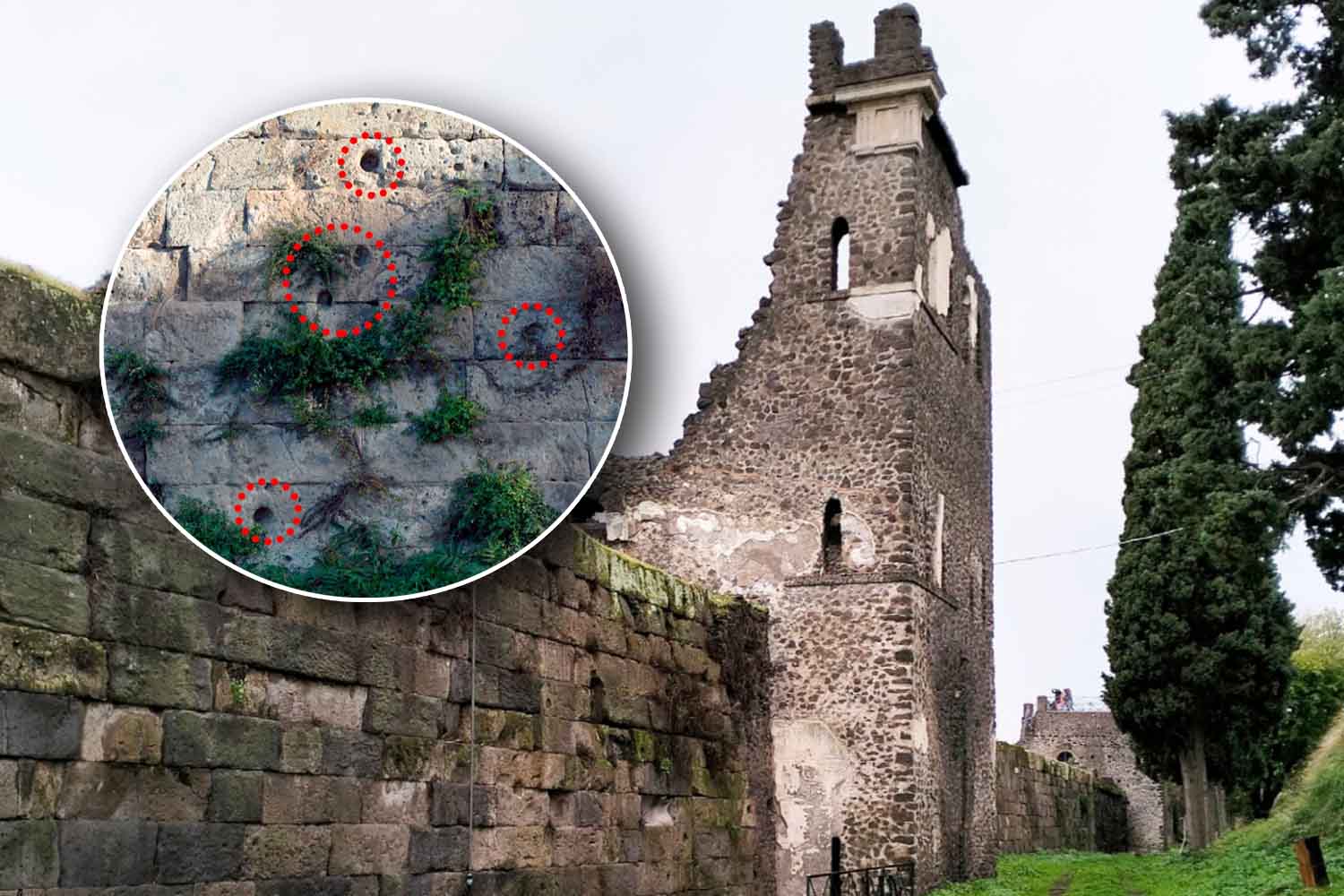
Archaeologists have long been familiar with the large circular craters caused by stone projectiles launched by Roman catapults. They are evident, almost didactic. But among these more striking shots, another plot is hidden, more subtle and less immediate: small quadrangular holesdistributed in a fan-shaped pattern.
For years they remained in the background, seen as general damage or simple degradation. The researchers chose to look at them closely, without rushing. They built very high precision three-dimensional models using laser scanners and photogrammetry, literally entering inside the shape of those signs. Depth, breadth, inclination: every detail was analyzed to understand what could have generated them.
From this analysis a clear lead emerged. Those impacts do not seem to be the result of isolated hits, but of a rapid, almost rhythmic sequence. Everything leads towards a war machine capable of firing multiple projectiles in succession: the polybolosa repeating catapult described in Greek engineering treatises from the 3rd century BC
The comparison with those ancient texts added another piece. The fan-shaped arrangement visible on the walls coincides with the mechanical movement attributed to these machines, a sort of lateral “sweep” that allowed different targets to be hit in rapid succession. It’s not just about hitting hard, it’s about hitting in a continuous and controlled mannerfollowing the rhythm of the battle.
The finds preserved in museums have also contributed to strengthening this reading. Some iron-tipped darts, associated with the so-called catapult Scorpionshow dimensions compatible with those obtained from the digital models of the walls of Pompeii. It’s as if, piece by piece, a frozen scene was being recomposed.
The ash of Vesuvius has protected these traces for centuries
There is an element that makes all this even more fascinating. After the siege, Pompeii was buried by the eruption of Vesuvius. That sudden covering acted like a time capsule, preserving not only buildings and objects, but also the scars left by the war. Without that protection, many of these signs would have disappeared under the action of time, rain and subsequent transformations. Instead they have reached us, allowing extremely precise reading today.
The images used in the study describe this passage well. On the one hand, historical photographs from the early twentieth century, such as those attributed to Van Buren around 1925, on the other, recent shots from 2024. The same signs are still there, recognisable, almost obstinate. In one of the oldest shots you can also see a measuring rod leaning against the wall, about three meters long, useful for estimating the proportions and dimensions of a fortification about four and a half meters high.
Even more eloquent is the comparison between three-dimensional models: on the one hand the impact of a large spherical projectile, on the other, groups of smaller, quadrangular and closely spaced marks. Two different languages engraved in the same stone. The first tells the siege as we have always imagined it. The second opens a new scenario, more dynamic, almost modern in logic.
According to the researchers, this radial and closely spaced configuration suggests the use of one automatic scorpiondesigned to target those who exposed themselves even for just a few moments. Archers appearing from the side openings, defenders appearing between the battlements: fleeting targets, intercepted by a machine designed to leave no respite.
In this reading, the walls of Pompeii become something more than a defensive structure. They transform into a narrative surface, capable of conveying the tension of a specific moment. No words are needed, just observe the direction of the blows, their density, the way they are distributed.
And perhaps this is what is most striking. The idea that a city known throughout the world for its sudden end also continues to tell the story of what came before. A story made of strategies, of ingenuity, of organized violence. A story that slowly resurfaces, while someone decides to take a closer look at a detail that had remained on the sidelines for years.
The Scars of Pompeii they don’t just talk about destruction. They also tell the story of the evolution of technologies, the way in which human beings have learned to fight, to plan, to strike. And in doing so, they restore an image of antiquity that is much less static than one might think. More complex, more alive, closer.
