
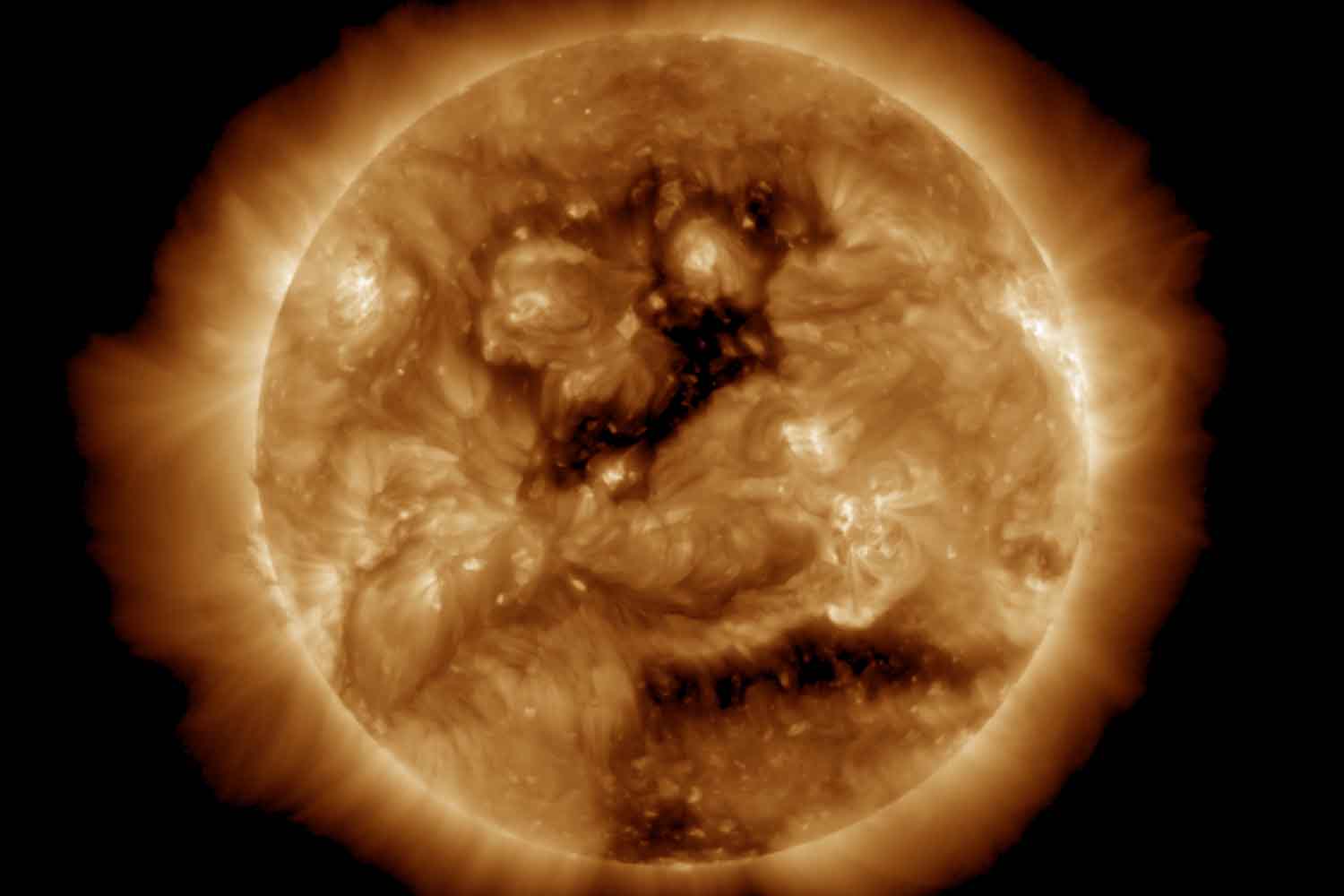
The Sun is going through a phase of strong activity and between 19 and 21 March 2026 a geomagnetic storm will reach Earth. This is not an exceptional event, but a natural phenomenon that directly relates space to our everyday life, with effects that can be visible or more discreet, but still real.
At the origin of the geomagnetic storm is the intensification of solar activity. Some regions of the Sun, characterized by unstable magnetic fields, are releasing large quantities of energy in the form of coronal mass ejections (CME). These ejections are composed of plasma and charged particles that are projected into space at very high speeds. When the trajectory is directed towards Earth, the material takes about a day or two to reach it.
According to the forecasts of space weather monitoring centers, the current event is between levels G1 and G2 of the NOAA scaletherefore between weak and moderate geomagnetic storm. This means that the Earth’s magnetic field will undergo a disturbance, but without extreme consequences. When solar particles arrive, they interact with the Earth’s magnetic field, compressing it and temporarily altering its balance. This is the mechanism that gives rise to the geomagnetic storm.
Effects of the geomagnetic storm: auroras possible in Italy?
The effects manifest themselves on multiple levels and mainly concern the space surrounding the Earth. Charged particles can interfere with the functioning of satellites, cause disturbances in radio signals and reduce the accuracy of navigation systems such as GPS. In some cases there are also temporary variations in high frequency communications, used for example in air traffic.
The electrical networks they can be involved through geomagnetically induced currents, which generally produce limited and controlled anomalies. On a visual level, the most evident phenomenon remains that of Northern Lights. During geomagnetic storms, the interaction between solar particles and the Earth’s atmosphere generates light emissions that can extend beyond polar areas.
In recent years, similar episodes have made it possible to observe auroras in Italy too, especially in the northern regions. Events documented between 2023 and 2026 showed skies colored red and purple, with visibility aided by clear sky conditions and low artificial lighting. With a G1-G2 level storm the probability remains more limited, but not excluded.
Geomagnetic storm and real risks
Geomagnetic storms are part of well-known natural dynamics. The most critical effects concern sensitive technological systems, but are generally managed thanks to continuous monitoring by space agencies and science centers. Satellites, communications and energy infrastructure are being designed to withstand these stresses. The warning systems also allow for early intervention in the event of an increase in intensity.
For this reason, rather than danger, we are talking about attention and management. Even during more intense events observed in recent years, the consequences remained temporary in most cases. For those observing from Earth, the geomagnetic storm remains above all a natural phenomenon which, in some conditions, also offers a rare spectacle such as that of the auroras visible at unusual latitudes.
