
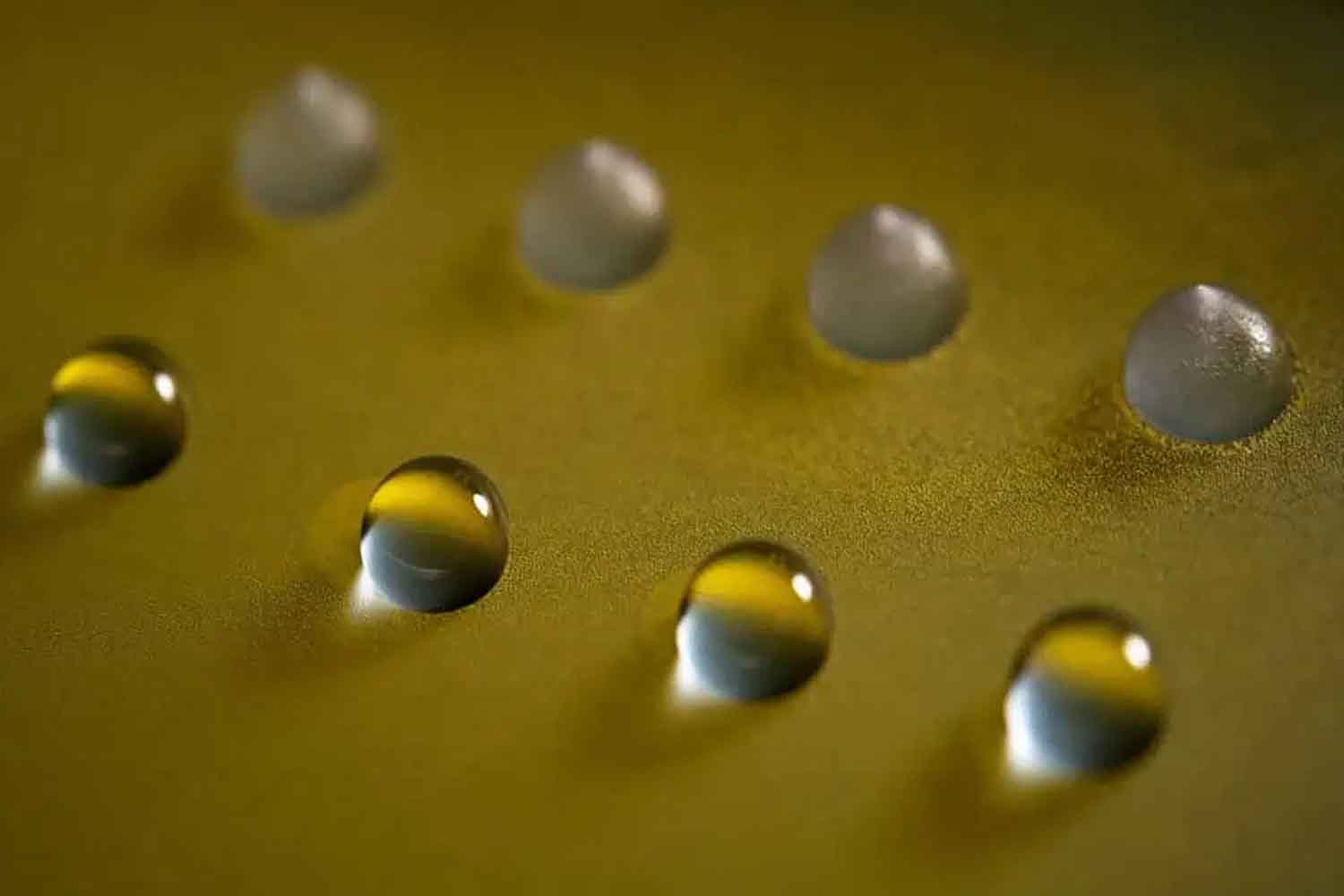
There is something that they explained to us in a simple way at school, perhaps too simple: water freezes below zero. It works, of course, but only as long as we stay on the surface of things. As soon as you go down a few levels, reality becomes more interesting, almost counterintuitive. Because water, left to itself, can remain liquid even at temperatures that we would define as prohibitive.
It is in this suspended space, between what we think we know and what really happens, that an unexpected protagonist enters the scene: a soil fungus capable of freezing water thanks to invisible but very powerful proteins. A discovery which, when put that way, seems almost marginal, but instead touches the heart of enormous phenomena such as the formation of clouds, rain and even the way in which we study the climate.
The secret of the soil fungus that freezes water sooner than expected
Water is in no hurry to become ice. If it lacks a surface on which to organize itself, it can remain liquid down to around -46 degrees, in a condition that scientists call supercooling. It also happens in clouds, where tiny droplets remain suspended in balance, waiting for something to start the transformation.
That “something” is a trigger, a kind of microscopic scaffolding. Usually these are dust, particles, residues floating in the air. The water molecules hook up there, arrange themselves in an ordered structure and from that moment the ice begins to propagate, until it becomes heavy enough to fall towards the ground.
Some living organisms, however, have developed a surprising ability: promoting the formation of ice in an extremely efficient way. Bacteria were already known for this ability, but they had an important limitation, because to work they must be present with the entire cell.
Mushrooms, however, have found a more elegant path. Some species produce free proteins, soluble in water, capable of acting even without the cell that generated them. These proteins are able to freeze water already at around -2 degrees, a much higher temperature than that required in the absence of triggers.
Scientists have identified these mechanisms by studying fungi of the Mortierellaceae family, collected in extreme environments such as polar regions and lichens. When they analyzed their DNA, they found sequences surprisingly similar to those of ice-making bacteria.
To verify that it wasn’t a coincidence, they transferred those genes into other organisms, such as yeast and E. coli. The result was immediate: these organisms also started producing ice. A sign that the mechanism works, and is extremely precise.
From the soil fungus to the clouds
This story, if you look at it carefully, also has something almost “pirate-like”. Because those genes did not originally belong to fungi. They were acquired millions of years ago through a process called horizontal gene transfer, a kind of passing of information between different species.
The mushrooms, however, didn’t just copy. They improved the system. Bacterial proteins only work if anchored to the cell membrane, while fungal ones have become more stable, more flexible, more autonomous. A small evolution that makes a big difference. And here come the practical consequences.
When we talk about cloud seeding, i.e. the possibility of artificially stimulating rain or snow, substances such as silver iodide are used today. They work, but they bring with them an environmental impact that remains open to discussion.
The proteins produced by these mushrooms offer a completely different alternative: natural, effective and free of toxicity. And above all, extremely efficient even in difficult conditions. If they can be produced on a large scale, they could change the way we intervene in the atmosphere. Then there’s the food. Anyone who has frozen strawberries knows what happens when they defrost: the structure changes, the internal water breaks down the cells. Guiding the formation of ice means better protecting food, maintaining consistency and quality.
The same principle applies in the medical field. Preserving tissues or organs is a delicate challenge, because ice can damage cells. Using these proteins allows you to control when water freezes, reducing damage and improving conservation options. Finally, there is a less visible but decisive aspect: climate models. Clouds are not all the same. The amount of ice inside them changes the way they reflect light and retain heat. And this directly affects global temperature.
These fungi live in the soil, everywhere. The wind lifts their spores and the proteins they release, carrying them into the atmosphere. This means that their role in cloud formation could be much more important than previously thought. Understanding it better also means reading more precisely what happens above our heads, every day, even when we don’t realize it.
You might also be interested in:
