
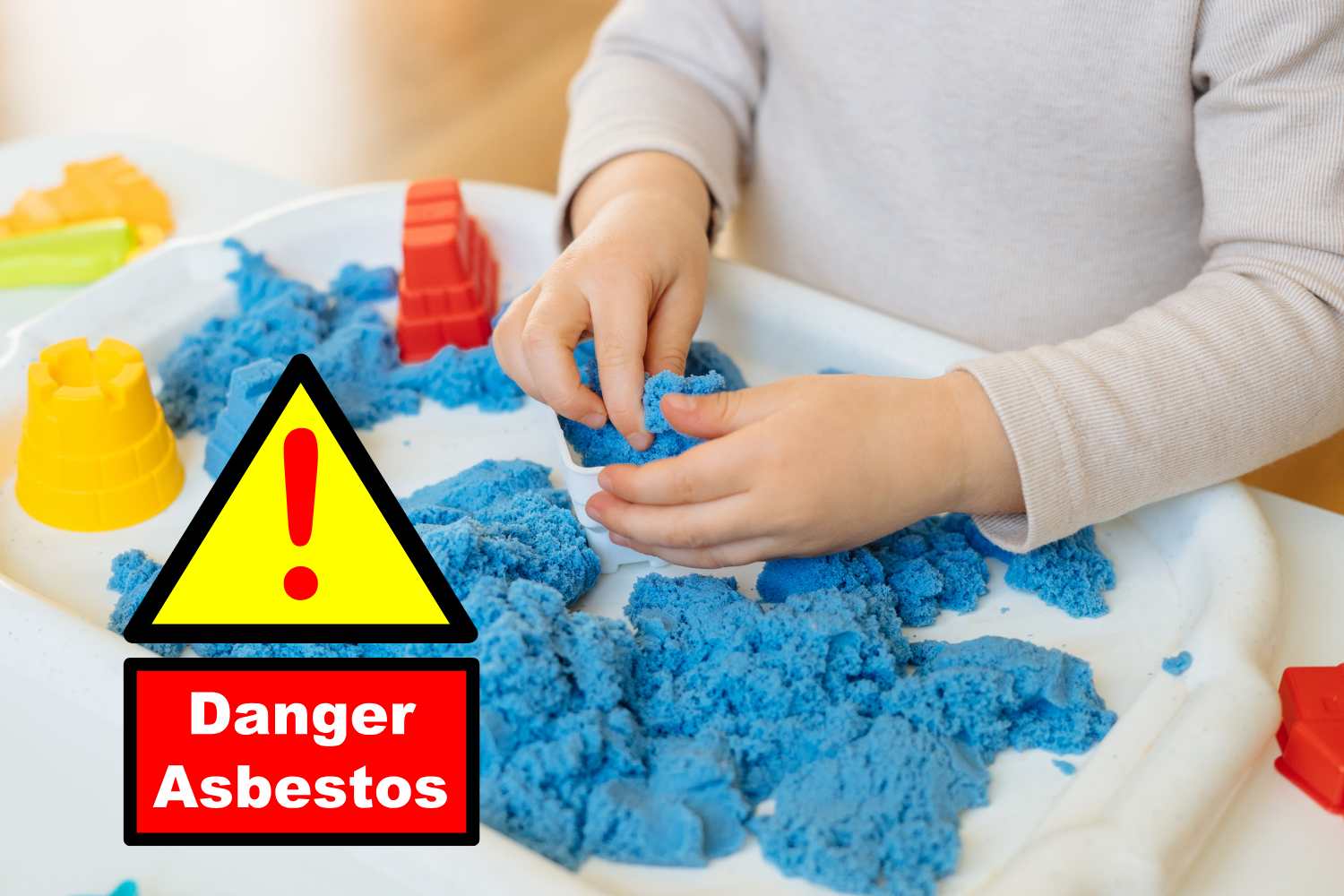
As we have already reported in a previous article, the alarm about the presence of asbestos in some colored sand-based toys arose from Australia between the end of 2025 and the first months of 2026, leading to the withdrawal of several products from the market after independent tests had identified the presence of tremolite, a form of natural asbestos.
The case had also had concrete and immediate consequences on the school system: more than 70 institutions had been closed as a precaution, the time needed to complete the clean-up and removal operations and return safe environments to students and teachers.
What seemed like a limited problem, however, quickly turned into a safety issue involving several European countries, bringing apparently harmless products such as kinetic sand, art kits and games filled with colored sand to the attention of the authorities.
The European alert: from the United Kingdom to Belgium
In the UK, as reported by The Guardianthe Hobbycraft chain recalled a play sand product after tests found the presence of asbestos, a case directly linked to the Australian recalls. Other British media have also reported further checks on creative kits and decorative sand.
In the Netherlands, independent laboratories analyzed several products, finding asbestos in multiple samples, including kinetic sand. Even Belgium did not stand idly by: the scientific authorities confirmed the finding of traces in some products and ordered withdrawals from the market, accompanied by health risk assessments.
In Germany, the Bundesinstitut für Risikobewertung has published an official communication confirming the cases of contamination detected in Europe, with particular reference to the Netherlands and Belgium, and the withdrawal of the products involved. And Austria also responded to the emergency: consumer associations and local authorities have released lists of reported or recalled products.
At European level, the European Commission’s rapid alert system, the so-called Safety Gate, has published official reports relating to playing sand containing asbestos fibres, confirming the non-compliance of some products with current standards. The issue even reached the European Parliament, where a question asked for clarification on the controls relating to playing sand imported into the Union.
Finally, targeted recalls of creative kits with colored sand have been reported in Ireland.
And Italy?
In the period between December 2025 and March 2026 there were no official recalls or public reports from the Italian authorities on children’s sand. However, as these products are often distributed online or through large international chains, the European authorities invite consumers to carefully monitor the reports of the Safety Gate system and to check for any recalls in individual countries.
However, a relevant case concerned the Action chain, which recalled some “Stretch Squad” toys due to the presence of asbestos in the internal padding. Although a direct connection with colored sand-based products has not been established, episodes of this type show how the problem may concern various categories of toys also distributed on the European market.
Where does the contamination come from?
According to available reconstructions, the contamination could be traced back to the sand used as raw material. In some geographical areas, natural deposits may contain tremolite, which risks ending up in the extracted material if adequate controls are not carried out during the extraction and processing phases. Once collected, the sand is colored and transformed into kinetic sand, but if the starting material is contaminated and not checked, the asbestos fibers can remain in the finished product which then ends up in the hands of children.
The problem is intertwined with the complexity of the global supply chain. Many of the products involved are manufactured outside Europe and distributed through online platforms or large international chains, making controls more difficult to ensure at every step, from the choice of raw materials to retail sale. A critical issue which, as underlined by several European authorities, concerns in particular low-cost and widely distributed products.
Sources: Guardian / BfR / Safety Gate
