
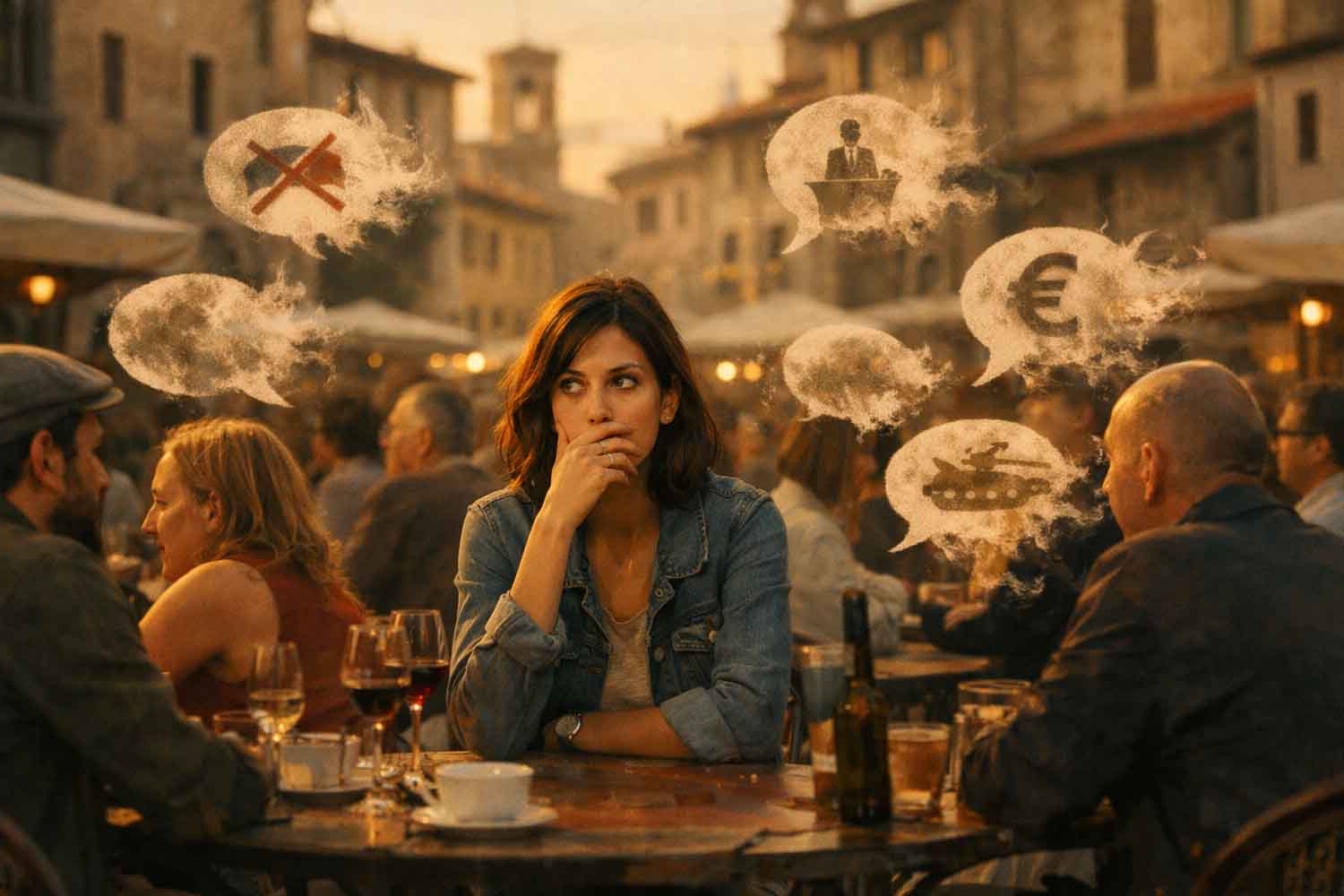
“Only the dead and the stupid never change their minds,” said James Russell Lowell. Too bad they all look like zombies around. In Italy there is only one word to describe those who change their political minds, and it is not exactly a certificate of esteem: turncoat. A word that brings with it centuries of distrust, of parochialism, of that closed group culture in which loyalty is worth more than the truth.
Just hearing it is enough to understand why millions of people keep a changed opinion to themselves every day, put it in the back of a mental drawer and sit on it with all the weight of social convenience. That silent calculation – better to stay silent than risk it – is so automatic that it seems normal. The problem is that it almost always leads to the wrong conclusion.
Research published in Journal of Personality and Social Psychologywritten by Trevor Spelman and colleagues at Northwestern University, precisely measured the gap between what we fear and what really happens when we change our minds on a political issue.
People tend to systematically overestimate the social punishment they would receive for expressing an opinion different from that of their group. The reaction of others, in reality, is almost always much milder than imagined. Almost disappointingly bland, one might say.
What happens when someone changes their mind and why almost no one tells it
The study involved over 4,500 participants in a series of experiments designed to measure exactly this gap. In one of these, the participants were divided into two groups: those who had to predict the reaction of others to their change of position, and those who had to react concretely to the news that a peer had changed their mind. The results showed a clear gap: those who predicted the reaction expected levels of exclusion, criticism and disrespect significantly higher than those who judged they actually felt.
The most concrete data comes from an experiment with live interactions and real economic stakes. Those who predicted their interlocutor’s reaction estimated that the latter would choose to change partners in 18.7 percent of cases; in reality, only 7.9 percent actually did so. Practically half. We build summary trials in our heads and then behave accordingly, as if the sentence had already been issued by a judge who in reality hasn’t even gotten up from his chair.
The distortion has a precise name: researchers call it signal amplification bias, i.e. the human tendency to believe that one’s behavior sends much stronger signals to others than actually happens. Those who anticipated the consequences of their dissent expected it to be perceived as a dramatic betrayal of group loyalty, while those who actually evaluated a dissenting peer did not see it as such a serious lack of loyalty at all. We are at the center of a drama that for others is little more than second-page news, read in a hurry between one coffee and another.
The side effect of all this silence goes far beyond the individual, and concerns the quality of the debate that we find around us every day. When people self-censor for fear of exaggerated social consequences in their minds, they deprive the public debate of their point of view. If only conformist opinions are expressed, it creates the false impression that everyone in the group thinks the same way, which makes the next person even more reticent to speak up.
Everyone is silent, everyone is convinced that the others are united and adamant, no one notices that even the person next to them has had his doubts for years. Psychologists call this mechanism pluralistic ignoranceand the practical result is a public debate impoverished by silences that no one has really consciously chosen.
In Italy the mechanism works with a few more cultural layers which make it even more difficult to undermine
Bringing these results into the Italian context requires some clarification, because here the dynamics become quite characteristically complicated. In the United States the political system is two-party and identities are relatively stable: you are Democrat or Republican, the group is defined, the rules of the game are known to everyone. In Italy, party fragmentation is much higher, and what might seem like a space of greater freedom – more parties, more nuances, more possibilities to disagree – in practice often produces the opposite effect.
Precisely because there are many parties and more fragile identities, tribal loyalty tends to become even more rigid and monitored. Those who change their political minds are perceived as someone who is structurally unreliable, not as someone who has simply updated their worldview based on new information or experiences. “Before you were with those, now you’re with these” is a phrase that in Italy brings with it a heavy moral judgement, and anyone who has experienced a family lunch with political topics on the table knows this very well without needing an American study to confirm it.
Then there is the variable that the research, conducted mainly among strangers, is unable to measure: the dimension of the restricted and dense social context that characterizes Italian life. Politics is still discussed a lot in environments where people have known each other for decades, where the group’s memory is long and judgment has a duration that no anonymous online interaction can replicate. At the bar, at the table, in the club, in the parish: these are places where the cost of dissent is truly felt on the skin, not just in the head.
On social media, then, the mechanism is radicalized in a further and specific way. The punishment does not come from a person in private but from an audience, it is public, and the screenshot lasts forever. The Italian online debate tends towards a much more marked dramatization than in other countries: moderate positions disappear in the noise, the tones rise rapidly, and those who observe end up convincing themselves that the country is divided into two impermeable and perpetually conflicting blocs. A distortion so widespread that it produces real effects on real people, those who live outside the screens and who bring that perception into daily conversations.
Yet, even in Italy the central mechanism described by the research remains true. The perception that everyone thinks the same way within a group is almost always a construction, not a reality. Beneath the surface of any apparently compact political group there are doubts, contradictions, second thoughts that are never said. We remain silent for the sake of a quiet life: a category, moreover, entirely Italian, which does not even need translation into any other language.
Past loyalty reduces fear
Among the most interesting results of the study there is also a concrete attempt to intervene on this distortion, and the mechanism is almost disarming in its simplicity. Participants who were asked to remember three actions carried out in the past in support of their political party then anticipated less social rejection than those who remembered actions against their group.
Reflecting on one’s past loyalties works as an emotional anchor that reduces the sense of threat and makes predictions more realistic. It is enough to remember that you have been faithful to stop being so afraid of not being faithful anymore.
Spelman underlined that about eight out of ten people, in the role of those who had to anticipate the reaction of others, overestimated the degree of rejection they would encounter compared to what their interlocutors declared. Eight out of ten, the vast majority of people systematically prepare for a process that in reality will never take place in the way imagined.
Research has its limits, and the authors themselves honestly acknowledge this. The experiments took place entirely in the United States during a period of intense polarization, and the dynamics may work differently in other cultural contexts or political systems. A clarification that is double for Italy, where the cultural factors at play are specific enough to deserve their own research, and sooner or later someone will do it.
The central point, however, remains solid and transferable. The perception of reality is the problem, much more than reality itself. When that perception is systematically distorted towards the worse, the cost is not only paid by those who remain silent: it is paid by the entire space of collective debate, which is impoverished of nuances, doubts, honest second thoughts, of everything that makes a public conversation something more than an exchange of already decided certainties. Lowell understood this almost two centuries ago. Evidently not everyone has read it. Or maybe they read it, but were afraid to tell anyone.
You might also be interested in:
