

There is an image that has gone around the world and that has convinced thousands of people to book a flight to Reykjavik: that of the Blue Lagoon, with its milky and steaming waters that are lost in the volcanic landscape. Beautiful, without a doubt, but expensive, crowded, and above all far away. What few people know is that Italy, in the silence of its countryside, among still intact woods and valleys, holds a thermal treasure among the richest in Europe. Waters that have flowed warm from the earth for millennia, natural pools where you can relax without spending a euro, landscapes that have nothing to envy of northern Europe. Indeed, they often surpass it in charm, history and variety. Here are seven places where the Italian geothermal miracle manifests itself in all its power, and where, most of the time, entry is completely free.
The Waterfalls of the Mill of Saturnia, Maremma Tuscany
Probably the most photographed free spa in Italy, the Cascate del Mulino di Saturnia have become an icon of the Maremma not by chance. Legend has it that they were formed when Jupiter, furious with Saturn, hurled a bolt of lightning that missed its target, opening a fissure in the earth from which hot, sulphurous water began to flow. Geology has a more prosaic, but no less fascinating explanation: we are on a volcanic territory, where the waters rise from the deep layers full of minerals and heat.
The result is a series of stepped limestone pools, where the water flows, overflows and progressively cools, creating different temperatures for each pool. The water flows at a constant 37.5°C, pleasant in every season. In winter, the steam rising in the cold air transforms the landscape into something almost dreamlike. At night, under the stars of the Maremma, a swim here is as good as any five-star resort. Access is free twenty-four hours a day, parking is free, and it is just a few steps from the roadside to the pool. Just bring a towel and the desire to slow down.
Bagni di San Filippo — Val d’Orcia, Tuscany

Hidden in the woods at the foot of Mount Amiata, the Bagni di San Filippo are one of those places that seem to come straight out of a fantasy novel. The path that starts from the small village leads to the Fosso Bianco stream, where the sulphurous waters, flowing over time, have deposited layers of calcite creating very white formations that stand out like natural sculptures among the dark green of the vegetation.
The main attraction is the so-called “White Whale”: an enormous limestone formation that resembles a solidified waterfall, at the foot of which small pools of hot water form which can reach 48°C. Diving here means entering an environment that is unlike anything known. It’s Tuscany, yet it seems like another planet. Access is free, and the site can be reached on foot in a few minutes from the main road.
The Petriolo Spa, between Siena and Grosseto
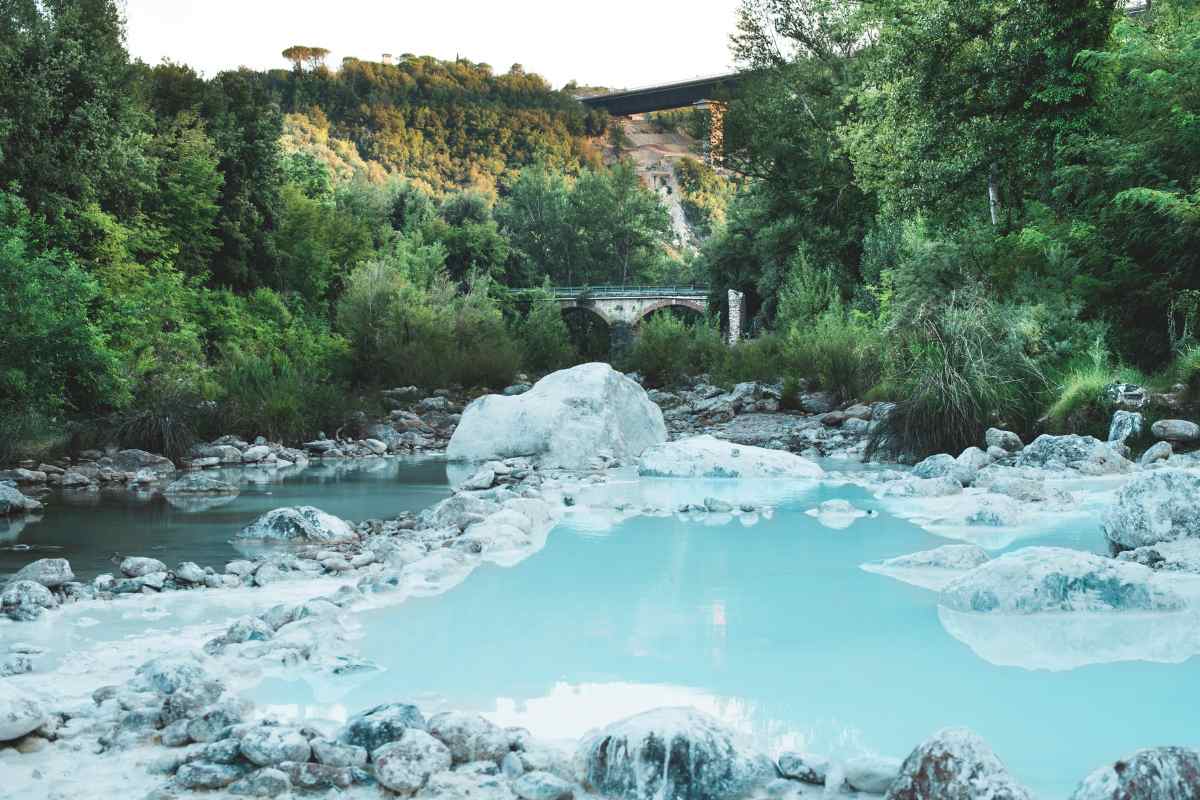
There are places that history has consistently frequented, leaving visible traces. The Petriolo Baths, immersed in the Basso Merse Nature Reserve, are one of these: Cicero mentioned them, the Medici family loved them, and even today the medieval walls surrounding the main spring remain standing as evidence of centuries of human attendance.
The waters flow at 43°C and collect in small natural pools along the Farma stream, offering the possibility of practicing the so-called contrast therapy: a hot bath in the thermal pools, then a dip in the fresh water of the river. An extraordinary benefit for circulation. The high concentration of sulfur makes them particularly suitable for respiratory and skin disorders. For a more intimate and less crowded experience, it is advisable to visit them during the week or in the evening hours, perhaps bringing candles to transform the atmosphere into something truly memorable.
Le Caldane di Gracciano, Val d’Elsa, Tuscany
Little known to the general public – and therefore still intact in their silence – the Caldane di Gracciano, near Colle Val d’Elsa, are one of those discoveries that are jealously guarded and shared only with the right people. The tanks date back to the Etruscan era, built over two thousand years ago in a bend in the stream, and the inhabitants of the area treat them as a living archaeological find.
The water here is cooler than other spas on the list — around 20°C — making them perfect for a refreshing dip in summer or a spring visit, when the Tuscan countryside is at its best. The tanks are surrounded by stone ruins, trees and woods, with the remains of an ancient mill nearby. Also known as Bagni di San Marziale, the waters are rich in calcium and historically used to treat skin disorders. An evening swim here, with the stars above the Val d’Elsa, is an experience that has very few equivalents in the world.
Lu Vurghe of Acquasanta Terme, Ascoli Piceno, Marche

Among the least known but most authentic spa places in Italy, the sulfur springs of Lu Vurghe, in Acquasanta Terme in the province of Ascoli Piceno, represent a discovery capable of surprising even the most astute travellers. The dialect name, which recalls the bubbling of water emerging from the earth, already says it all: here nature doesn’t pose, it just acts.
The water flows in the hamlet of Santa Maria di Acquasanta at around 30 degrees, rich in calcium, sodium, iodides and bicarbonates – a precious mineral composition for the skin and for the general well-being of the body. Thanks to a recent redevelopment project, the site now has actual tanks, which make diving more comfortable without distorting the wild character of the place. Nature looms green and silent, and the sense of isolation from the world is total.
It is not a place for those looking for comfort. The route requires a minimum of walking on irregular paths, not recommended for those with walking difficulties or traveling with strollers. But this small sacrifice is an integral part of the experience: you arrive sweaty, you immerse yourself, you leave rejuvenated. A ritual that the Romans knew well – traveling along the Via Salaria, they stopped right here to heal and regain their strength. Access is free.
The Bullicame Baths, Viterbo, Lazio

Dante Alighieri immortalized them in the Divine Comedy, and this is enough to understand that it is not just any place. The Bullicame thermal baths, on the outskirts of Viterbo, owe their name to the visible bubbling of the main source – a small crater in which the water bubbles to the surface, now protected by a plexiglass structure which allows for close observation.
The waters feed two pools, one large and one smaller, where it is possible to bathe for free. The site is managed by the Municipality, the surrounding lawn is cared for, parking is free. It is not a wild place like Petriolo or San Filippo: it is a neighborhood spa, frequented with affection by the people of Viterbo, authentic for this very reason. It is located on Strada Bulicame, about 2.5 km from the city center.
Leonardo’s Pool, Bormio, Valtellina

Who said that immersing yourself in warm water surrounded by snow is a privilege exclusive to Iceland or Norway? In Bormio, in the heart of Valtellina, there is Leonardo’s Pool – so called because Leonardo da Vinci mentioned it in his Codex Atlanticus, a sign that his fame was already consolidated in the fifteenth century.
The natural pool collects the waters that flow from the nearby and renowned Bagni Vecchi and Bagni Nuovi establishments, maintaining a temperature between 38 and 41°C. Around, the Alps. In winter, snow. Steam rising into the freezing air. It’s an image that competes on equal terms with any Icelandic postcard, with the advantage of being reachable by car along the road to the Stelvio Pass. You park after a small bridge over the stream and continue on foot for a few minutes along the waterway.
Because thermal Italy is still a secret
It is surprising that such a vast heritage is still relatively ignored, both by foreign tourists and by many Italians. The reason is probably cultural: we are used to looking far away to find the wonderful, forgetting that often it is enough to travel a few kilometers on the provincial road. These seven spa destinations have in common that they are completely or almost completely free, the beauty of the natural context, and a history that has its roots in ancient civilisations. They don’t require reservations, they don’t impose timetables, they don’t demand specific outfits. They only require a willingness to slow down, to immerse ourselves, in the most literal sense of the word, in something bigger and older than us.
