
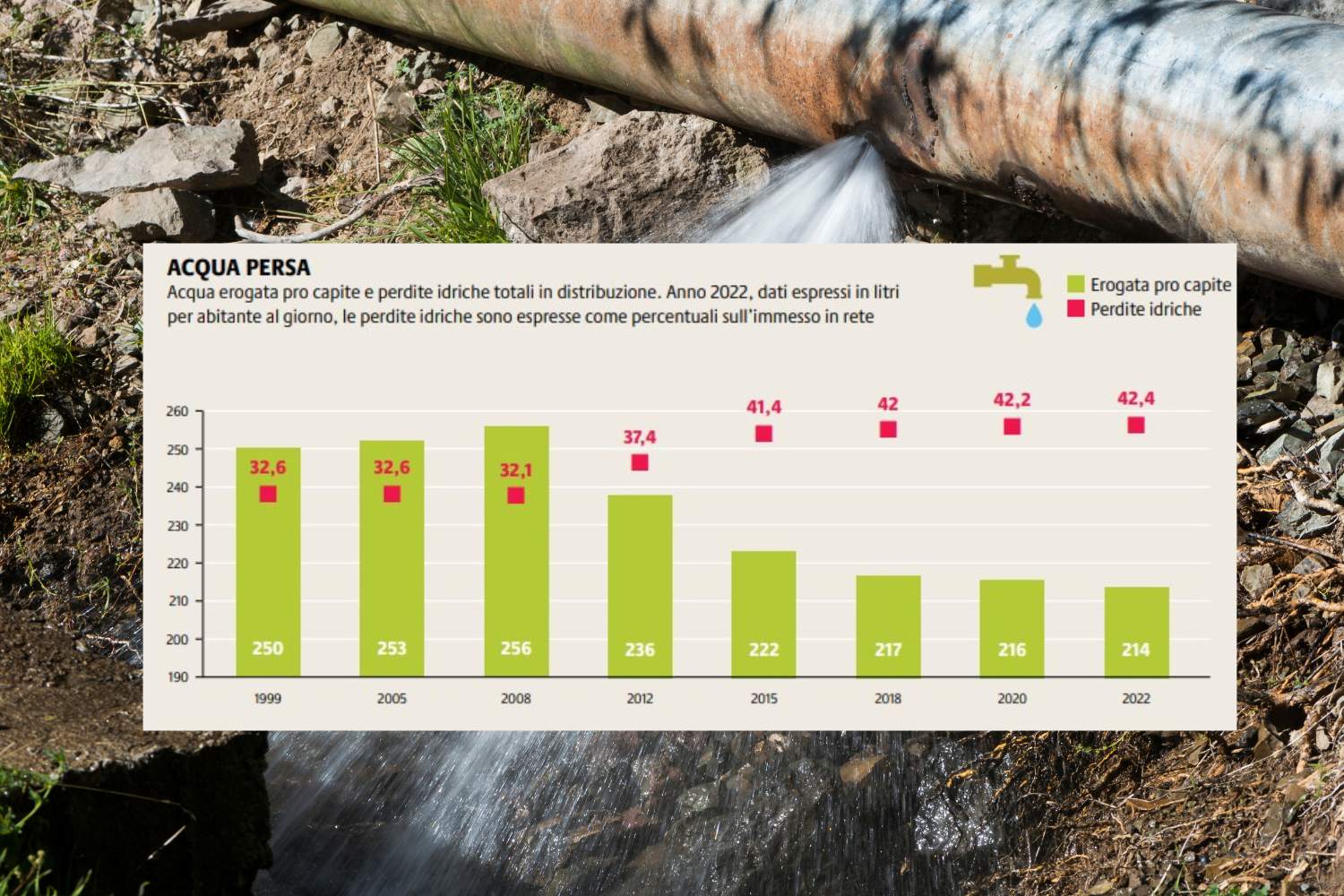
The Italian paradox is all in a leaky tap. While some virtuous countries are starting to count the drops, we are letting billions slip away. The data from the new Water Atlas 2026 tell us that Italy is among the European nations that withdraw the most drinking water (155 cubic meters per year per inhabitant) and, at the same time, one of those that throws away the most. To be precise, 42.4% of the resource vanishes before even reaching our homes. A record that borders on the absurd in the South, with flaws that swallow up 60% of flows (the EU average is 25%).
Data is thirsty
Water leaks are part of the problem; the other half of the flaw lies in the servers that power our digital lives. Our water footprint is not only linked to meat or long showers, but also to our smartphone. To make one you need 12,000 liters of water. Artificial intelligence, then, is a thirsty machine: by 2027, global AI systems could consume six times as much water as the whole of Denmark. Every time we query an algorithm, we are asking the Planet for a water sacrifice that we had not foreseen. The average data center drinks a million liters a day.
Glaciers in red and the Po holding its breath
While we waste on the plains, our “safe” at altitude is melting. Between 2000 and 2023, the glaciers of the Alps and Pyrenees lost 39% of their mass. If the mountain no longer holds snow, the rivers remain alone. The Po must alone support 75% of its district’s irrigation withdrawals as it fights against microplastics and chemical pollution. A criticality of the water cycle that puts 24% of the Italian population living along its banks at risk.
PFAS and poisons: the water we don’t want
The remaining water, then, is not always a gift. The shadow of PFAS — the eternal chemicals that never disappear — stretches across vast territories. The Veneto case, with 350,000 people exposed, is the tip of the iceberg of a contamination that travels in the blood, placenta and breast milk. Yet, instead of investing in reclamation and purification (where only 56% of our waste water is treated according to standards), we prefer to pay heavy fines to Europe for our non-compliance.
Beyond concrete: cities that know how to absorb
Is there an alternative to the “sieve model”? Some neighbors are showing us the route. The Netherlands has stopped considering rain an enemy. Their “sponge cities” are made to retain, filter and reuse. In Germany, integrated management has reduced losses by investing over 110 euros per inhabitant per year in preventive maintenance, using acoustic and satellite sensors that identify micro-leaks before they become a sinkhole.
A construction site called the future
Fixing the “leaky bucket” is the country’s greatest opportunity for innovation. It means opening intelligent construction sites, digitizing networks and bringing agriculture towards an efficiency that technology already allows today. Transparency from the tech industry and modern infrastructures are the insurance for an Italy that wants to continue producing and growing. The technology is there, the models too.
