
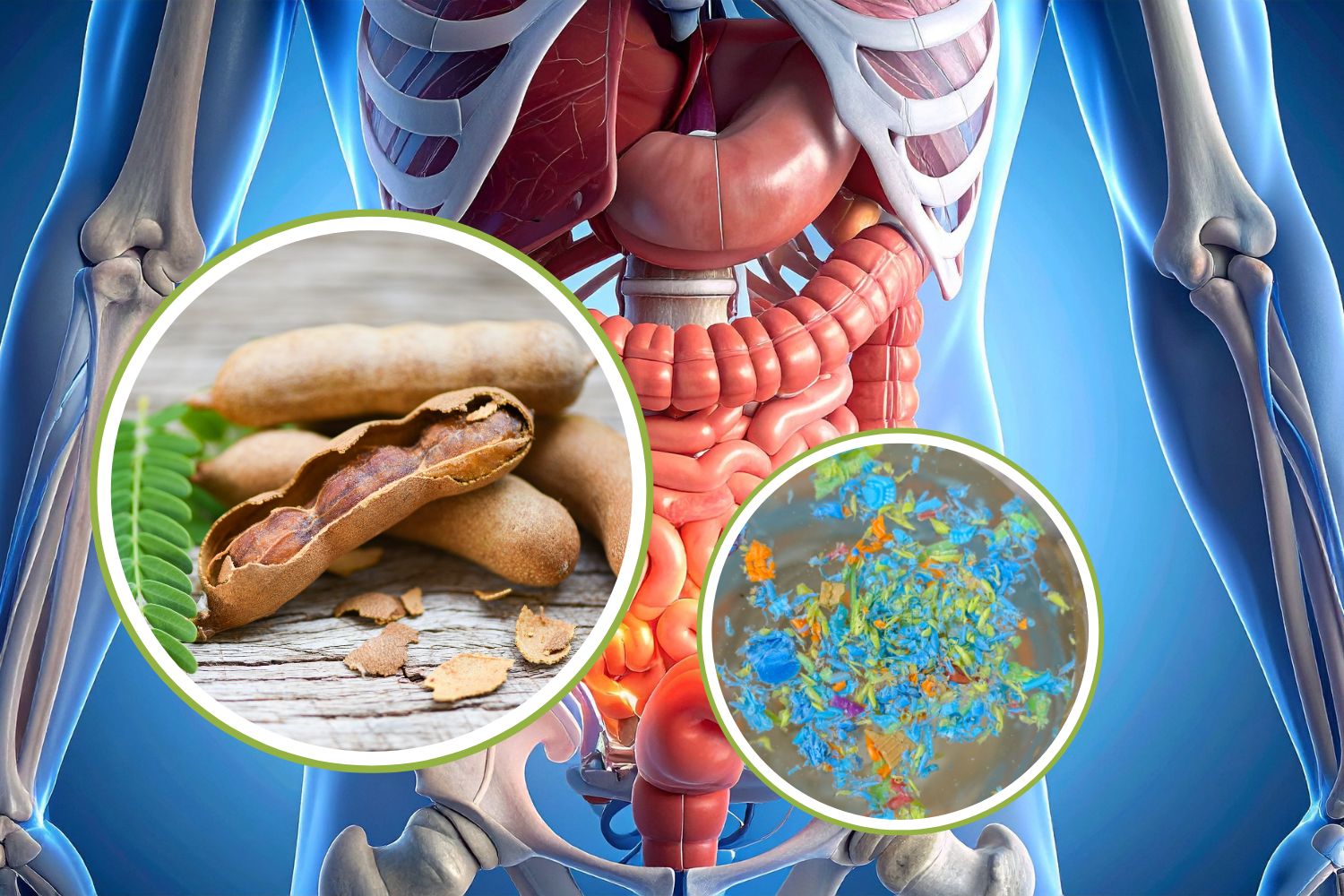
For a few years, microplastics have stopped being just an environmental problem to transform into a concrete presence inside the human body. We find them in the water we drink, in the air we breathe and, as various research shows, also in the blood, organs and even the brain.
This scenario has pushed the scientific community to look for new, possibly natural, solutions capable of intervening on an accumulation that our body struggles to manage. In this context, interest in tamarind takes shape, an ancient fruit, rooted in the food tradition of many regions of the world, which today enters a completely different conversation.
Tamarind and microplastics: how seeds can capture particles
The most interesting aspect concerns the tamarind seeds, often overlooked compared to the pulp, but rich in substances that are showing surprising behavior in the laboratory. Researchers have identified polysaccharides inside them, i.e. natural polymers capable of interacting with microplastics. This encounter generates a precise effect: the particles, normally dispersed and invisible, tend to aggregate, becoming larger and therefore easier to intercept and eliminate.
This process, initially observed in aquatic systems, changes perspective on the problem. Microplastics are difficult to manage precisely because they remain isolated and light, free to move in fluids. However, when they are “captured” by these natural structures, they lose part of their mobility and can be treated more effectively. It is a dynamic that has already shown promising results in water purification, where similar plant extracts manage to significantly reduce the presence of plastic particles.
The next step is the one that is most intriguing today: understanding whether the same principle can also work within the human body. Here the matter becomes more delicate, because complex biological variables come into play.
What the tamarind study observed
A study conducted in Texas tried to bring this intuition into a controlled experimental context. Researchers analyzed the effect of some plant extracts, including tamarind, to verify their ability to interact with microplastics in biological systems.
Available studies have focused on aquatic systems and laboratory conditions, where tamarind compounds have demonstrated the ability to bind microplastics. The hypothesis that the same mechanism can also work in the human body currently remains a possibility yet to be verified.
This observation suggests a possible mechanism: the compounds present in tamarind could help the body to “collect” the dispersed particles and facilitate their expulsion. This is a crucial step, because one of the main current limitations is the body’s inability to efficiently free itself from these substances. Microplastics, due to their size and characteristics, manage to insinuate themselves into tissues and remain there for a long time, making any natural elimination process complex.
At the same time, it is important to keep a clear eye on the results. The research is still in an initial phase and moves within laboratory conditions, where every variable is precisely controlled. This means that the transition to a concrete application requires further studies, checks and confirmations. We need to understand which quantities are effective, how replicable the observed effect is on a large scale and what the implications may be in the long term.
In the meantime, the value of this discovery lies above all in having opened a path. The fact that compounds of plant origin can interact with microplastics introduces a new perspective, closer to sustainable solutions compatible with the human body. Tamarind, from a daily food in many cultures, thus becomes the subject of research that combines environment, health and innovation.
The topic of microplastics will continue to grow in the coming years, accompanying the transformations in our relationship with plastic and ecosystems. In this scenario, every clue that suggests a possible way out acquires an important specific weight. The tamarind enters this narrative on tiptoe, with data still to be consolidated, but with a potential that deserves attention.
You might also be interested in:
