
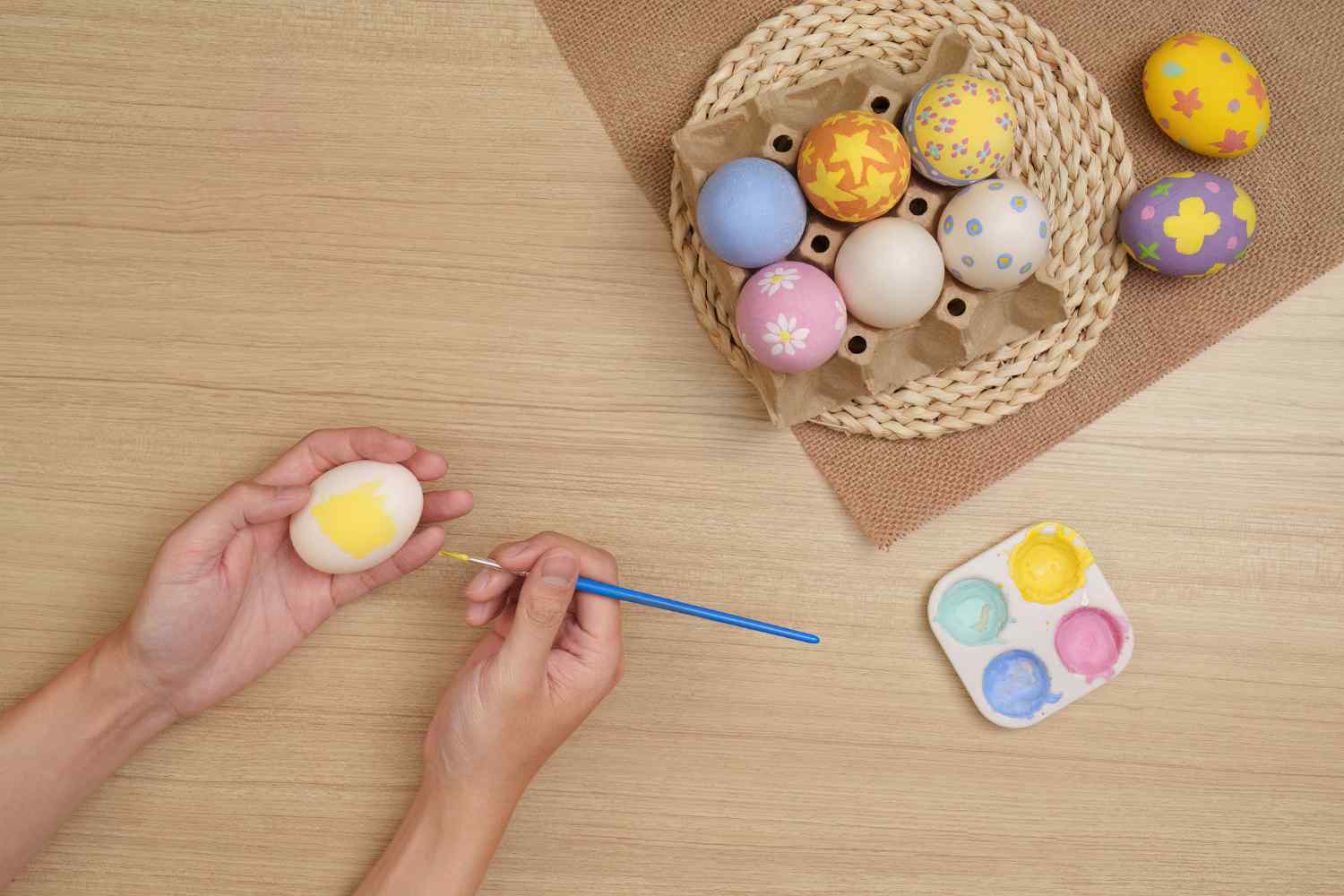
Coloring eggs in a natural way, with the right techniques and dyes, allows you to consume them without problems and without waste if you decide to choose hard-boiled eggs. Are Easter eggs to color hard-boiled or hollow eggs? Both solutions are suitable. Bear in mind that hard-boiled eggs are more resistant than hollowed eggs.
How to empty and color eggs
If you decide to empty the eggs before coloring them, you can use them to prepare your Easter dishes and desserts. The ideal is to make the moment of coloring the eggs coincide with that of using them in the kitchen, so as to have fresh eggs available.
Emptying fresh eggs is very simple. You will need to have a syringe available to aspirate the contents through a small hole. Or you will have to make two holes, one at the top and one at the bottom, and then blow vigorously inside the eggs to free them of their contents, which you can use for your recipes.
You will therefore have eggs to color of which only the shell will remain. These are more fragile eggs than hard-boiled eggs, but you can try to color them using the same techniques that we will propose below to paint them directly on the surface with tempera and watercolors as in the case of inedible eggs. However, you will need maximum delicacy to avoid breaking the eggshells. Rinse the eggs and let them dry before coloring them. Here is more useful information.
How to prepare and color hard-boiled eggs
As for hard-boiled eggs, preparation and coloring can happen at the same time. In fact, the coloring of eggs occurs by adding some specific ingredients to the egg cooking water.
The most practical way to color hard-boiled eggs is to add a few drops of food coloring during boiling (the same colorings that are often used to decorate desserts). Food coloring is also good for coloring hard-boiled eggs by soaking them in cold colored water. Even better: turn to natural dyes to decorate your hard-boiled eggs.
The best process for coloring eggs naturally involves cutting two or three cups of your chosen fruit, vegetables or herbs into small pieces, then immersing them in a steel pan with a liter of water and bringing everything to the boil. Finally, add the eggs to the boiling water for 12 minutes until completely boiled. A good tip is to rub them with vinegar before cooking while immediately after dyeing them you can rub them with vegetable oil so that they are brighter.
You can add the following ingredients to the egg cooking water, in varying quantities depending on the number of eggs and the shades you would like to obtain, together with a teaspoon of vinegar to fix the color.
Yellow: saffron, turmeric or chamomile flowers
Green: spinach, parsley
Red and pink: cooked red beetroot, red cabbage, red tea, karkadè
Orange: onion peels, paprika
Brown: coffee, cocoa, black tea
Purple: grape juice, red wine
Blue: blueberry
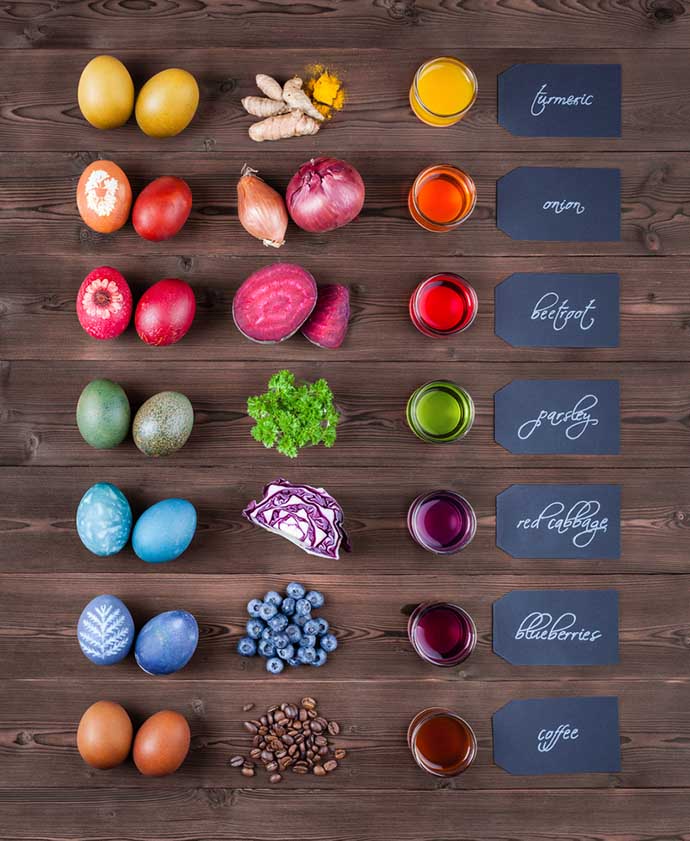
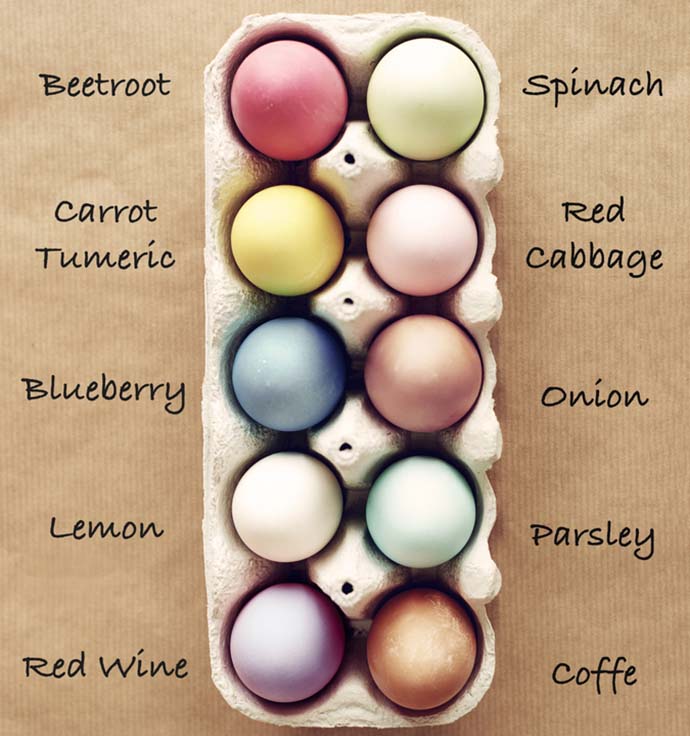
You can also create separate colors with the primary colors and then mix and obtain new colors, for example combining red and blue for purple, yellow and red for orange. Here is more useful information on natural colours.
If you want, you can for example with a leaf motif or with stripes. In this case you can put small leaves on the outside of the egg then insert it tightly into a sock and finally dip it in the color you prefer or wrap it in an elastic band and then put it in the color to create stripes.
All that remains is to use your imagination to create original decorations by covering parts of the egg with adhesive tape, rubber bands or other objects that you can easily find at home.
Times and doses for each natural dye
To obtain satisfactory results, quantities make the difference. For a liter of water and 4-6 eggs, here are the indicative doses to use when boiling or soaking:
In all cases, add a spoonful of white vinegar to better fix the color on the shell.
Intense or pastel colors: how to adjust
The secret lies in the contact time between the egg and the dye. To obtain delicate, pastel shades, simply immerse the eggs in the dye solution for 15-30 minutes at room temperature. If instead you want saturated and deep colors, leave them to soak in the refrigerator overnight, even 8-12 hours. Another factor is the concentration of the liquid: doubling the quantity of natural dye for the same amount of water produces significantly more intense colours. The quality of the shell also applies: white eggs absorb colors more evenly and vividly than brown eggs, which tend to give warmer, earthier shades.
How to color and decorate inedible eggs
If you don’t usually consume eggs, you can still make egg-shaped Easter decorations from inedible eggs. These are special eggs to decorate which can be made of polystyrene, wood or other materials.
In the case of synthetic eggs that will have a simple decorative purpose, you can choose the colors and materials you prefer for coloring. You could, for example, decide to cover the eggs with scraps of fabric or tissue paper, paint them with watercolors or tempera, or decorate them with the decoupage technique.
View this post on Instagram
There really is no limit to the imagination. In the case of inedible eggs, in fact, you can also resort to the use of ecological glues and small decorations, such as glitter, beads, buttons and ribbons.
How to store colored eggs
Once coloured, hard-boiled eggs can be stored in the refrigerator for up to 7 days, preferably stored in an airtight container or in their original carton to prevent them from absorbing the odors of other foods. It is important not to leave them at room temperature for more than two hours, especially if the house is heated. If you have used natural dyes, keep in mind that the colors may fade slightly over the days: this is completely normal. Emptied eggs, on the other hand, can be stored practically indefinitely in a dry place away from light, as long as the shell is intact.
What are your methods and tricks for decorating and coloring eggs?
You might also be interested in:
