
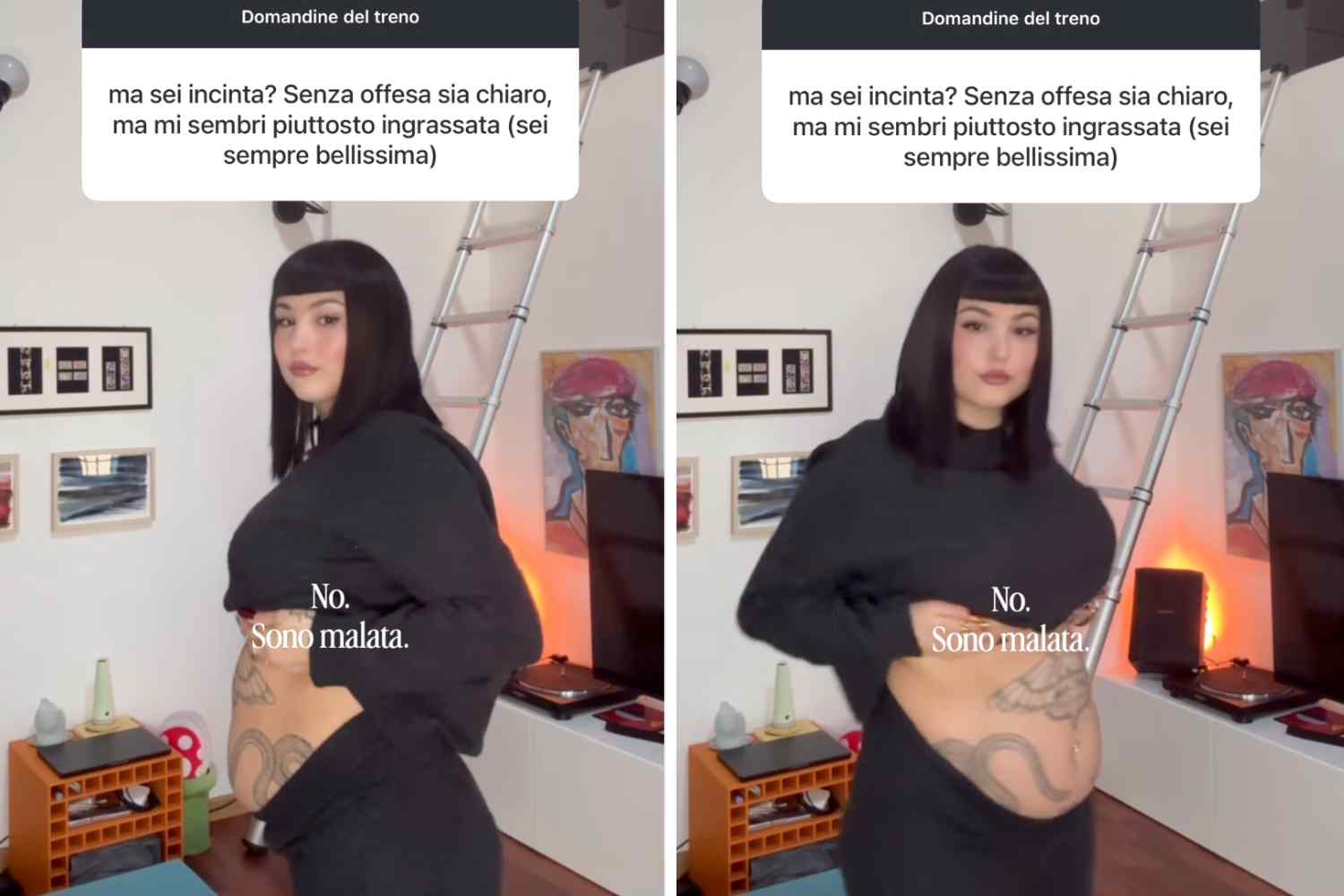
One photo, a thousand wrong questions
It takes courage to show off your body when you already know how it will be interpreted. Giorgia Soleri knows this well: she published a video in which she shows her swollen belly, and above it she put one of the questions she receives every day — “are you pregnant?” — chosen at random from the hundreds of similar ones that have been coming to her online and offline for years. The answer is no, it’s not pregnancy. It’s endometriosis.
What is endobelly
That abdominal swelling has a precise name: endobellyliterally “endometriosis belly”. It is one of the most visible and most misunderstood symptoms of a disease that has affected 1,800,000 women in Italy, yet remains little known and very little discussed.
March is endometriosis awareness month, and Soleri has chosen this moment to remember it with a concrete gesture: showing one’s body and explaining what those who see it are really looking at.
One of the hardest data that Soleri cites is that of diagnostic delay: on average, a woman with endometriosis waits ten years before receiving a correct diagnosis. In the meantime, he goes from doctor to doctor being told that the pain is normal, that it is anxiety, that he is exaggerating. She is labeled hysterical, a liar, a hypochondriac, anxious.
It’s not a rare or unfortunate story: it’s the norm. And it has precise causes, the poor training of health professionals on the disease, the historical tendency to underestimate female pain, the lack of biomarkers that allow a non-invasive diagnosis. The only way to confirm endometriosis today is still, in most cases, laparoscopic surgery.
The weight of a wrong question
This isn’t just a misunderstanding. Soleri underlines how much that seemingly harmless question can hurt: for those who are trying to get pregnant that doesn’t happen, for those who live with infertility or sub-fertility linked to the disease (estimated between 40 and 50% of cases), being asked “are you pregnant?” it can break something.
Added to this is the daily struggle of inhabiting a body that changes due to illness and therapies, with minimal margins of control, under an external gaze that judges and still expects an effort to be presentable.
«I don’t want to be beautiful. I want to be cured”
The most powerful part of his outburst is also the most direct. Soleri writes that she is not interested in being beautiful. She wants to be heard, believed, cared for. It wants to be seen by the healthcare system and protected by the institutions. He wants more research, more training, a cure.
And she wants the next women with endometriosis not to have to wait an average of ten years to receive a diagnosis, after being labeled crazy, anxious, liars, hysterical all along the way.
What Soleri does, showing her belly, naming the symptoms, talking about the therapies, is not simply personal sharing. It is an act of visibility in a field where invisibility has done enormous damage for decades. Every time an illness is silenced, normalized or ridiculed, those who suffer from it learn to do so in silence.
And silence delays diagnoses, discourages research, leaves people alone. The body of a woman with endometriosis is already a daily battlefield. Making it public, with all that it entails in terms of looks, judgments and wrong questions, is a costly choice. And that’s exactly why it’s worth something.
A voice in a void that is still too big
Soleri is no stranger to this type of denunciation: in recent years she has become one of the most recognizable voices in Italy on the topic, using social media to transform her experience into a tool for raising awareness. The point, however, is not her: it is that in 2026 we still need someone who shows their belly on Instagram to remember that a chronic, disabling and widespread disease exists.
View this post on Instagram
