
Biodiversity continues to tell stories that escape official maps and scientific catalogues, especially in territories that we consider “already explored”. Australia, with its harsh and stratified landscapes, still houses animals capable of surprising even those who have studied fauna all their lives. And it is precisely from here that a discovery comes that has the flavor of things left under everyone’s eyes without actually being seen.
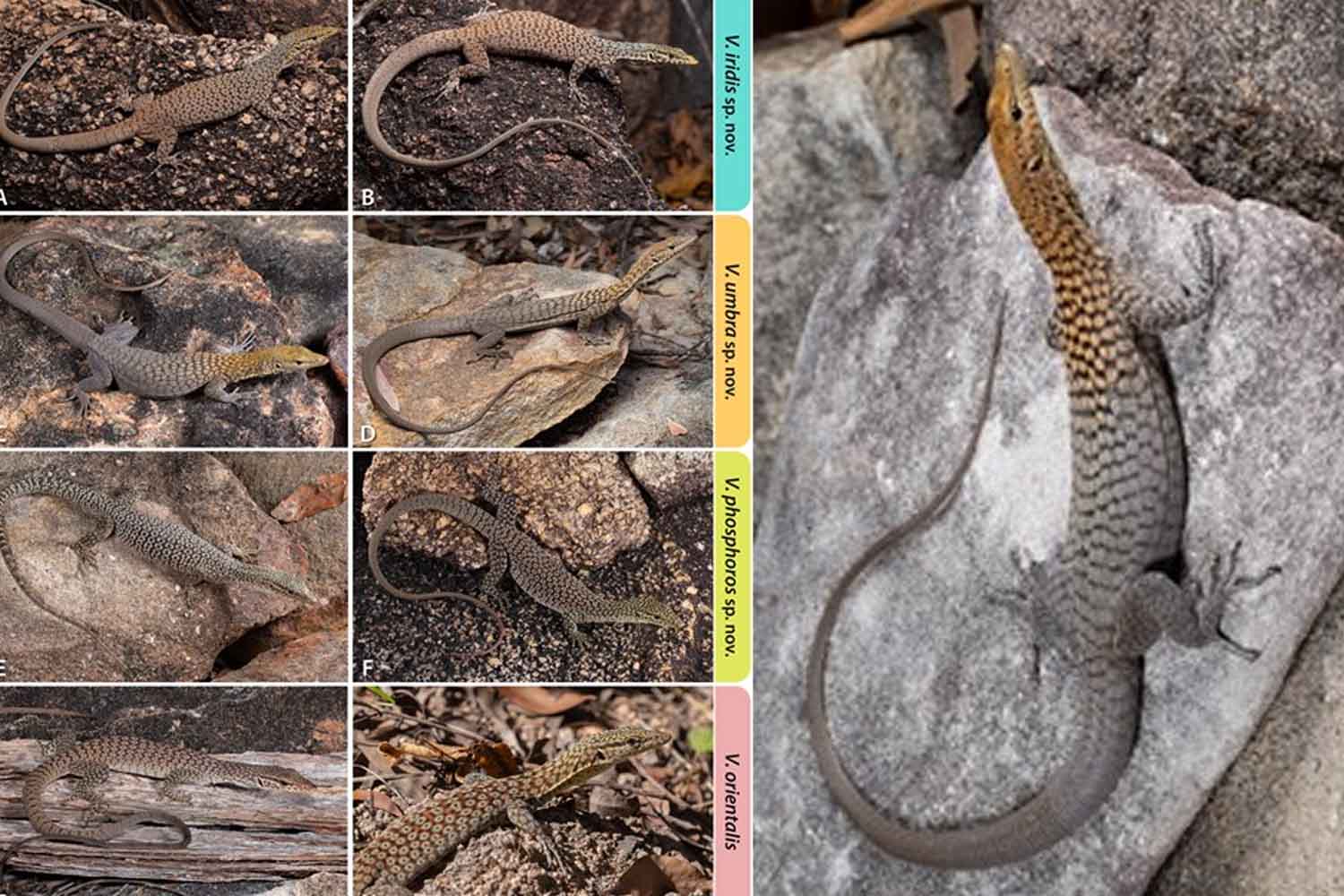
The most surprising protagonist is the Varanus umbra, a rock monitor never described before, recognizable by its intense orange head which makes it almost unreal in the light of the savannah. It was identified by the team led by Stephen Zozaya, a researcher from the Australian National University, during an expedition in northern Queensland.
The first encounter with this reptile had something disorienting. Zozaya said he struggled to place it among the already known species. Those shapes, those colors, that evident presence seemed out of place compared to everything that had already been classified. Yet some images were already circulating online, shared by enthusiasts and local observers who had intuited the uniqueness of the animal without having the tools to prove it.
Alongside the Varanus umbra, the expedition brought to light two other species: the Varanus phosphorus, with a bright yellow head, and the Varanus iridis, which shades in almost iridescent shades. Three large reptiles, visually distinct, remained for years in a sort of limbo between intuition and confirmation.
When genetics confirms what the eyes had already intuited
For a long time these monitors were considered simple local variants of already known species. A difference in color, a nuance linked to the environment, nothing that could justify a new classification. Then the genetic samples arrived, and with them a clearer truth: the differences between these populations are profound, greater than those that separate already recognized species.
This genetic distance has completely changed the perspective, transforming those isolated observations into a real scientific discovery. A passage that also tells something broader, because it highlights a delay in research compared to those who live and observe those territories every day.
The areas in which these monitor lizards have been documented speak of isolation, difficulty of access, landscapes unsuitable for human intervention. Areas considered marginal, unsuitable for breeding and difficult to cross, which have functioned as a sort of natural barrier, leaving these species far from systematic studies.
Within this story there is also a concrete fragility. Varanus phosphorus is already involved in the illegal trafficking of exotic animals, a trend that continues to affect reptiles around the world. A silent pressure that moves fast, often faster than the search itself.
This discovery opens a window on a fact that remains difficult to ignore: the dry savannas of Queensland receive less attention than the rainforests, yet they preserve a biodiversity that is yet to be told. Even large, visible, present animals manage to stay off the radar for years, as if it were enough to look at them without actually recognizing them.
You might also be interested in:
