
The salt is not noticeable, yet it is everywhere. On the edge of the pan, inside ready-made sauces, in supermarket sauces that save time but don’t save sodium. The palate gets used to it without realizing it, the threshold of perception rises and the hand goes almost by itself towards the salt shaker. It is an automatic, silent mechanism that is difficult to reverse.
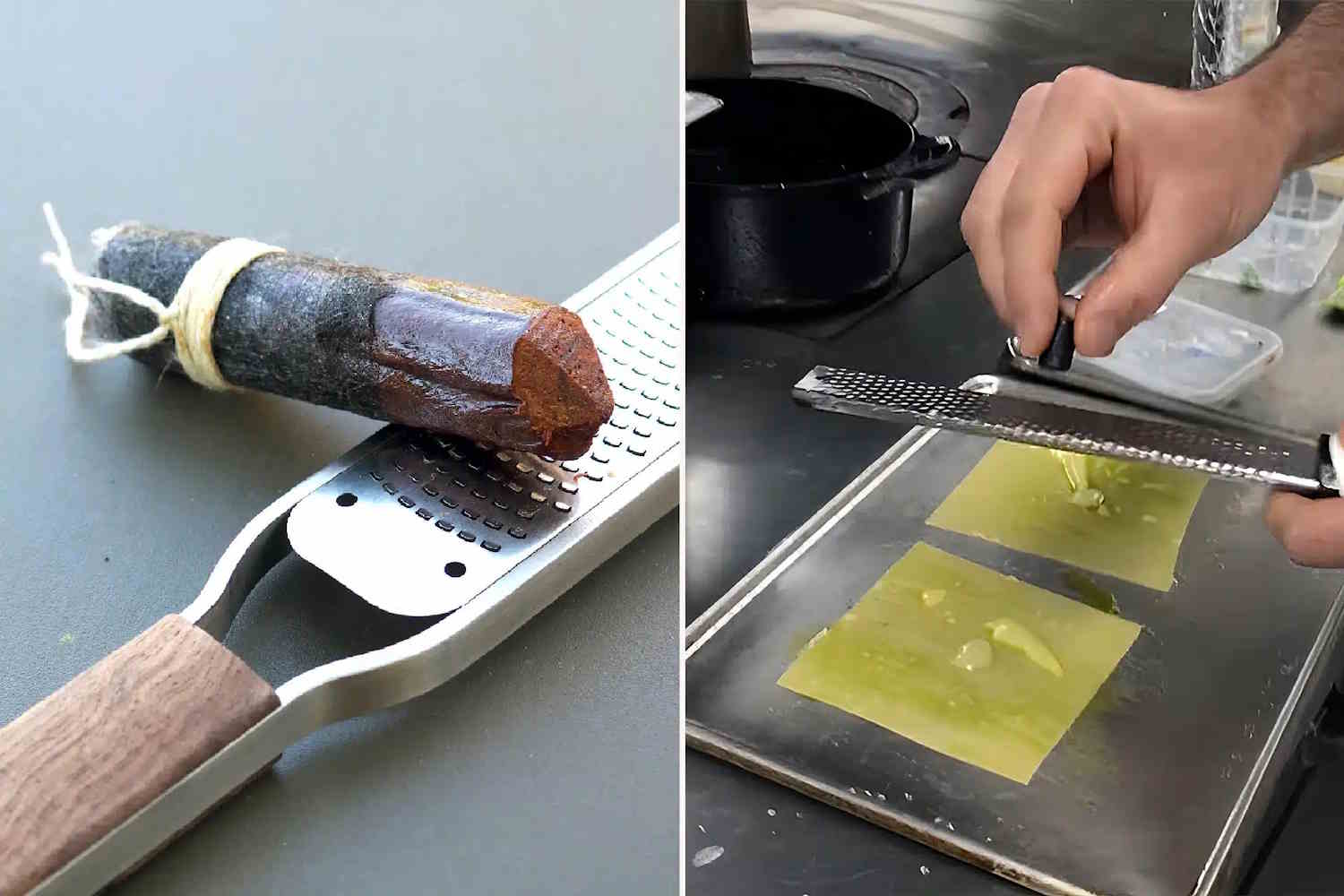
Yet someone tried, and not starting from a pharmaceutical laboratory or a wellness startup, but from a starred kitchen. Glenn Viel, chef with three Michelin stars at the L’Oustau de Baumanière restaurant in Provence, has developed a solid-state condiment that is grated directly on the plate, as if it were a truffle or a piece of mature parmesan. He called it “caillou”, which in French simply means “pebble”, and the name already says it all about its appearance: a small, hard, compact stone, dense with concentrated flavour.
How stone seasoning is born
The process behind Viel’s caillou has nothing mystical about it, but it requires time and a certain obstinacy. We start with real ingredients – celery, mushrooms, shellfish, meat – which are pressed and processed until dense, concentrated juices are obtained, with an already well-defined personality. That liquid part is then subjected to extensive dehydration, in order to eliminate all the water and leave only what matters: the aromatic complexity of the ingredient, its natural mineral salts, its purest gustatory identity.
The end result is a hard, almost opaque solid that doesn’t look like anything you’d normally find in the pantry. Grated on a plate, it releases a fine, fragrant, intense powder. A minimal amount is enough to change the perception of a bite, to give it depth without flattening it under a single dominant flavour.
The difference compared to traditional salt lies right here: each version of caillou brings with it a different story. The celery one adds freshness and an almost herbaceous green note. The mushroom one introduces an earthy depth, almost pure umami. The shellfish version gives a marine vibration that completely transforms the context of the dish. It is not a substitute for salt in the technical sense of the term, but an autonomous condiment, with its own voice.
Exploiting the mineral salts already present in foods, concentrating them instead of adding them from the outside: this is the principle that guides Viel’s project. An idea that actually overturns the way we normally think about flavor, which is almost always treated as something to add rather than something to take out.
Inside the everyday kitchen
The most interesting aspect of this invention does not only concern haute cuisine, which has its tools, its times and its rituals. It also concerns those who cook at home, between meetings and laundry to do, without the pretense of transforming Sunday lunch into a gastronomic experience to be reviewed.
Bringing a seasoning like this into a domestic kitchen means making a small change of perspective: instead of seasoning out of habit, you season it with intention. You choose what flavor to give to a plate of pasta, to a fish fillet, to some baked vegetables. The physical gesture remains simple, but the result has a personality that table salt rarely achieves on its own.
There is also an impact on the general perception of taste. Those who stop covering everything with the same flavor begin to better distinguish the nuances of what they eat, to recognize the difference between a ripe tomato and one picked early, between a fruity oil and a more bitter one. The palate, in some way, re-educates itself, or rather, recovers a sensitivity that the excess sodium had somewhat put to sleep.
Glenn Viel did not invent the concentration of flavors: it is a technique that has existed for centuries in many culinary traditions, from restricted broth to miso pastes. However, it has found a new form, a new format that makes that ancient principle accessible and applicable even outside professional contexts. A pebble in the kitchen, small and dense, which weighs much more than it seems.
You might also be interested in:
