
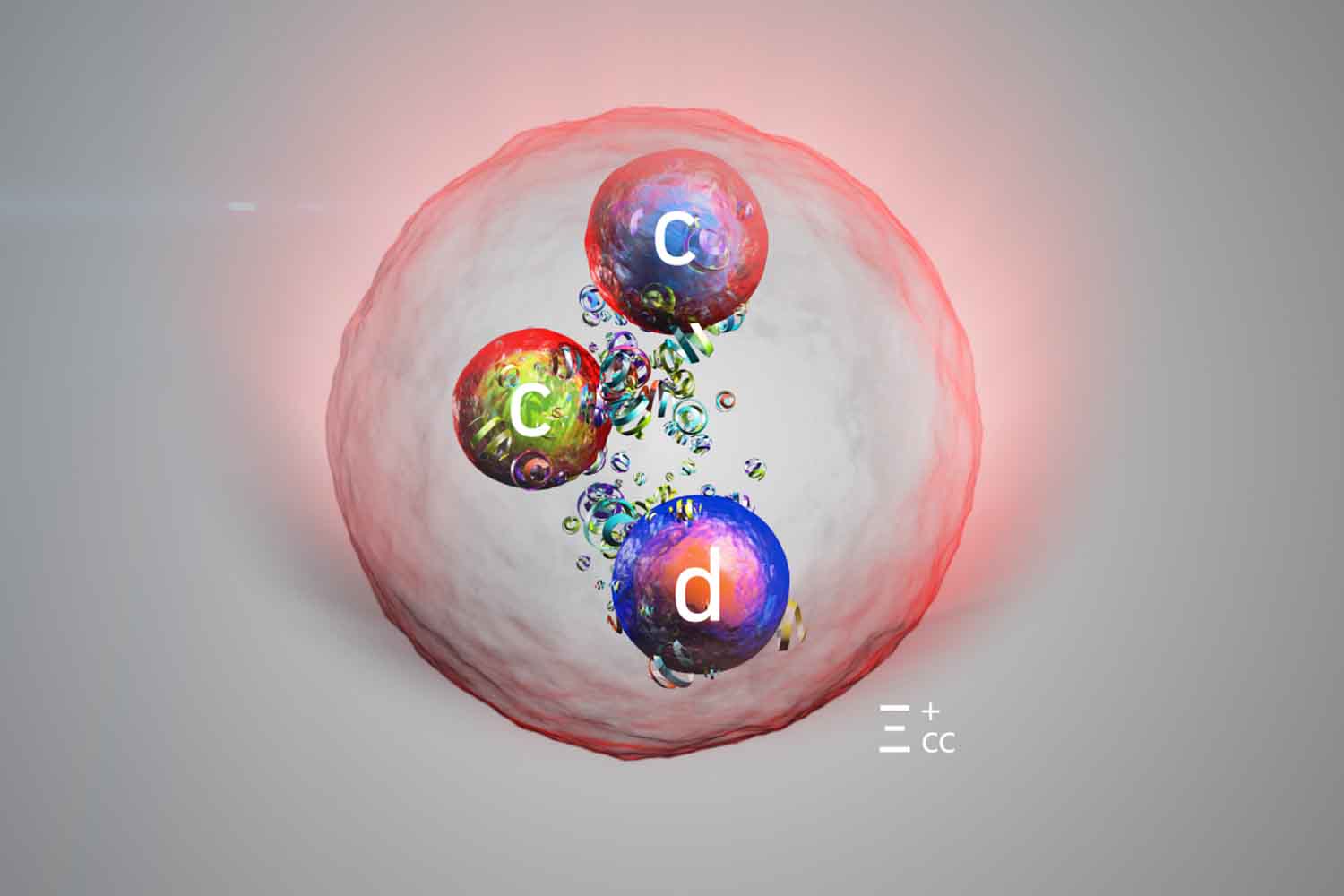
The matter seems stable, compact, almost obvious. Tables, bodies, air: everything appears solid, continuous, reliable. Then we go below the surface, into the invisible level of particles, and that balance begins to show all its fragility. That’s where the CERN of Geneva, has identified a new subatomic particle called Xi-cc-plusa tiny and very rare object that adds an important piece to the understanding of how matter really works.
The discovery comes from Large Hadron Colliderthe largest particle accelerator in existence. Here, protons launched at very high speeds collide with each other, generating a shower of fragments. Among those fragments, for an infinitesimal time, the Xi-cc-plus also appeared.
Inside the giant accelerator at CERN
The Large Hadron Collider it is a 27 kilometer long underground ring, built to study the deepest structure of matter. When particles collide at very high energies, the energy is transformed into new matter, just as happened immediately after the Big Bang. Under these conditions, unstable particles emerge, existing for only a fraction of a second and then disappearing.
The Xi-cc-plus was observed just like that, in collision debris. Researchers do not see it directly, but reconstruct its presence by analyzing what it leaves behind when it disintegrates. It is a work of extreme precision, made up of traces, signals and reconstructions.
What made this discovery possible was LHCbone of CERN’s experiments, recently updated to improve the ability to analyze huge amounts of data. Thanks to this update, the particle was clearly identified.
The Xi-cc-plus is similar to a proton, but contains heavier components
To understand what makes this particle special, we can start from a known element: the proton. It is one of the fundamental building blocks of atoms and is made up of three even smaller particles called quarks: two “up” and one “down”.
There Xi-cc-plus it maintains this three-quark structure, but changes two fundamental components. Instead of “up” quarks it contains two charm quarksmuch heavier. This makes it about four times more massive than a proton.
Its existence lasts very little, less than a millionth of a millionth of a second. Immediately afterwards it transforms into lighter particles. Despite this extremely short life, the Xi-cc-plus is very important because it allows scientists to better study the strong nuclear forcethe one that holds quarks together and, consequently, makes the very existence of atoms possible.
This discovery also completes a picture that began in 2017, when a very similar particle, the Xi-cc-plus-plus. The new particle was predicted by theory, but experimental confirmation was still missing. Now that prediction has been confirmed.
Each new particle observed at CERN does not change daily life immediately, but it makes the functioning of the world at a deeper level clearer. And when we understand better what holds matter together, the ability to explain phenomena that, until recently, remained only hypotheses also expands.
