
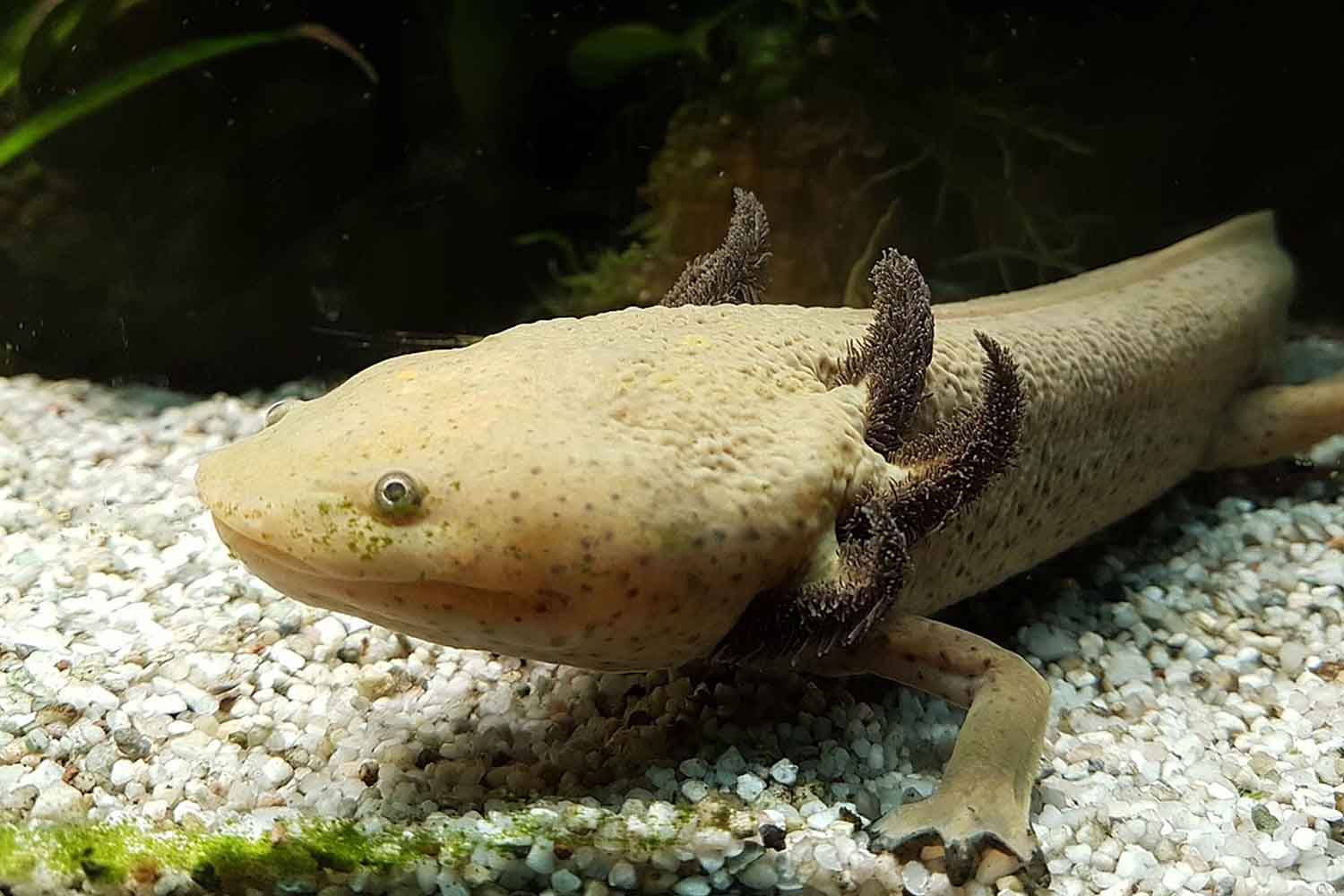
Behind a basilica in Pátzcuaro, in the Mexican state of Michoacán, there are tubs of cold water, hands accustomed to patience and an amphibian that seems to have come from a drawing too strange to belong to the real world. External gills, wide snout, larval body that decides to remain so forever. The resemblance to the axolotl is very strong, and in fact the confusion arises there. Except that in the Dominican convent the protagonist is above all the achoque, or salamander from Lake Pátzcuaro, a different species from the axolotl of Xochimilco and a very close relative of the same group of Mexican neotenic salamanders.
Overlay works great on social media, much less so when you’re trying to figure out what’s really going on. The most famous axolotl, Ambystoma mexicanum, has become a global pop icon, appearing in viral videos, in exotic pet shops, in laboratories all over the world. In nature, however, it still lives only in the wetland area of Xochimilco, on the outskirts of Mexico City, within a reduced ecosystem, polluted and attacked by urban expansion, invasive species and the progressive collapse of the old lake system.
The achoque, an amphibian that many mistake for an axolotl
For more than a century, in the monastery of the Virgen Inmaculada de la Salud, this animal was treated as raw material. The nuns raised the achoques to prepare a traditional syrup which was attributed with effects against coughs, asthma and anemia. That preparation, which for years sold for around 200 pesos a bottle, represented a concrete source of income for the convent. The uncomfortable part of the story lies here: before protection there was use, and before that there was the belief that a remedy could be obtained from that slimy and silent body.
Then the lake began to empty of life. Pollution, eutrophication, fishing and human pressure have caused the wild population of the achoque to collapse, now classified as critically endangered, with estimates of less than one hundred individuals remaining in the wild. In the 1980s that decline also forced the convent to change pace. Breeding, from a practice useful for the trade of the preparation, has slowly transformed into a form of captive conservation. The nuns continued to do what they knew how to do, except that the context was now different: no longer taking to transform, but rather keeping alive a species that the lake was losing.
Today that work intersects with research. The convent colony is considered one of the most important for the survival of the species and collaborates with the Universidad Michoacana de San Nicolás de Hidalgo and with international partners such as Chester Zoo. In a recent study, 28 of the 80 achoques microchipped to test an individual identification system came from the monastery. It is used to monitor animals, follow their health, understand age, survival, population dynamics. Translated: giving a few more chances to a species that risks disappearing without a sound in open water.
Xochimilco remains the place where the axolotl became a symbol
Here the other name returns, the one that everyone knows. The Xochimilco axolotl lives inside the canals and chinampas, the ancient agricultural plots built on the water in pre-Hispanic times. Those cultivated islands still have enormous ecological value today, because they can function as a refuge for native fauna when they are recovered with the right criteria. UNAM and other groups working on the Chinampa-Refugio project are trying to do just that: bringing together traditional agriculture, improved water quality and amphibian survival. The meaning is simple and very harsh at the same time: the axolotl can only be saved if its habitat is saved.
The scientific fascination, meanwhile, continues. The axolotl remains a larva throughout its life, retains external gills and has regenerative capabilities that have made it a valuable model for biomedical research. In Mesoamerican culture it already occupied a strong place: the Aztecs linked it to the myth of Xolotl and had inserted it into their imagination well before aquariums, cute videos and merchandising arrived. Today that fame produces an almost cruel paradox. The animal abounds in homes, shops, laboratories, while the wild population has reached the edge. Public worship alone does not make canal water clean.
This is why the story of the Dominican nuns of Pátzcuaro weighs more than it seems. It holds together two opposing movements, first exploitation and then protection, without pretending to be retroactive. And it tells us something very concrete: an animal can become fashionable, end up in memes, enter global trade, fill mouths with tenderness and still remain one step away from disappearing. Behind the windows of the convent, however, the matter has already taken a more adult form: there is water, work, memory. And an amphibian still trying to stay alive.
You might also be interested in:
