
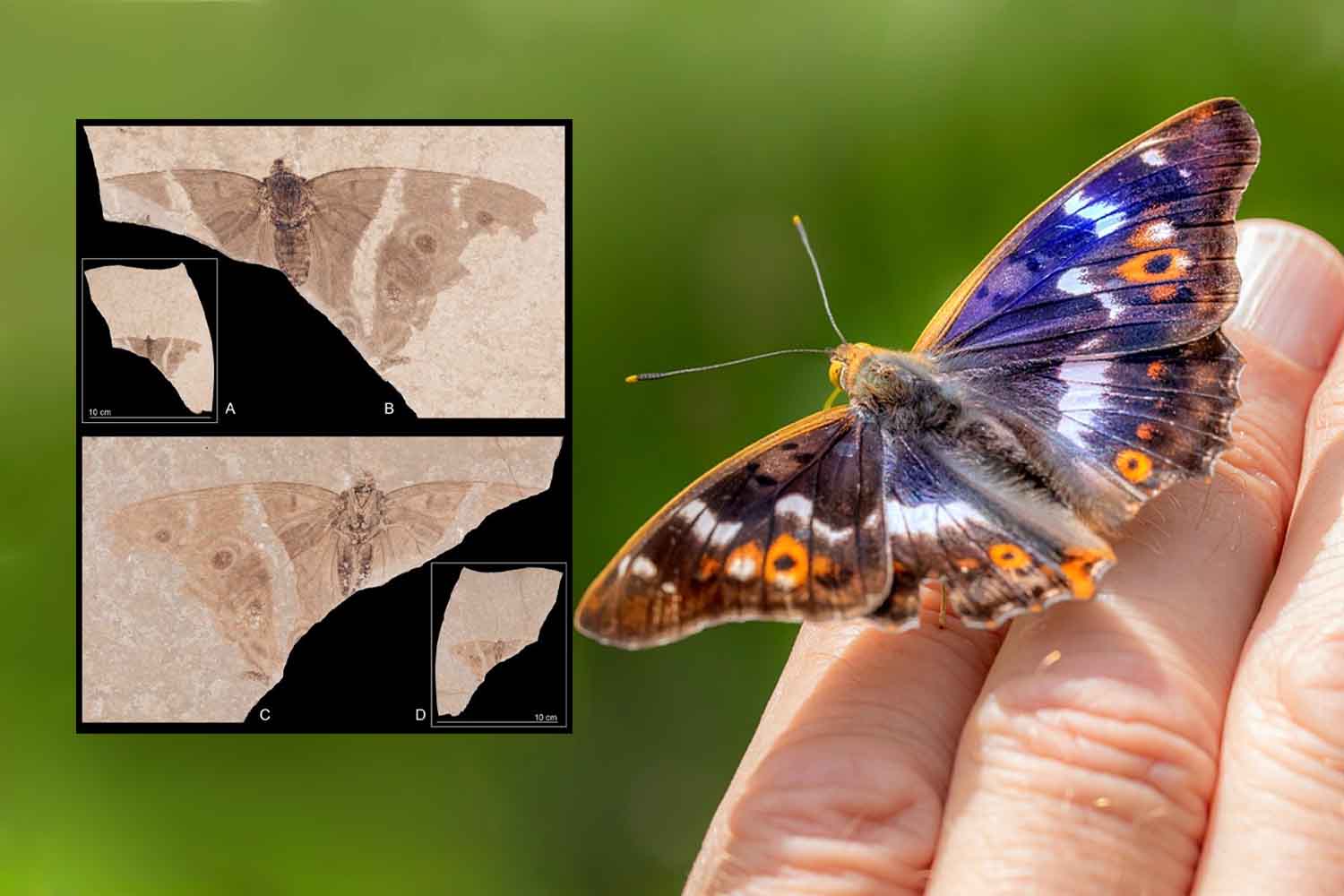
For years it was a slab among others, still inside a collection, with its stone silence and its geological time upon it. Then someone actually looked at her. From there, a butterfly re-emerged that lived in the Rupelian, between 33.9 and 28.4 million years ago, when in the Céreste area, in south-eastern France, there were shallow and calm lakes, with variable salinity, capable of retaining insects, plants, fish, birds and mammals in the sediments. Inside those very thin clay-limestone laminations, the so-called Papierschieferthis also remained imprinted emperor butterfly fossiltoday described as Apaturoides monikae.
The strength of the find lies entirely in the quality of conservation. The authors explain that you can see almost the entire right wings, a large part of the left front wing, the head without the complete antennae, the thorax and a good part of the abdomen. The plate preserves both the part and the counterpart, and this allows the insect’s body to be read from multiple sides, with rare precision for such fragile animals. The sample was collected by Herbert Lutz in 1979 in the Campagne-Calavon formation, today within the Luberon National Geological Reserve.
The dimensions also help to imagine her alive. Scientists estimate a wingspan of approximately 9 centimetres and a front wing length of approx 4.1 centimetres. Even a well-developed spirit horn, about 0.9 millimeters long, can be distinguished. Two eye spots appear on the front wings, three on the hind wings, with the classic light dot in the center and the outermost rings still legible. It is precisely that level of detail that makes the fossil so precious: here both the veining and part of the wing design remain visible.
Butterflies in fossil deposits are rare for a simple reason: they break, they degrade, they disappear. In the Lepidoptera fossil record many finds come from amber, therefore from very different contexts, and a recent revision mentioned in the paper drastically reduces the number of true butterfly fossils recognized with certainty. Within that framework, the Nymphalidae are already an important group; the Apaturinaehowever, until now they remained without a fossil that could be attributed with certainty. This example fills that void.
The similarity with some modern butterflies comes from the ocelli
At first glance the pattern of the wings may recall species of the genus Junoniain particular for the arrangement of the ocelli. The authors write it clearly. Then come the decisive differences: the position of some ribs, the origin of R1, that of CuA2, the general shape of the wings. There is a character that weighs more than the others, the presence of open wing cellsa feature that directs the fossil towards the Nymphalidae. From there the comparison with all the subfamilies leads to the most solid solution: the find is placed in the Apaturinae.
Scholars also explain why the name cannot simply be Apatura. The relationship is close, the venation brings it closer to modern emperor butterflies, yet the shape of the forewing remains different, with an angle of approximately 73 degrees between the internal and external margin, while in comparable Apatura species that structure changes significantly. The profile of the rear wing also follows its own path. This is where it comes from Apaturoidesa name created specifically to say “similar to Apatura” without forcing its insertion into a current genre. The epithet monikae pays homage to Monika Lutz-Scholz.
Today the Apaturinae include more than 80 species distributed in 22 genera, with an important presence in the Palearctic, in the Indo-Australian area, in Africa and in part of the Americas. They are the butterflies we call emperora name that brings with it an idea of grandeur and elegant flight. This fossil comes from a period of time that matters a lot to them. According to the molecular estimates referred to in the study, the subfamily would have separated from the Biblidinae approximately 47–52 million years agowhile the diversification towards modern genres would have begun around 33 million years ago. The age of Apaturoides monikae falls almost exactly there, close to that threshold.
An ancient line that today also serves as a calibration point
The value of the find, in fact, exceeds the description of a new species. In the work published on Acta Palaeontologica Polonicathe authors indicate it as a new direct fossil calibration point to reconstruct the evolutionary relationships and divergence times of emperor butterflies. In practice, this butterfly helps to put a marker in the group’s deep calendar. The paper also suggests a more precise hypothesis: Apaturoides monikae it could represent an extinct lineage close to the base of the Apatura clade, therefore an ancestral branch left out of the genera we know today.
Then there is an aspect that in these cases counts almost as much as the fossil. The artifact sat around for decades, then came in handy when the right question came along. It applies to protected deposits, it applies to museums, it applies to those collections that seem immobile and yet continue to work over the long time of science. This Oligocene butterfly remained locked in rock long enough to become an answer. And the answers that arrive after 34 million years usually weigh a lot.
