
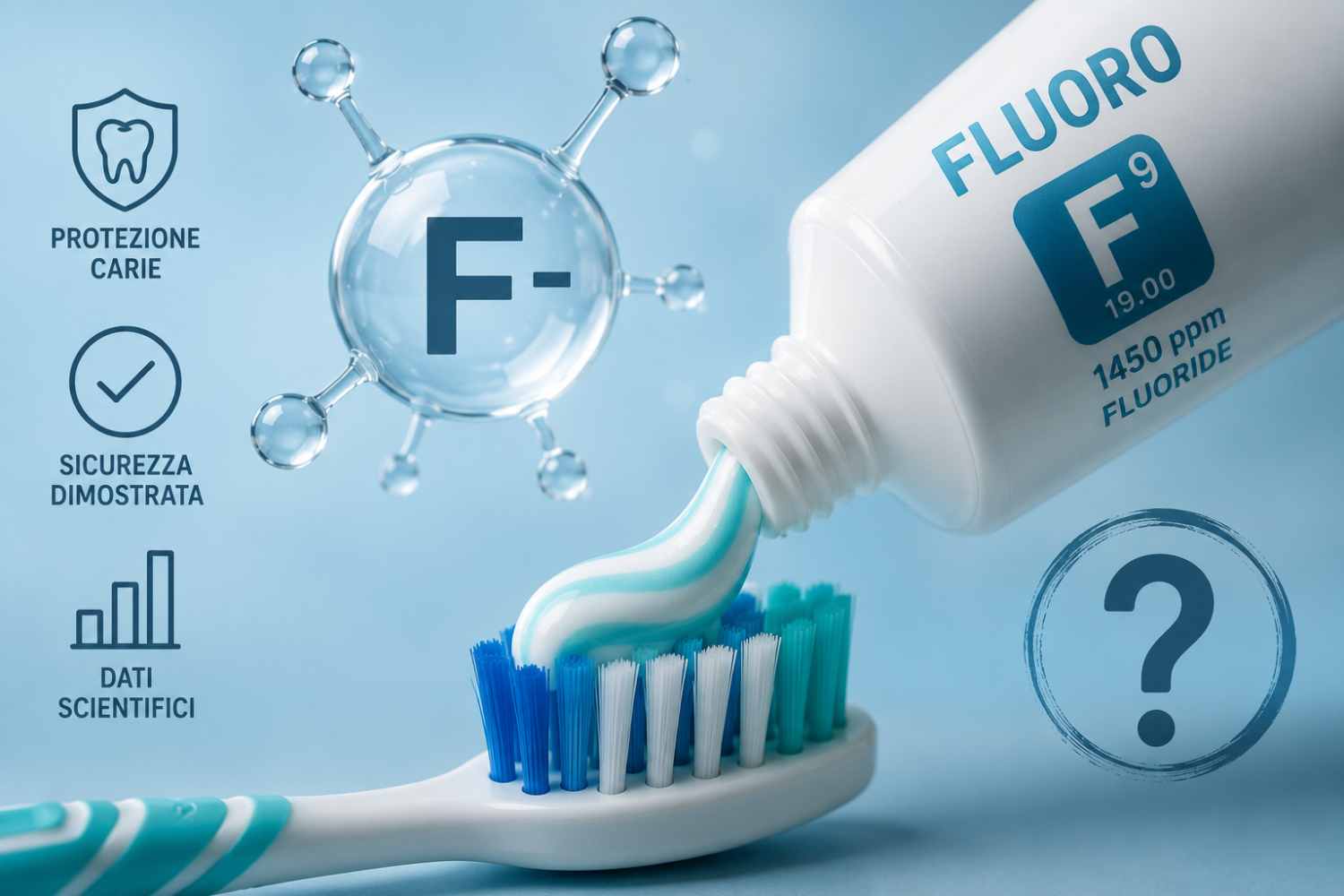
Approximately nine out of ten toothpastes sold in Europe contain fluoride, so the question arises spontaneously: why in recent years have the shelves of shops and supermarkets been filled with products that flaunt the word “fluoride-free” as if it were a guarantee mark?
The paradox is all here: the substance most studied and recommended by the dental community is also the one that marketing has transformed, in the eyes of many consumers, into an ingredient to avoid. If we were to search for “fluorine” on the internet we could easily come across alarming safety data sheets, because fluorine in its pure state is actually a reactive and corrosive gas.
The point is that the fluoride used in toothpastes is something else: they are fluorides, chemically stable compounds, just like the sodium chloride in table salt has nothing to do with gaseous chlorine. The confusion between the two forms is at the root of much of the alarm.
What the law says
In Europe, the quantity of fluoride in toothpastes is not left to chance, it is governed by the cosmetics regulation 1223/2009 which sets, in its Annex III, a maximum limit of 0.15% (1500 ppm), while there is no mandatory minimum, which is why products containing fluoride and products without it coexist on the market, without any regulation prohibiting it. In the tests conducted by Altroconsumo on the most popular toothpastes in Italy, the concentration of available fluoride was almost always between 1000 and 1500 ppm, the range that dentists and hygienists consider effective against tooth decay.
Tap water also often comes into play, usually inappropriately. In Italy, artificial fluoridation of water networks does not exist: Legislative Decree 18/2023, which transposes EU Directive 2020/2184, sets a parameter value of 1.5 mg per liter for fluoride naturally present in subsoil rocks, a threshold which in most Italian networks remains largely ignored by default.
The EFSA verdict
In July 2025, the European Food Safety Authority (EFSA) published the most up-to-date assessment of fluoride ever, based on the review of over twenty thousand scientific publications. The central conclusion is clear: for the levels found in Europe, overall exposure to fluoride remains below safety thresholds for almost the entire population, including correct use of toothpaste. Experts have also dismantled a very widespread fear, clarifying that brushing your teeth in the right way, spitting out the product instead of swallowing it, does not significantly increase total exposure. However, EFSA identifies an exception, and it concerns children between 4 and 8 years old, who if they systematically ingest toothpaste could develop mild fluorosis, i.e. discoloration of the enamel on the still forming molars. A risk which, the researchers themselves point out, is drastically reduced when the child learns to spit correctly.
Because dentists do not compromise on fluoride
The reason dentistry has never abandoned fluoride is all in the chemistry of enamel. Every time we eat, plaque bacteria produce acids that erode hydroxyapatite, the mineral that makes up our teeth. Fluorine inserts itself into that structure and converts it into fluorapatite, which is much more resistant to acid attacks. Natural alternatives exist, biomimetic hydroxyapatite in the lead, the fact is that none can yet boast a comparable amount of clinical evidence. For the little ones, where the risk of ingestion is real because the swallowing reflex is not yet mature, the guidelines of the Ministry of Health indicate the precise doses: a quantity equal to a grain of rice up to three years old, the size of a pea from three to six, always with an adult supervising the brushing phase.
The fact remains that, for anyone who uses toothpaste as intended, fluorosis is more of a laboratory hypothesis than a real risk. The danger, if anything, lies in eliminating from your routine the only ingredient whose effectiveness against tooth decay has been demonstrated by decades of studies.
