
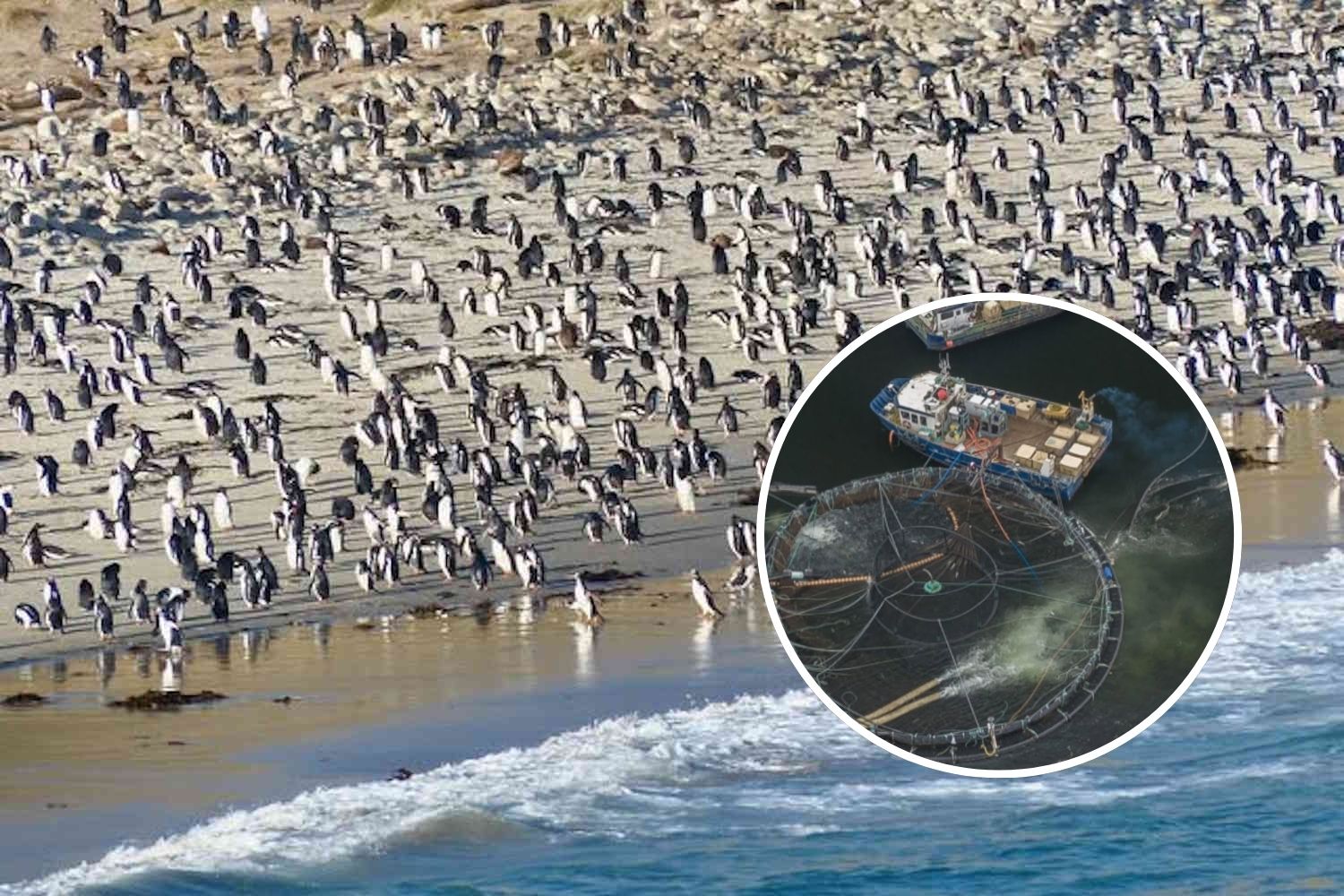
It is among the world’s last pristine wilderness, with unique coastal waters rich in krill and squid that attract sea lions, elephant seals, dolphins and whales, and where penguins, of which there are five different species, outnumber people.
But plans to transform the Falkland Islands, one of the most remote British overseas territories, into a new frontier for salmon farming have divided that population of just 3,500 souls. And now those who oppose salmon farming are calling for a referendum.
What exactly is happening?
Unity Marine, a joint venture between Fortuna, a local fishing company, and Danish company F-land ApS, wants to farm 50,000 tonnes of salmon a year in 16 locations, in what would be hailed as the largest coastal industrial development in the archipelago’s history.
If on the one hand – according to an assessment commissioned by the Falkland Islands government – cultivating 30 thousand tonnes annually could add 35 million pounds a year to the territory’s economy, equivalent to 11% of GDP, and provide 133 jobs, on the other hand, according to Salmon Free Falklands (SFF), an organization founded by residents to oppose the project, only a popular consultation will allow a decision to be made once and for all.
View this post on Instagram
The reports commissioned by the Falkland Government as part of the consultation are based on unverifiable data provided by Unity Marine – explains Sally Poncet, of SFF. There is “insufficient information” on the impact the industry would have on the islands.
The problem, he says, is that some of the reports commissioned by the government are based on data provided by Unity Marine itself and not independently verified. Big questions also remain about the effects that thousands of tons of farmed fish could have on coastal ecosystems.
One of the fears concerns the accumulation of organic waste, feed and excrement under the cages, which could alter the seabed and affect marine algae. These areas represent important habitats and breeding areas for numerous species, including squid, which also play a fundamental role in the local economy.
How do we deal with “carrying capacity”
Second Louise Cherrieformer member of the Tasmanian Environmental Protection Authority and now consultant to Sustainable Fisheries Falkland, one essential piece of data is still missing: how many salmon can actually be farmed in Falkland waters without exceeding the ecological limits of the environment.
It is what in ecology is called carrying capacity: Cherrie maintains that this parameter has not yet been established through a sufficiently rigorous scientific process.
And without knowing the real capacity of the ecosystem, it becomes difficult to calculate the environmental costs, those of regulation and any economic benefits. According to the expert, the reports published so far are therefore too preliminary to represent a true cost-benefit analysis.
Then there is another issue that worries environmentalists: mass mortality, which in intensive farming is not an exceptional event. Diseases, parasites, high water temperatures, oxygen deprivation and algal blooms can cause the sudden death of large numbers of fish.
But in the remote Falklands a far from secondary question remains: how would thousands of tonnes of dead salmon be managed and disposed of? According to Cherrie, this scenario would not have been adequately addressed in the available environmental documents.
Already in 2022 the Government had said no
In fact, it is not the first time that the Falklands have discussed intensive salmon farming. In 2022 the government had decided not to proceed with the development of the salmon industry.
Unity Marine then challenged that decision through judicial review proceedings, arguing that public consultation involving the entire population of the islands was necessary before banning the activity.
The dispute ended with an agreement between the parties: the 2022 decision was annulled and the new evaluation and consultation process was started.
Today, environmentalists do not necessarily argue that all forms of aquaculture are impossible in the Falklands. However, they ask that a potentially irreversible decision be taken only after having established with independent data what the limits of the ecosystem are.
In fact, 50 thousand tons of salmon per year is not an experiment and involves large quantities of feed, organic waste, possible drugs, parasites, mortality, transportation and infrastructure distributed along kilometers of coastline.
And in a remote archipelago, where the economy and biodiversity are deeply dependent on the sea, how much could it cost if something went wrong?
