
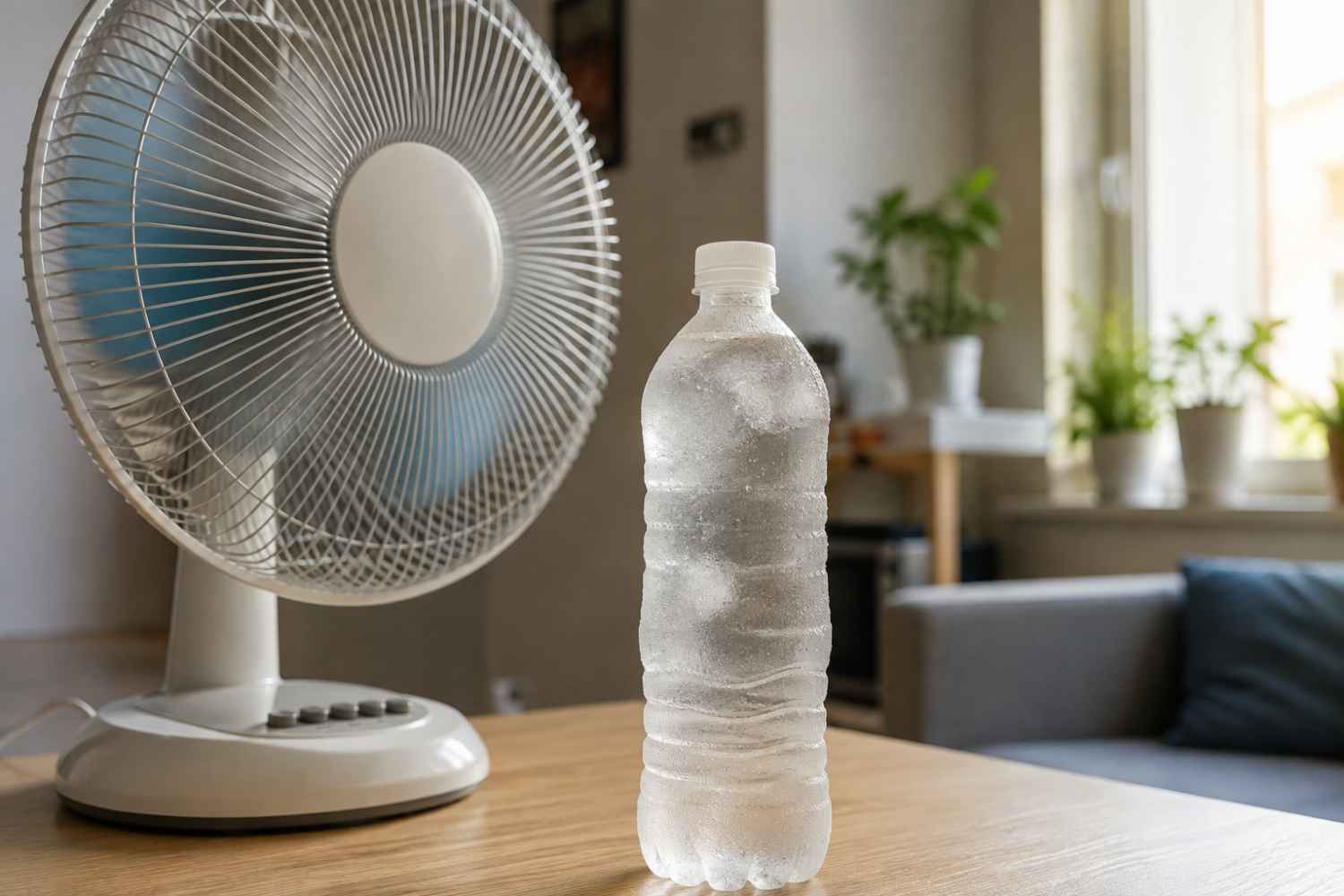
When the heat becomes difficult to bear and you don’t have an air conditioner, small home remedies promptly come back into circulation that promise to make the house cooler with what you already have available. One of the best known involves placing a frozen bottle of water, or a basin full of ice, in front of a fan, in the hope of turning it into a sort of homemade air conditioner.
The idea isn’t completely meaningless, because air passing near a very cold surface can actually give up some of its heat. The point, however, is to understand what the real extent of the effect is: a frozen bottle can make the flow of air in the immediate vicinity more pleasant, but it is unlikely to be able to significantly lower the temperature of an entire room.
What happens when you put a frozen bottle in front of the fan
From a physical point of view the mechanism is rather simple. The ice contained in the bottle has a lower temperature than the air in the room and absorbs heat as it warms up and progressively changes from a solid to a liquid state. The air pushed by the fan, coming into contact with the cold surface of the bottle, can therefore cool slightly before reaching those in front of it.
However, this is a limited heat exchange, the bottle contains a finite quantity of ice and, once this has melted and the water has approached room temperature, its cooling effect practically disappears. In other words, there is no continuous process capable of removing heat from the room and taking it outside.
This is precisely the fundamental difference compared to an air conditioner. An air conditioning system uses a refrigeration cycle to take heat from the internal environment and transfer it to the outside; refrigerators and air conditioners, in fact, do not “produce cold”, but move thermal energy from one environment to another through a system that requires work and energy.
A frozen bottle, on the other hand, simply temporarily absorbs a certain amount of heat before reaching thermal equilibrium with the room.
The fan doesn’t really lower the room temperature
Then there is another element that is often overlooked. A normal fan is not designed to lower the temperature of the environment: it moves the air and allows our body to disperse heat more easily, in particular by promoting the evaporation of sweat.
The US Department of Energy sums it up very simply: Fans cool people, not rooms. This is why it makes sense to turn them off when there is no one in the room, because leaving them running does not continue to “cool” the room like an air conditioner would.
The ice bottle can change this scenario slightly because it introduces a cold surface in front of the airflow. Whoever is sitting near the fan can therefore perceive a cooler breeze than normal, especially at the beginning, but talking about a real cooling of the entire room would be excessive, the larger the room, the more evident this limit becomes.
There is also the problem of the freezer
The trick also presents a small energetic paradox. To get that frozen bottle you first have to freeze it. The freezer removes heat from the water and transfers it to the surrounding environment through its refrigeration circuit. To do this it consumes electricity and the overall heat released outside the appliance also includes the energy used by the compressor.
It is the same principle of thermodynamics that regulates the functioning of a refrigerator: the heat extracted from its interior is discharged into the room together with the energy used to carry out the transfer.
This does not mean that it is useless to take an already frozen bottle and place it in front of the fan when you are very hot. It simply means that continuously freezing large quantities of water with the goal of cooling the same home is not the same as using an air conditioner and does not produce comparable net cooling. The advantage, when there is one, is above all local and temporary.
Can it at least make us feel less hot?
If we are close enough to the fan, a frozen bottle can make the airflow momentarily cooler and increase comfort. However, the effect depends on many factors: size and number of bottles, quantity of ice, distance from the fan, air speed, room temperature and humidity conditions.
You should therefore not expect a single bottle to turn a 30 or 32°C room into a cool environment. It’s more realistic to imagine it as a little personal help, useful while working at your desk, watching television or seeking some relief before going to sleep.
The World Health Organization also clearly distinguishes the cooling of the person from that of the home. During heat waves he recommends, among other things, wetting the skin with a damp cloth or a spray bottle and using fans within certain temperature conditions, because the movement of air can help the body lose heat.
When the fan is no longer sufficient
However, there is one important aspect, especially during extreme heat waves. The fan should not be considered sufficient protection under all conditions.
The indications from the health authorities are not perfectly identical on the precise thresholds, also because temperature, humidity, age and health conditions modify the body’s response. The CDC recommends using fans to cool down when the core temperature is below about 32°C, while the WHO indicates that above extremely high temperatures the fan may become ineffective or even increase the heat load on the body.
This is especially important for older adults, young children and people with chronic conditions, who may be more vulnerable to the effects of high temperatures.
If symptoms such as strong weakness, dizziness, nausea, confusion or other signs compatible with heat illness appear, a frozen bottle in front of the fan is obviously not a solution: you need to move to a cool place and follow the appropriate health instructions.
To cool your home, the most important thing is to prevent heat from entering
If the goal is to actually keep a room cooler, some tricks have a much more solid basis than the bottle trick.
The WHO and the NHS recommend closing windows, curtains, shutters or shutters during the day when it is warmer outside, in order to limit the entry of solar radiation and hot air. The windows can then be opened in the evening and during the night, when the external temperature drops below the internal one.
Reducing heat sources in the home can be equally useful. Home appliances, oven and other devices produce heat during operation; the US Department of Energy suggests, for example, to prefer cooking systems that produce less heat than a traditional oven when possible during the summer.
In the cooler hours, natural ventilation can instead be exploited by creating air currents between windows located on different sides of the house, when the configuration of the house allows it.
So, does the frozen bottle work or not?
If the goal is to significantly cool an entire room, the answer is essentially no. A frozen water bottle has a limited ability to absorb heat and does not have a system capable of continuously transferring it out of the home, like an air conditioner does.
However, if the goal is to get a slightly cooler airflow near the fan for a while, then the trick can have a noticeable effect, especially if you stay in its immediate vicinity.
In short, more than a do-it-yourself air conditioner, it is a very localized and temporary cooling system. It can provide some relief on hot evenings, but when temperatures become high the most effective strategy remains to reduce heat entry during the day, ventilate the house when it is cooler outside and, in situations of intense heat, look for adequately air-conditioned environments.
