
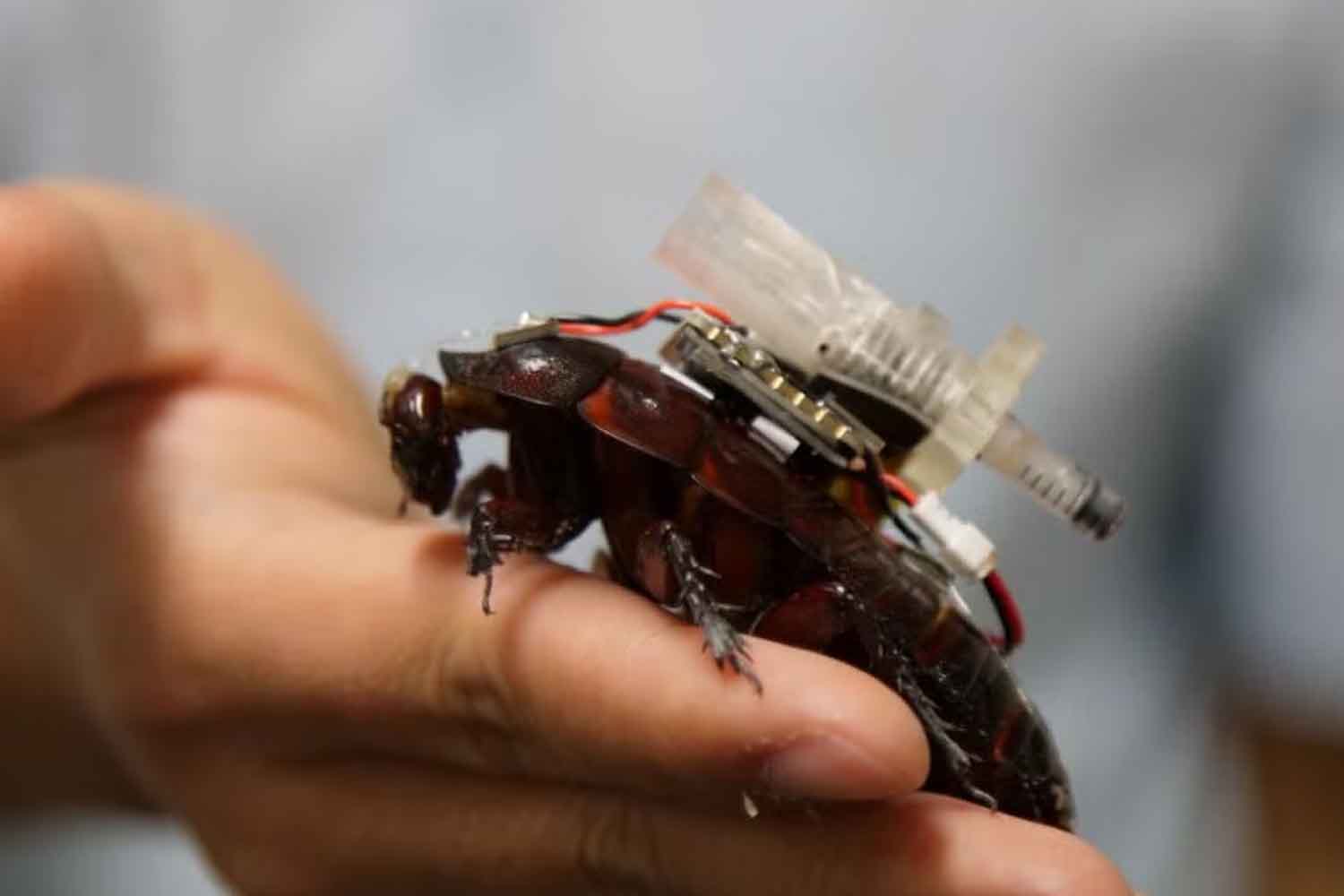
A cockroach enters the rubble with a camera on its back. Another follows carrying a tiny syringe. If the first finds a trapped person, the second is guided close enough to administer a drug. It looks like the health department of a science fiction film with a particularly creative budget, but instead it is an experiment conducted in Australia. They called them Paraborg: Paramedic cyborg cockroaches designed to get where doctors and rescuers, at least in the first minutes after a collapse, simply can’t get through.
The system was developed by researchers atUniversity of Queensland together with biomedical engineers at the University of New South Wales (UNSW) and is described in a study published in Advanced Science. The animals used are Macropanesthia rhinocerosthe giant burrowing cockroaches of Queensland: the specimens in the study measured approximately 8.4-8.7 centimeters and weighed between 34 and 40 grams. A size that, for once, comes in quite handy.
©The University of Queensland
One searches for the injured person, the other brings the injection
The idea comes from a very concrete problem of search and rescue operations. After earthquakes and collapses, a person can remain alive under meters of debris while direct access takes time. The small artificial robots must carry around chassis, actuators, sensors and a power source, while maintaining enough agility to negotiate narrow passages and uneven surfaces. At that size, making everything fit together is still complicated.
The cockroach already knows how to do much of this work. It walks, reacts to obstacles, has biological sensors and adapts its movement to the terrain. The researchers then take advantage of the insect’s body as a platform and add electronics, remote control and instruments. It is also one of the most interesting aspects of this technology in terms of resources: according to the authors, biohybrid robots can reduce energy requirements and manufacturing costs compared to fully artificial microrobotsbecause locomotion, structure and part of the sensory capabilities are already provided by the animal. For the stimulation needed to orient the Paraborg alone, we are talking about powers in the order of microwatts.
This, however, is not enough to automatically transform a cyborg cockroach into “green” technology. The study primarily measures the operation, consumption and performance of the system, not its overall environmental footprint. Lithium batteries, circuits, plastic components, durability and the ability to recover and reuse electronics continue to be part of the bill. The interesting advantage, for now, is more precise: avoid artificially reconstructing what millions of years of evolution have already placed on the insect’s legs.
In the prototype the work is in fact divided. A cockroach acts as “observer” and carries a small Wi-Fi camera that sends images in real time. A second carries the automatic injection system, called AIM. Loading everything on the same animal would increase weight, bulk and energy consumption, while also reducing wireless operation time: hence the idea of distributing tasks among multiple individuals.
The insects are remote-controlled through light electrical stimulations applied to the antennae and cerci, the posterior sensory appendages. By stimulating an antenna a deviation in the opposite direction can be induced, while intervention on the cerci is used to modify the forward movement. In the experiment the operators manually guided them through a path to the target. The result has something surreal: the animal continues to walk with its own paws, while someone on the controller suggests where to go.
The test worked, but no one is still cured of a cockroach
Here it is best to leave science fiction under the rubble for a moment and look at what has actually been proven. The study used five cockroacheseach engaged in five tests. Everyone managed to reach the expected points during navigation; the entire sequence, from the path to the administration of the liquid onto a silicone target, was successful 72% of attempts18 out of 25. When the device was operated within 15 centimeters of the target, the delivery success rate was up to about 95%.
The small injector was also checked separately on ex vivo porcine skin. In ten tests, penetration and administration were successful in 90% of cases, reaching approximately 5.5 millimeters in depth. The experiments, therefore, were not carried out on injured people and do not yet demonstrate that the device can give a safe and effective injection to a human being trapped under a building.
The authors themselves set a rather clear limit. The forces measured with the current system can exceed those normally used to insert small needles into human skin and the results obtained on silicone cannot be read as a demonstration of clinical safety. Among the solutions proposed for subsequent developments are patches with microneedleswhich could make administration more controllable and less invasive. Before arriving at real emergencies, new devices, checks on much more complicated terrain and real medical validation will therefore be needed.
Why send cockroaches at all?
The species chosen helps a lot. Macropanesthia rhinoceros is large enough to carry centimeter-sized equipment: in the configuration with the injection system, the equipment added approx 17 grams and 15 millimeters in height without producing significant differences in the locomotion observed during testing. The camera configuration added around 26 grams instead. This also explains why researchers are focusing on a team of specialized insects rather than the medical Rambo of cockroaches with all the instruments on their backs.
Then there is the question of the animals used. According to the University of Queensland, cockroaches are anesthetized during the installation of the electrodes and microchips; once the experiments are finished, devices and supports are removed. The team reports that, after the harnesses are removed, the insects live as long as other specimens raised in the colonies. However, the study also points out that ethical guidelines for research on invertebrates are not yet as standardized as those applied to many vertebrates.
It is a detail that is anything but lateral if the future goal is to go from five animals in the laboratory to real ones Paraborg swarms. The project imagines insects with different roles: some could carry cameras and environmental sensorsother medical equipment. The human responder would remain within the process, both to guide operations and make healthcare decisions. No autonomous six-legged ambulance, in short.
In a sector where every gram of battery, material and motor added restricts the available space, these biohybrid systems therefore follow a rather radical path: instead of building a machine capable of imitating an insect, they directly use the insect’s abilities and build only the necessary technological part around it. From an energy point of view it is a real advantage indicated by the researchers themselves; from an overall environmental point of view, the comparison with traditional microrobots has yet to be made. And there remains, of course, the ethical question of transforming living organisms into components of a rescue machine.
There is still a long way between the laboratory and a real mountain of rubble
The most prosaic difficulties begin as soon as the tidy walls of the laboratory disappear. Concrete and ground can severely attenuate the Bluetooth signal; debris and obstacles interrupt the video link; gravel, sand and unstable surfaces can completely change the animal’s ability to reach the target. The amount of drug that can be transported is also limited: the current device uses a 500ml tank 0.5 milliliters.
Thang Vo-Doan, a biorobotics engineer at the University of Queensland, imagines that teams of cyborg insects could arrive in real emergencies by 5-10 yearsas long as research and field tests proceed quickly enough. This is a researcher’s prediction, not an in-service date.
For now, the Paraborgs know how to cross a path, find a target and deliver a small dose of liquid under human control. Between this laboratory and a person buried under rubble there is still a lot of work. But if one day, after an earthquake, something with six legs and a syringe were to approach under a concrete slab, it could be one of the rare occasions when seeing a cockroach coming will be very good news.
