
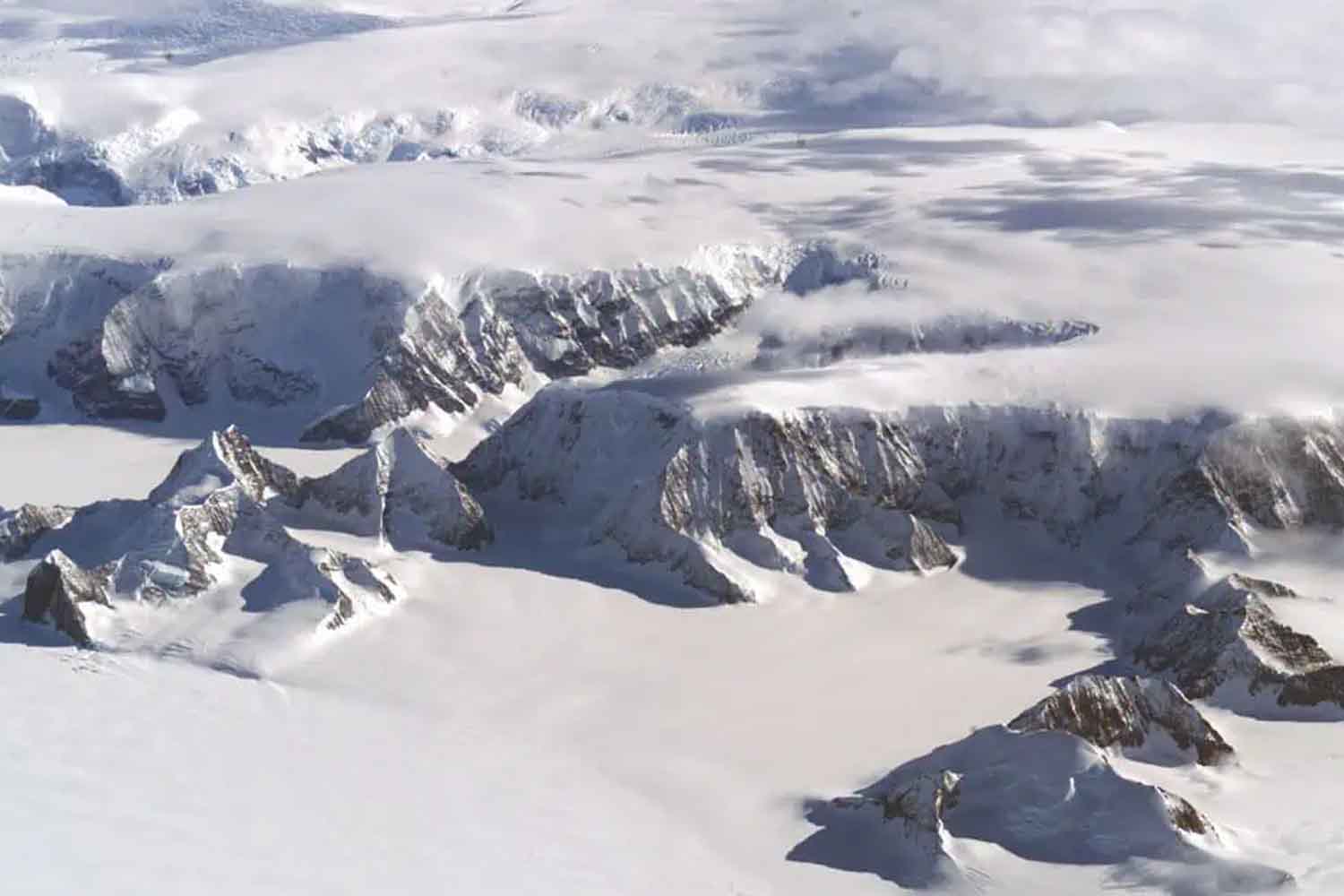
From afar, Antarctica resembles a surface that has already decided everything. White, compact, silent. An expanse that gives the idea of fixity, as if time up there passed at another pace and left the rest of the world to consume itself elsewhere. Except that that white, for years, has been holding together two different movements: that of the ice which retreats and that of the earth which, lightened, slowly begins to rise again. It is a change that is almost invisible to the naked eye, but it works under the skin of the continent and changes the way we look at it. At a certain point the postcard ends and the material remains.
The study published on Nature Climate Change try measuring this very step. For the first time, it also includes glacial isostatic rebound, i.e. the rising of the land when the weight of the ice sheet is reduced, together with the effects of sea level, into the projections of future Antarctica. The result is very concrete: in the high melting scenario, up to 120,610 square kilometers of new ice-free lands could emerge by 2300; in the intermediate scenario 36,381; in the low one 149. In the most extreme scenario the extension of the ice-free areas would grow up to approximately 550% compared to the reference values used by the study.
Put like that, it seems like a numbers game. Instead, the point is made better by starting from a simple detail: today the part of Antarctica free from ice remains tiny, less than 0.6% of the continent according to the estimates cited by the authors. The rest covers mountains, valleys, canyons, coasts, islands, volcanic reliefs. When that cover thins, more than just rock resurfaces. Available territory, habitat, space for scientific infrastructures, and at the same time also a geology that until now remained hidden or accessible at times, resurfaces.
This is where history stops being just geophysical. The research signals that new ice-free lands could emerge in all areas with existing territorial claims and even in the West Antarctic sector without formal claims. In the areas that could re-emerge there are also concentrated mineral deposits already identified or considered probable, including copper, gold, silver, iron and platinum. The largest part of the expected emergence is concentrated above all in the sectors claimed by Argentina, Chile and the United Kingdom, that is, precisely where physical geography has met an already sensitive political geography for decades.
The forehand remains slower than the ice
The Madrid Protocol on the Environment, within the Antarctic Treaty System, describes Antarctica as a nature reserve dedicated to peace and science. Article 7 prohibits activities related to mineral resources, except those carried out for scientific research. So far the framework is clear, at least on paper. The problem comes when the geographical map begins to move faster than the legal one.
In public debate, 2048 is often portrayed as the date on which the mining ban “ends”. The Antarctic Treaty Secretariat clearly denies it: the protocol does not expire. From 2048, a consultative party will be able to request a review conference, but very strict steps are needed to modify the text, and the ban on mining activities remains linked to the possible existence of a new binding legal regime, which would require consensus. This is the real contradiction that the scientific piece brings to the surface: the continent changes shape, the law continues to move at a much heavier pace.
For this reason the decisive step does not only concern the future possibility of digging. It is about the resilience of Antarctic governance in the face of a changing material structure environment. Tim Stephens, jurist from the University of Sydney involved by Eos to comment on the study, has been moving along this very ridge for some time. Already the title of one of his recent works, The Big Thaw: Who Governs Antarctica’s Ice?shifts attention from the single mineral deposit to a broader question: what happens to a system designed to freeze disputes when the physical medium on which those disputes were suspended melts.
Stephens also invites us to keep our feet on the ground. Antarctica will remain a very harsh environment for any industrial exploitation: extreme cold, enormous costs, ferocious logistics, very high environmental impact. New geological accessibility does not automatically translate into operational mines. But reducing everything to “nothing will be done there anyway” would be a shortcut. International treaties also govern the perception of future pressure, and a study that shows new lands emerging, new resources becoming visible and new sensitive areas gathering in the same sectors already changes the tone of the discussion.
Within this story there is also a less noisy and more important reverse. Ice-free areas in Antarctica concentrate terrestrial biodiversity, geological sampling, soils, fossils, research bases and infrastructure. Each new outcrop, therefore, opens up both an economic possibility and an environmental vulnerability. The dispute, even before the bulldozers, is played out over which of the two images will gain more political weight in the coming decades.
Climate change isn’t just melting the ice in Antarctica. It is removing covers, putting old claims back into view, forcing the right to look at a map that no longer remains still. The first tongue of rock that emerges first opens a diplomatic file, then everything else.
You might also be interested in:
