
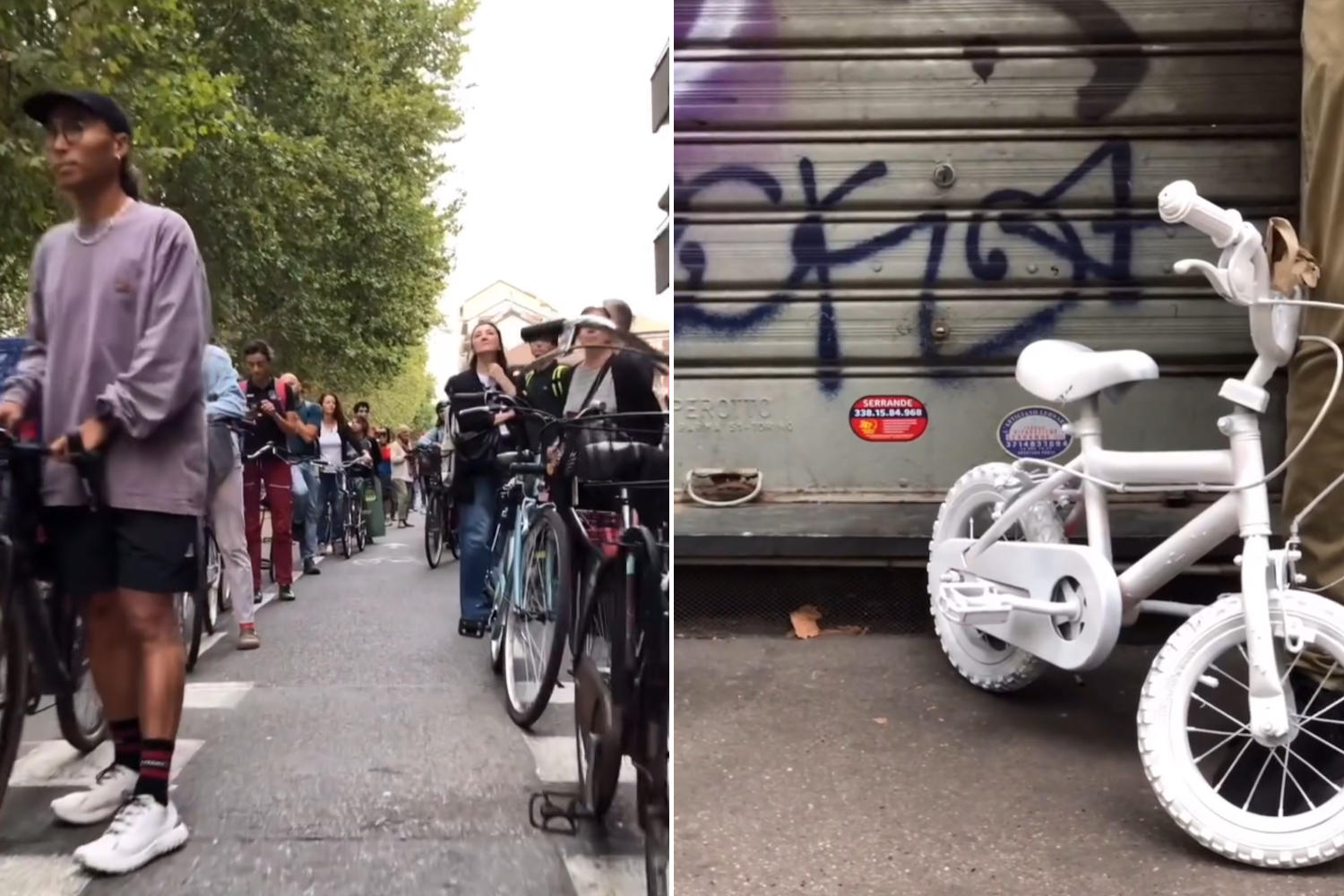
Turin is currently mourning the death of Nicolò Di Questo, the 7-year-old boy hit and killed by a motorist while he was cycling along the main road of Corso Regina Margherita to go to school with his father. A few hours after the tragedy, around 300 people spontaneously gathered to form a human cycle path and symbolically block traffic, tying a small white ghost bike and a bunch of sunflowers to number 63.
View this post on Instagram
Among those present, many parents and students expressed dismay at the danger of a stretch of road where the cycle lane is delimited only by white paint and shared with cars. Associations such as Fiab Bike Pride and Fridays For Future have denounced inadequate urban mobility, pointing the finger at speed limits that are systematically ignored and an infrastructure that is unsuitable for protecting the most vulnerable users.
View this post on Instagram
The protest under Palazzo Civico and the response of the Municipality
The bicycle procession then headed to Palazzo Civico to the incessant ringing of bells, amidst chants of protest and shouts of indignation to ask how many more fatal accidents must occur before a change of direction. There were moments of nervousness on the part of motorists stuck in traffic, highlighting the strong tension that runs through the city streets, where haste and the use of the car continue to dominate to the detriment of safety.
It was Mobility Councilor Chiara Foglietta who took to the streets to confront the demonstrators, expressing her condolences as a mother and reiterating the need to evaluate new protected infrastructures, highlighting how the problem of speed and failure to respect signs on main roads and in 30 km/h zones represents an emergency that is no longer tolerable for the Piedmontese capital. Just as the death of a child who was just riding his bike to school is not.
View this post on Instagram
