
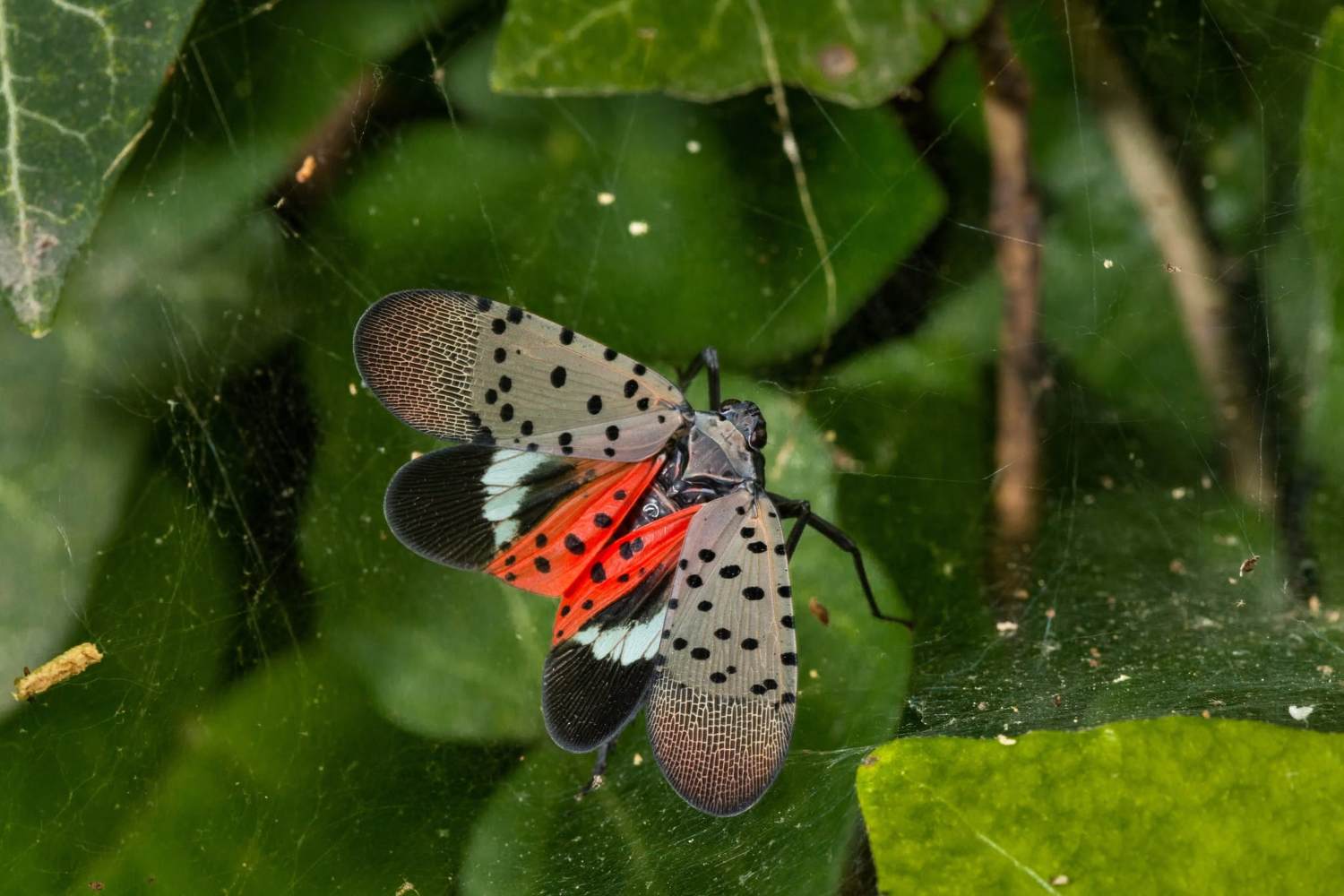
It looks like an exotic and elegant butterfly thanks to its gray front wings dotted with black and crimson-toned hind wings, but behind this colorful appearance lies one of the most feared ecological and agricultural threats in the world. The spotted lanternfly, scientifically known as Lycorma delicatulahas officially landed in the European Union. The confirmation came from the Hungarian food safety agency Nébih, which validated the first official discovery which occurred in the summer of 2026 in the county of Bács-Kiskun, on the border with Serbia and Croatia, following the timely report of a citizen.
This episode follows by a few weeks the detection that took place in Moldova, where in August 2026 adults and nymphs were identified within an industrial area of Chișinău. Although a single isolated specimen was recorded in Spain in 2024, the Hungarian case represents the first real confirmed establishment within the EU borders, immediately triggering strict quarantine and phytosanitary control measures.
The devastating damage to agriculture and the dramatic experience in the United States
The international alarm is not random, but has its roots in the disasters caused by the species in the United States, where the insect appeared for the first time in 2014 in Pennsylvania, quickly spreading to several north-eastern states. According to data from the US Department of Agriculture, infestations in vineyards can cause a loss of grape production of up to 90%.
This leafhopper belonging to the fulgoridae family acts on a double destructive front. First of all, it causes direct damage: both the nymphs, recognizable by their black and white or red-black livery, and the adults sting the plant tissues to suck the sap, weakening the plant to the point of causing its death if the attacks are massive. Secondly, it generates indirect damage through the production of a sugary substance called honeydew, which favors the proliferation of sooty mold, a group of fungi that forms a dark film on the leaves, blocking photosynthesis and making crops vulnerable to other pathogens.
Extreme dietary flexibility and the bond with ailanthus
What makes the spotted lanternfly an extremely dangerous organism is its incredible adaptability and dietary flexibility that allows it to feed on over 100 different plant species, including fruit trees, vines and numerous forest species. The European and Mediterranean Plant Protection Organization highlights that among its favorite host plants is ailanthus (Ailanthus altissima), an invasive exotic tree now widely naturalized and widespread throughout Europe and Italy, a circumstance that makes our continent an ideal habitat for its rapid proliferation.
Further complicating containment efforts is the extraordinary capacity for passive spread: Females lay their eggs in masses protected by a waxy substance on hard surfaces, including containers, vehicles, wood and man-made objects, facilitating inadvertent transport via global trade. To stem the crisis, the authorities invite citizens to promptly report any suspicious sightings to the phytosanitary authorities, offering a fundamental contribution to nipping a possible continental-scale invasion in its tracks.
