
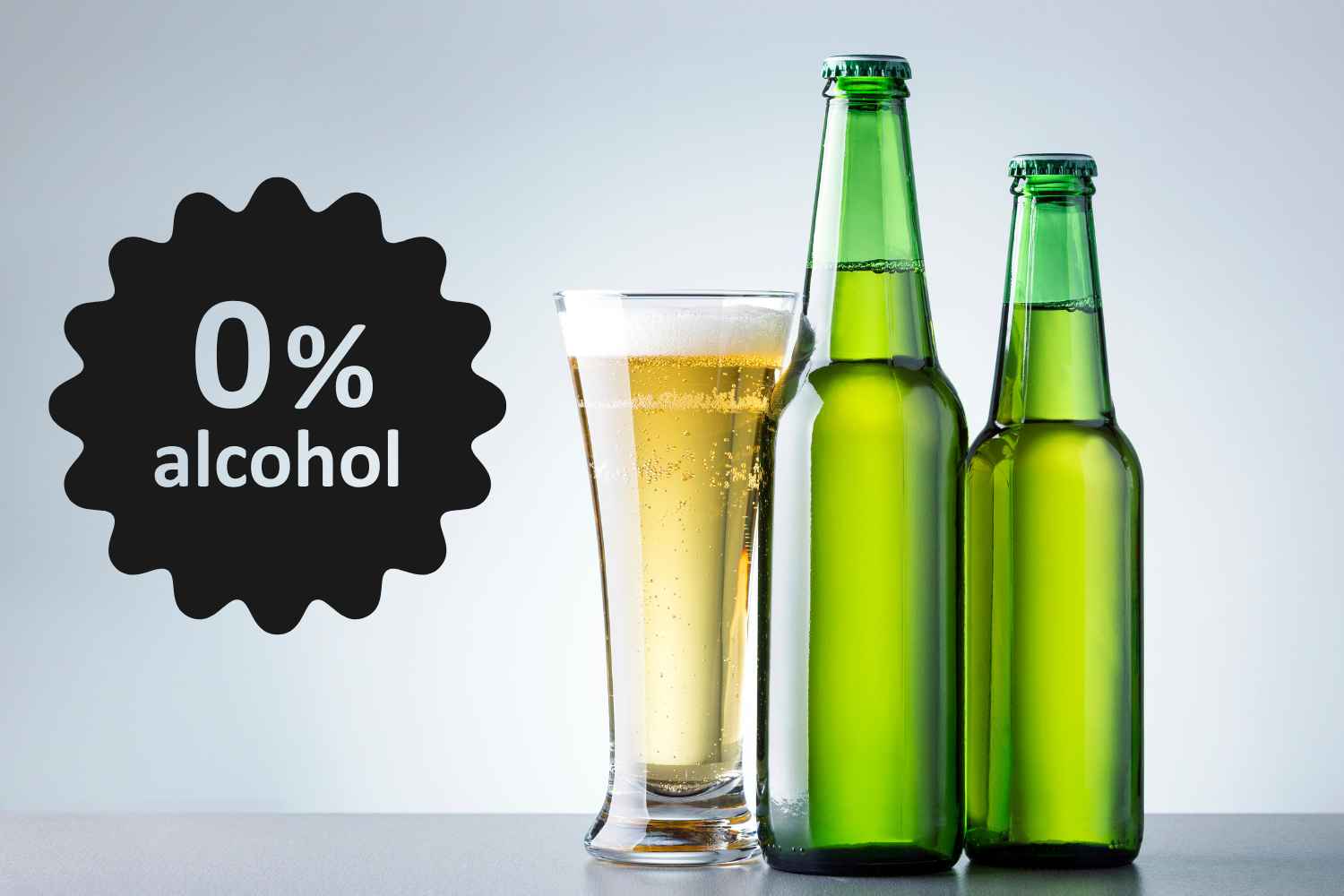
For many they have become the alternative to traditional beer when you want to give up alcohol but not the taste and ritual of a good cold beer, perhaps in company. Non-alcoholic beers are in fact gaining more and more space on supermarket shelves and in clubs, so much so that they no longer represent a niche product.
But there is a detail that is important to know before choosing: the wording “non-alcoholic” does not necessarily mean that the beer is completely alcohol-free. Some may in fact contain a small quantity, perfectly compatible with the legislation. It is a minimal difference from a quantitative point of view, but important for those who want or need to completely avoid alcohol.
Non-alcoholic beer and 0.0% beer are not the same thing
Let’s start with the most important distinction. In Italy the law reserves the name “non-alcoholic beer” for beers with an alcoholic strength by volume not exceeding 1.2%. This means that a beer can legally be sold as non-alcoholic even if it contains a certain amount of alcohol.
The limit is therefore significantly higher than what many consumers might imagine when they simply read the word “non-alcoholic” on the package.
This doesn’t mean, of course, that a non-alcoholic beer necessarily comes in close to 1.2%: many are much lower, for example around 0.5%. But if you want to avoid even minimal quantities of alcohol, it is important to check the alcohol content declared on the label and choose a product indicated as 0.0%.
The difference is particularly interesting because the market is making products available with very different characteristics, all however included, in common language, under the label of “non-alcoholic beer”.
But why can there still be alcohol? The explanation is also technological.
Beer is born through a fermentation process in which yeasts transform sugars into alcohol and carbon dioxide. To obtain a beer with low or no alcohol content, different production strategies can be used, for example limiting the formation of alcohol during fermentation or starting from a traditional beer and subsequently removing the alcohol through dealcoholization processes.
This last path is technologically more complex because we must try to eliminate alcohol without completely losing the characteristics that make a beer recognisable, from the aromas to the bitter component. And it is also one of the reasons why the world of 0.0% beers has required an important evolution in production technologies over the years.
What really changes between 0.5% and 0.0%?
At first glance it might seem like a negligible difference. In fact, we are talking about very small quantities compared to a traditional beer. But not all consumers are simply looking for a beer with less alcohol. For some people, the goal is to avoid it completely.
Let’s think, for example, of those who have to drive and want to exclude any alcohol intake, or of those who choose not to consume it for personal, religious or health reasons.
Particular attention then concerns pregnancy. The Ministry of Health also reiterates in the campaign “Zero alcohol during pregnancy” that there is no amount of alcohol considered safe during pregnancy and therefore indicates abstention as the choice to follow.
In these cases, knowing whether what we have in front of us is a truly alcohol-free drink or a beer that contains a small quantity is not a secondary detail.
Further complicating matters is the fact that the definitions and thresholds are not identical in all countries. European legislation on food information establishes, for example, that the alcoholic strength must be indicated mandatorily for drinks with more than 1.2% alcohol by volume.
In the United States, however, the TTB legislation explicitly distinguishes between “non-alcoholic” And “alcohol free“: a drink can be defined as “non-alcoholic” if it contains less than 0.5% alcohol, while the words “alcohol free” is reserved for drinks that do not contain alcohol.
This is therefore why the same word may not have exactly the same meaning when we move from one market to another.
The non-alcoholic beer market is growing rapidly
Meanwhile, while we discuss labels and definitions, the market continues to grow. In Italy, 2025 ended with a 2.5% drop in overall beer consumption, which dropped to 21.2 million hectoliters. Within this scenario, however, low and no alcohol beers have followed a completely different direction: according to AssoBirra’s 2025 Annual Report, their share went from 2.1% in 2024 to 3.9% in 2025, with a growth of more than 85%.
It’s a significant change because just as the overall market slows, demand is growing for products that maintain the beer experience by reducing or eliminating alcohol.
What to look at on the label
As you may have understood, you shouldn’t stop at the word “non-alcoholic”. If it is important for us to know how much alcohol a drink actually contains, we must carefully check the information on the packaging and distinguish between a beer with low alcohol content and one declared 0.0%.
It is precisely this difference that tells us well how the market is changing; today on the “non-alcoholic” shelves we find products that are not necessarily identical from the point of view of alcohol content.
And while companies invest in creating beers that are increasingly similar to traditional ones but without alcohol, the label should also help the consumer to immediately understand what he is really buying.
Because between “less alcohol” and “zero alcohol” there is a small difference in the glass, but far from irrelevant for those who have chosen to completely avoid taking this substance.
Sources: Law 125/2001 / Regulation (EU) n. 1169/2011
