
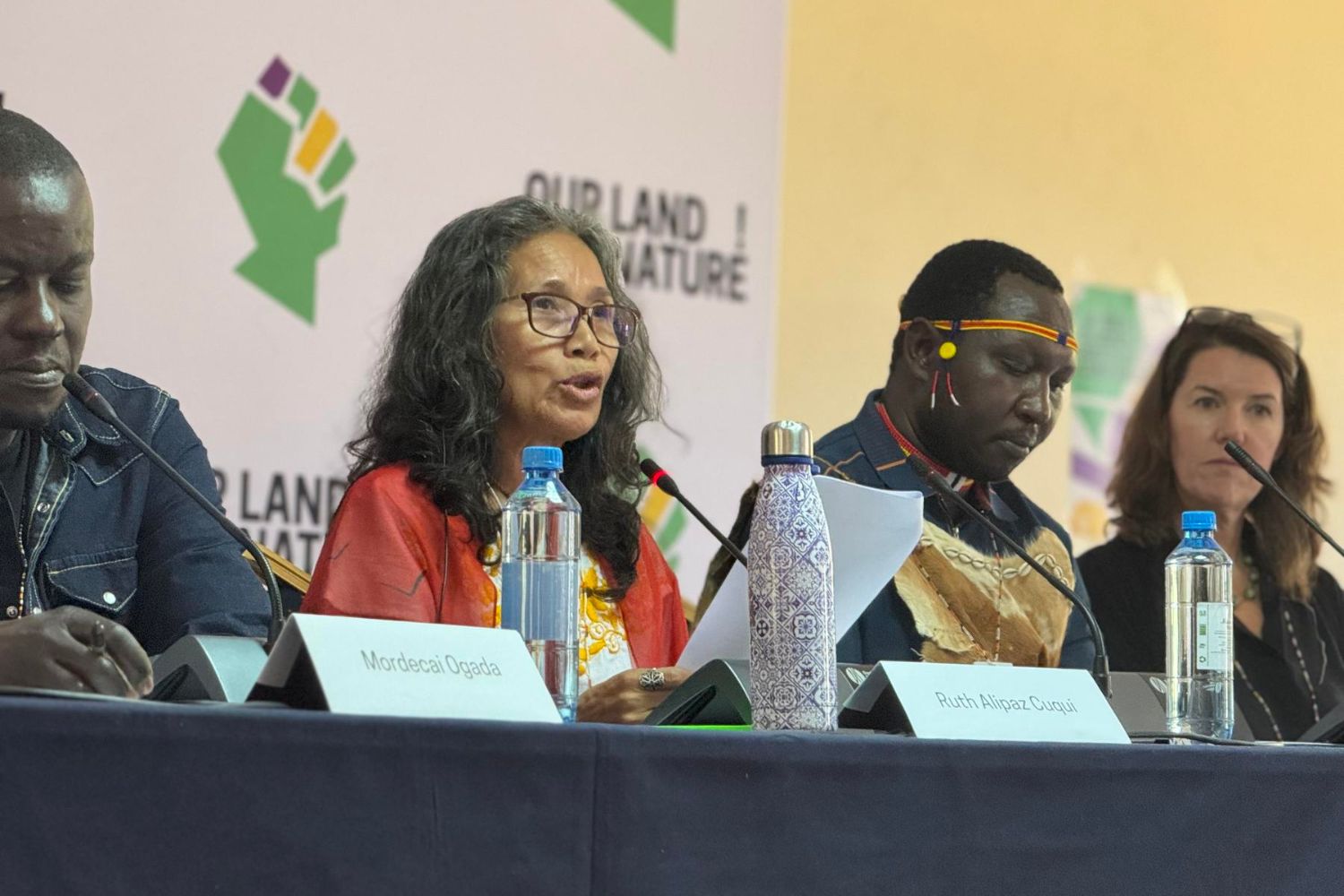
In Nairobi, sixty indigenous representatives from sixteen countries signed a document that overturns the dominant narrative on nature protection. The Nairobi Declaration, presented on 25 September at the end of the Our Land Our Nature (OLON) meeting, organized by Survival International and Conservation Solutions Afrika, no longer asks for margins for dialogue with large environmental organisations: it asks for them to leave, and together proposes an alternative model of land management.
View this post on Instagram
The text opens by claiming a relationship with the territory opposite to that of park management: “We, the Indigenous Peoples of the world, are the custodians and have a deep and customary bond with our lands, our waters and our territories. Our ecosystems do not belong to us: we belong to them”. Hence the central accusation: nature conservation “usurps and steals our territories under the guise of saving Mother Earth,” transforming indigenous lands into “national parks, tiger reserves, wildlife sanctuaries, protected areas, conservation areas and sport hunting reserves without our consent.”
An industry worth billions of hectares
The numbers released by Survival International give the measure of the phenomenon: at least 1.1 billion hectares of indigenous lands would have been stolen in the name of environmental protection, and three million people in Africa, Asia and the Americas would today pay for that choice “with their lands and with their lives”. The declaration describes a precise economic mechanism: the stolen lands are “sold through carbon markets, biodiversity credits and other compensation systems that serve to give a semblance of environmental sustainability (greenwashing) to the destructive practices of multinationals”. Despite the formal designation of “protected areas,” the document claims that those same areas are designated “for open-pit mining, green mining of minerals critical to the energy transition, and commercial plantations of rubber, pine, tea, coffee, soy, and teak,” as well as safari tourism.
At the base of this system, according to the signatories, is “a coalition composed of governments, multinationals and international NGOs dealing with environmental conservation”, financed by “multilateral development banks, multilateral financial institutions, the World Bank, fossil fuel industries and other polluting industries”. The conclusion of the passage sets the tone for the entire document: “This is not nature conservation. It is nothing more than a sign.”
The text also denounces a repressive dimension that goes beyond expropriation: communities subjected to “intimidation, beatings, incarceration, torture, gunshot wounds and murders”, burned houses and forced evictions. Among the cases cited in Survival International’s press notes is that of Mising Pranab Doley, an Indian activist arrested in July and jailed after leading a protest against a luxury hotel project with repercussions on indigenous communities near Kaziranga National Park.
Twelve acronyms in the sights
The statement names specific names. Twelve organisations, including WWF, Wildlife Conservation Society, African Parks, UNESCO, International Union for Conservation of Nature, Frankfurt Zoological Society, Conservation International and The Nature Conservancy, are ordered to leave indigenous territories: “leave our lands and respect our rights, otherwise we will chase you away by applying our judicial system”. The same organizations are asked to “make public all agreements relating to carbon and biodiversity” stipulated on indigenous territories, while the signatories ask journalists who deal with conservation to “name those responsible and follow the money trail”, unmasking “the financiers of our evictions and the violence we suffer”.
The document asks public institutions for the restitution of ancestral lands “including those that were stolen from us to create parks and nature reserves”, the legal recognition of communities, the cancellation of projects imposed on indigenous territories, the release of people arrested for defending them and respect for the sentences of national and regional courts. He simply asks those who fund conservation to “stop funding colonial-style conservation.”
The alternative: self-government and consensus
The Declaration does not simply list responsibilities: it proposes a different management model, rooted in what it defines as indigenous “traditional systems”. The key passage reads: “The true conservation of nature is an integral part of our traditional systems”, practices based on pastoralism, fishing and gathering that communities claim to have applied for generations according to their own “natural laws”, without the need for external bodies to certify their sustainability.
The first pillar of this model is self-government: the text calls for “self-determination and self-government” on ancestral territories, along with the principle that “nature conservation must be led by indigenous peoples, because we know best.” The second pillar is procedural and is Free, Prior and Informed Consent (FPIC), the standard already provided for by Convention 169 of the International Labor Organization and by the United Nations Declaration on the Rights of Indigenous Peoples: in the text it becomes a binding requirement “for any initiative” launched in the territories, not a simple formal consultation. The signatories ask that these rights “be exercised concretely and not just on paper”.
The third element is the explicit rejection of the financial instruments with which today attempts are made to reconcile environmental protection and the market: the document opposes “the trading of carbon credits and compensation mechanisms, REDD+, biodiversity credits and compensations, and geoengineering”, proposing in their place a relationship with the earth defined as non-negotiable, in which animals such as “the jaguar, the lion, the elephant, the whale and the buffalo” cannot become “carbon sinks” or “biodiversity credits”.
Finally, the newly formed Indigenous Land Alliance is itself part of the proposal: a permanent network uniting peoples such as the Uchupiamona of Bolivia, the Plong Karen of Thailand, the Baka of Cameroon and Congo, the Ogiek and the Maasai of Kenya, as well as delegations from Argentina, Botswana, Cambodia, Colombia, Ecuador, India, Nepal, Peru, Tanzania, Uganda and the United States, designed to coordinate land claims on a global scale rather than country by country. Spokespeople who appeared at the launch press conference included Ruth Alipaz Cuqui, of the Bolivian Uchupiamona people, and Krieangkrai Cheechuang, of the Thai Plong Karen people. The underlying principle of the alliance is summarized as follows: “Our solidarity is our strength. If one of us is threatened, we are all threatened.” The closing of the Declaration summarizes the entire program in five lines: “Our land. Our rights. Our knowledge. Our future. Nothing about us without us.”
