
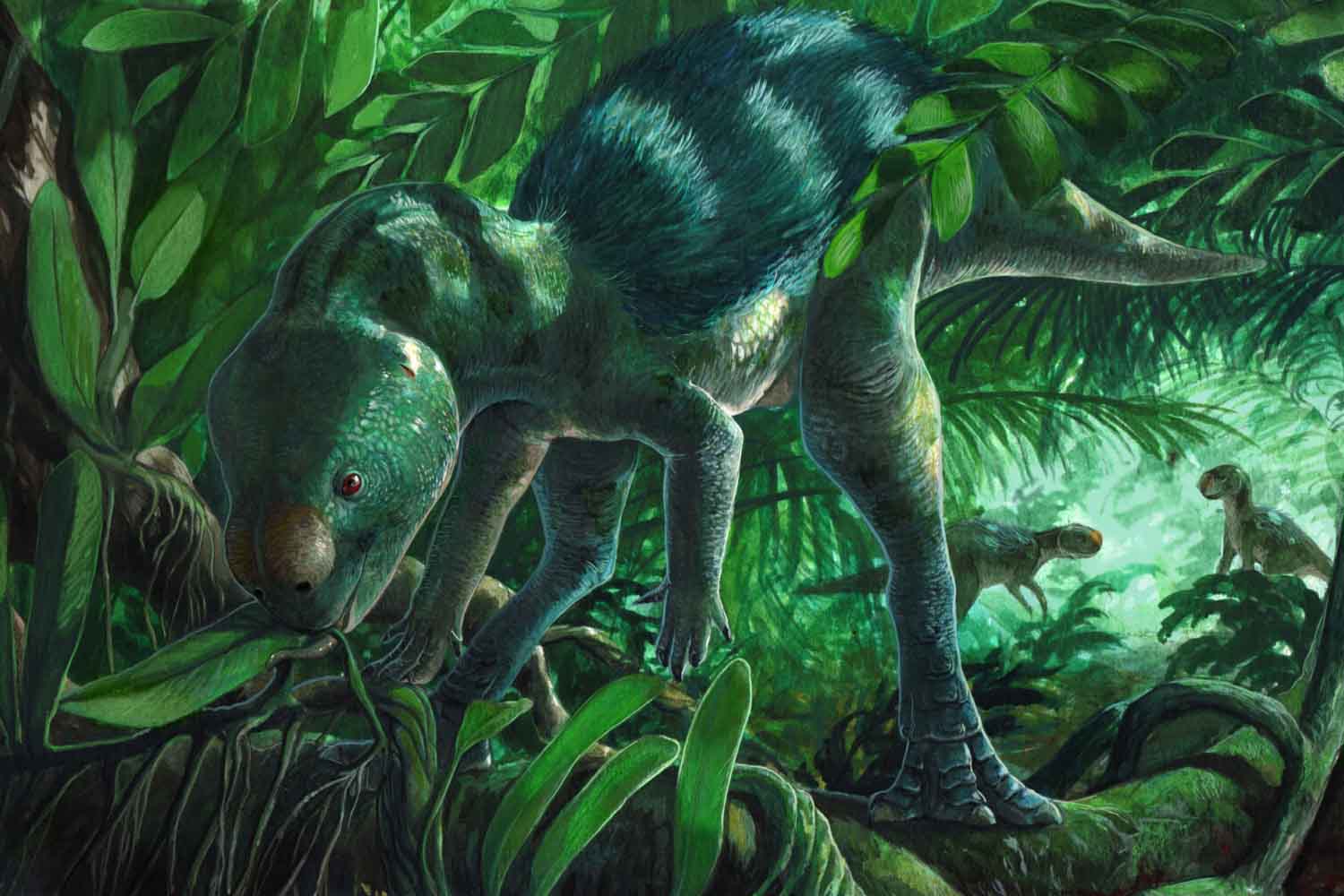
There is something vaguely comforting in the idea that one of the most revolutionary animals in the history of life on Earth was, in every way, the size of a chicken. No fangs, no very long neck, nothing of what we expect from a creature capable of overturning decades of science. Foskeia pelendonum it was small, probably fast, and probably completely unaware that it was destined to become a huge problem for twenty-first century paleontologists.
The study that officially described this species was published on Papers in Palaeontologybut the story begins much earlier: in 1998, in the geological formation of Castrillo de la Reina, in Spain, the first bones came to light. The researchers immediately understood that they had in their hands the remains of a small herbivorous dinosaur from the Ornithischia group, but for years a doubt remained unresolved which in paleontology is worth as much as a scientific death sentence. Those fragments could simply have belonged to a larger species hatchling, and that would have changed everything.
The 70 million year old hole that paleontology brought with it
To really understand why this discovery is making noise, it’s worth taking a step back to the 19th century, when paleontologists began to classify dinosaurs based on the shape of their pelvis. From this anatomical distinction two large families were born that still guide the classification today. THE Saurischia they have a pelvis similar to that of lizards and this includes the most famous predators of the collective imagination, such as the Tyrannosaurus rex, or the Velociraptor, together with sauropods with disproportionate necks such as the Brachiosaurus. On the other side there are the Ornithischiawith a pelvis reminiscent of that of modern birds, and here we find Stegosaurus, Triceratops and hadrosaurs, the duck-billed dinosaurs.
It is worth highlighting a small perfidy of evolution: despite the “avian” pelvis of the Ornithischia, birds actually descend from Saurischia, through small feathered theropods. Nature has this vice of not respecting our categories.
Within the Ornithischia there is a subgroup called Rhabdodontomorphawhich would have given rise to a series of herbivores widespread especially in the southern hemisphere. The trouble is that the fossils only told the beginning and the end of this story: the most primitive forms on one side, the most advanced ones on the other, and about seventy million years completely empty.
Paleontologists call this situation a “ghost line,” a hole in the fossil record that exists because there was, somewhere, an evolutionary continuity that no one had yet found a way to demonstrate. And it is exactly in that void that Foskeia was hiding.
The micro-computed tomography that changed everything
The research group led by the paleontologist Paul-Emile Dieudonné of the Universidad Nacional de Río Negro subjected the Spanish finds to computerized micro-tomography, a technique that allows the internal structure of bones to be analyzed with a precision that until a few decades ago was simply unthinkable. The scans revealed the fact that changed everything: at least one of the individuals examined was an adult. Half a meter long, chicken size, fully mature skeleton. The doubt that had weighed on fossils since 1998 was finally resolved.
The new species has been named Foskeia pelendonuma name that means “forager of the Pelendoni”, in reference to a Celtic population that inhabited that area of Spain before the arrival of the Romans — a small homage to the human history of the place that preserved these fragments of natural history.
The anatomical analysis returned surprising details. The structure of the teeth and jaw joint indicate a highly specialized diet, with Foskeia occupying a specific ecological niche in Lower Cretaceous forests, probably moving nimbly through vegetation and relying on speed to escape predators. The scholars also hypothesize a change in the way they moved during growth: the puppies walked on four legs, while the adults progressively became bipedal.
The co-author of the study Thierry Tortosa called this fossil “a key capable of opening an evolutionary chapter that had remained hidden for millions of years,” and the presence of Foskeia in Europe demonstrates that the Rhabdodontomorpha lineage was alive and well during those seventy million seemingly empty years simply thriving in small, fast forms, while elsewhere evolutionary relatives bloated to monumental proportions.
The discovery, however, also opens up a broader and decidedly more destabilizing front for the scientific world. The anatomy of Foskeia reignites the debate on a hypothesis called Phytodinosauriaaccording to which all herbivorous dinosaurs formed a single large evolutionary group with a closer common origin than previously thought. If this theory found further confirmation, the dinosaur family tree would have to be completely redesigned, and by “completely” we really mean from scratch, with all that this entails for decades of research and classification.
As Dieudonné explained, evolution has experimented radically even in small-sized species, and the future of paleontological research will increasingly depend on the attention paid to fragmentary fossils and less conspicuous species. Because sometimes the answer to a seventy-year-old question is hidden in a bone the size of the palm of a hand, buried in a Spanish geological formation while patiently waiting for someone to arrive with the right equipment and the curiosity to take nothing for granted.
