
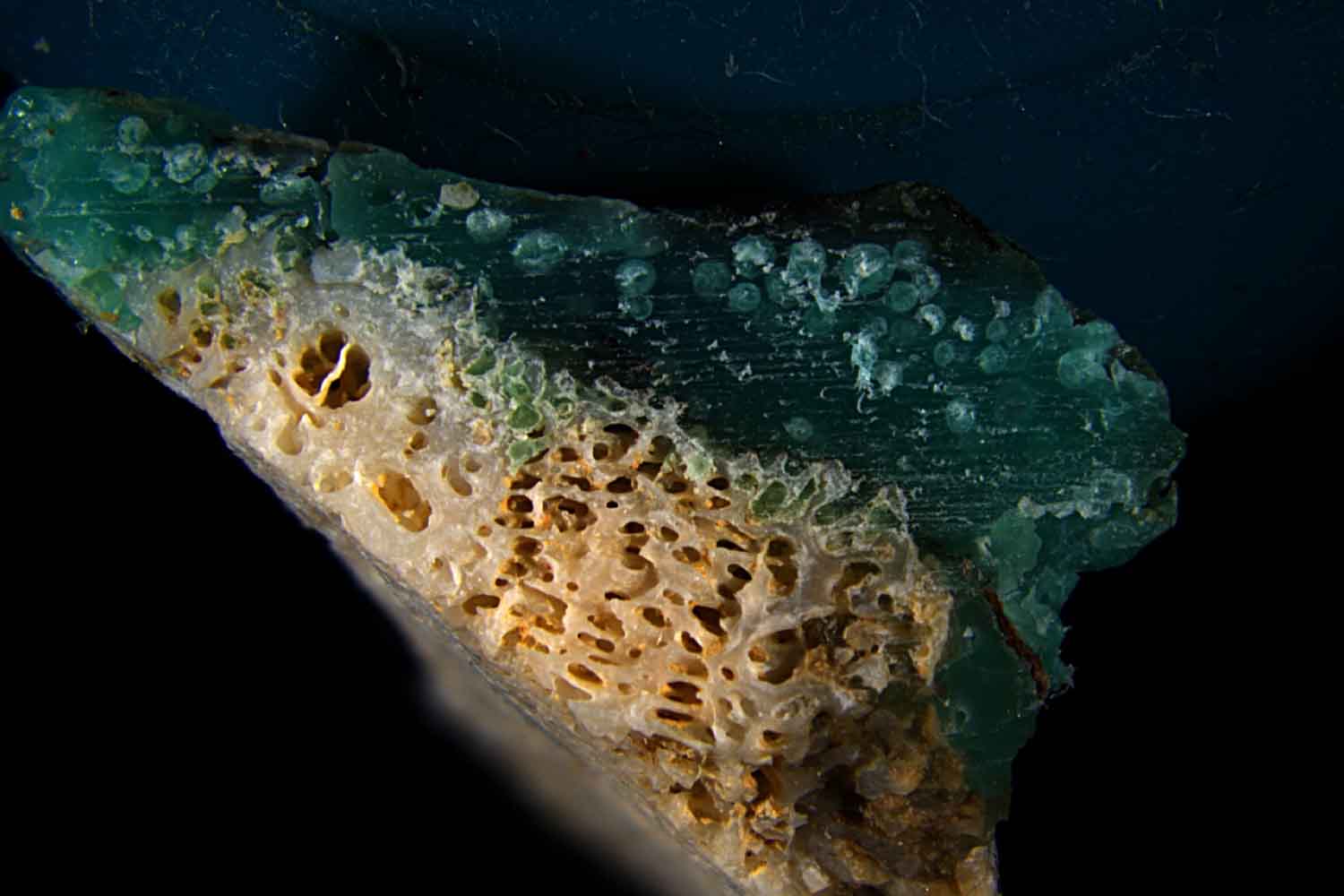
They were small blue, green, yellow and red inserts embedded in the white of the coral fragments. During routine marine litter checks along the beaches of Okinawa, Japan, a group of researchers found five. The surprise arrived in the laboratory: that plastic was not simply placed on the coral. It had merged with the skeleton, penetrating its tiny pores until it became practically inseparable.
The authors called them plasticoralli. In the work published on Marine Pollution Bulletinresearchers from the Okinawa Institute of Science and Technology (OIST) and the Ryukyu University describe them as a new variant of plastiglomerates, those hybrid debris in which plastic ends up embedded in natural materials. This time the natural material is what remains of a coral.
Five cases, three beaches and two very common plastics
Plastic corals have been spotted on the beaches of Sosu, Ibu and Odo on the island of Okinawa. Three cases came from Sosu, while the other two were observed in Ibu and Odo. Some of the sites are located within Yanbaru National Park in the north of the island. Four samples were collected and analyzed: they measured approximately 3.8 to 8.8 centimeters. Small enough to go almost unnoticed among the beach debris.
Raman spectroscopy has identified polyethylene and polypropylene, two of the most used polymers in packaging and everyday objects. Using microscopy and micro-CT, the team then observed the plastic entering the cavities of the coral skeleton instead of simply coating its surface. It is this fusion that distinguishes plastic corals from other forms of plastic encrusted on rocks or organisms already described in recent years.
How they were formed precisely, however, has not yet been demonstrated. One lead is particularly concrete: bonfires on the beach. One of Sosu’s specimens was found right at the bottom of a hearth. The heat may have melted the plastic waste, causing it to leak into the coral fragments on the sand. It is a plausible hypothesis, not yet the complete biography of every plastic coral found. The Okinawa Institute of Science and Technology underlines this in the official communication on the discovery.
That dead coral can return to the sea
The word “dead” might make those fragments seem biologically irrelevant. In the reefs, however, the coral rubblethe coral rubble produced by the fragmentation of colonies, continues to do a lot of work.
Currents can carry it back to the sea, where it provides a surface on which new corals can settle. Its irregular shape also creates small shelters used by young fish and other organisms to escape currents and predators. In short, a small piece of coral on the beach can still be part of the barrier mechanism. With the plastic now incorporated inside.
This study did not measure the toxic effects of plastic corals on organisms. The authors themselves call for new research to understand how widespread they are, how they form and what consequences they may have once they return to the marine environment. Caution is needed here: having found melted plastic in coral does not mean having already demonstrated new biological damage.
There are reasons to investigate, however. Previous experiments have shown that substances released from some plastics can trigger stress responses in corals under certain conditions. And a study published in Science in 2018, on over 124 thousand corals in the Asia-Pacific area, it had found a strong association between contact with plastic waste and the presence of diseases. They are results obtained in different conditions and contexts: they do not prove what Okinawa plastic corals do, they explain why having found them deserves something more than a curious name.
A small stone from the “Plasticene”
The authors also propose a geological meaning. Plastic melted into material produced by marine organisms could be preserved in sediments and become one of the traces left by our era. Hence the reference to the “Plasticene”, a term used by some researchers to describe the footprint of plastic on the Earth, especially since the explosion of production in the second half of the twentieth century. It is not a formally recognized geological epoch: rather, it describes the kind of find we might leave for those who come later.
Five plastic corals on three beaches do not yet say how widespread the phenomenon is. However, they do say how far a bag, container or any other plastic object can reach once it has lost its name and function. In Okinawa there are some polyethylene and polypropylene left stuck in the pores of an old coral. Firmly enough to now deserve a name of their own.
