
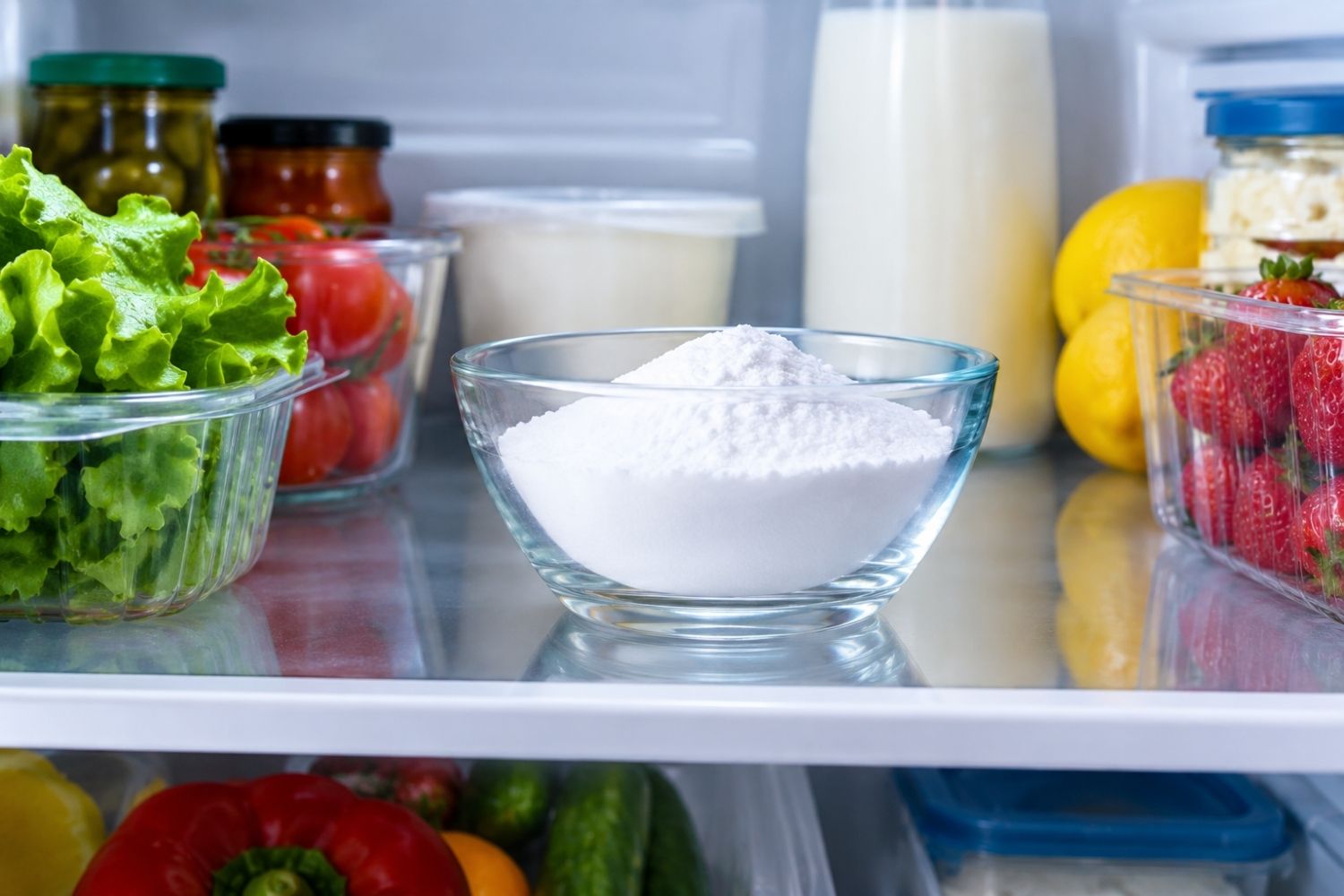
In 1970, everyone who bought the yellow Arm & Hammer box used it primarily to clean the walls of the refrigerator. Two years later the same box was inside the refrigerator, open, next to the butter. It wasn’t a laboratory that decided to move but an advertising agency: the 1972 campaign convinced American families that it was enough to leave it there to keep bad smells at bay, and in three years sales of the package rose by 72%. Half a century later, the bowl of baking soda between the refrigerator shelves becomes part of grandmother’s infamous advice. Does it really work? The answer is a partial yes, as long as it is used against certain odors and under certain conditions.
What baking soda does, and what it can’t do
Baking soda is a weak base, and when it meets an acid it reacts. With acetic acid, for example, it forms sodium acetate, water and carbon dioxide, substances that say nothing to the nose. The reaction is described in black and white in a 2020 study by the World Institute of Kimchi in Gwangju, South Korea, dedicated to the smells of kimchi, the fermented cabbage which has few rivals in terms of olfactory presence. Many spoiling and fermenting foods release acidic compounds, from soured milk to pickled foods, and that’s where baking soda has something to say.
The fish that begins to go bad plays another game. The terrible smell is largely due to trimethylaminewhich chemistry classifies as aminea close relative of ammonia. Base against base, the reaction that neutralizes acids does not take place here. On the sulfur compounds of garlic and cabbage, in the Korean test, the picture was more confusing, because some molecules decreased, one even increased.
The numbers of the laboratories
In the aforementioned Gwangju study, one gram of bicarbonate, closed in a five-liter bag with acetic acid, eliminated 31% of it in half an hour and 86% after two and a half hours. The same amount of coal exceeded 99.9% already in the first thirty minutes. In the sensory test, with fifteen trained tasters, kimchi odor dropped from 5.5 to less than 3 on a nine-point scale with both baking soda and charcoal. Another example concerns the tests conducted at Universiti Sains Malaysia, the protagonists being waste from a canteen. Fifty grams of baking soda spread in the bottom of an eight-liter bin, with a pound of waste left there for a week, reduced the odor by about 70 percent. Encouraging results, albeit obtained in small, closed spaces, with the dust close to the source. A refrigerator is another matter.
In this regard, America’s Test Kitchen, the kitchen-laboratory of Cook’s Illustrated magazine, tested the idea with sealed containers full of sour milk, cheese and spoiled fish: the opinion of the “noses” was divided, and the outcome was deemed inconclusive. In the same article the editorial team calls into question Robert Wolke, chemist and for years the author of science in the kitchen on the Washington Post, who in his What Einstein Told His Cook 2 He judges the chances of molecules from sour milk passing through the fridge to encounter bicarbonate of soda to be slim, and maintains that no single substance can defuse all the stinky compounds. In a second test, which lasted a month, two mini fridges full of chopped onions, kimchi, parmesan and canned tuna housed one a cup of baking soda, the other a cup of activated charcoal granules: the second, according to all the tasters, smelled much less.
How to use it, if you want to use it
Obviously, the bowl does not replace cleaning. A forgotten container at the bottom continues to emit odors, and no dust keeps pace with a still active source: the first step is to find the culprit and throw it away. Furthermore, a wide, low bowl is better than a box with a narrow opening, because the reaction only occurs where the powder touches the air. For the same reason it must be changed regularly, as recommended by the manufacturer himself, who has a clear interest in frequent replacement but, in this case, also some reason. Another factor to consider is whether bicarbonate works best in direct contact. America’s Test Kitchen also verified that, to remove the smell of garlic and onion from a cutting board, the most effective method was a paste of a spoonful of baking soda and a teaspoon of water. The same principle applies to shelves, drawers and fridge seals, where odors stick to the surfaces. For stubborn odors, tests indicate activated charcoal, to be placed in an open container at the bottom, near the air vent.
