
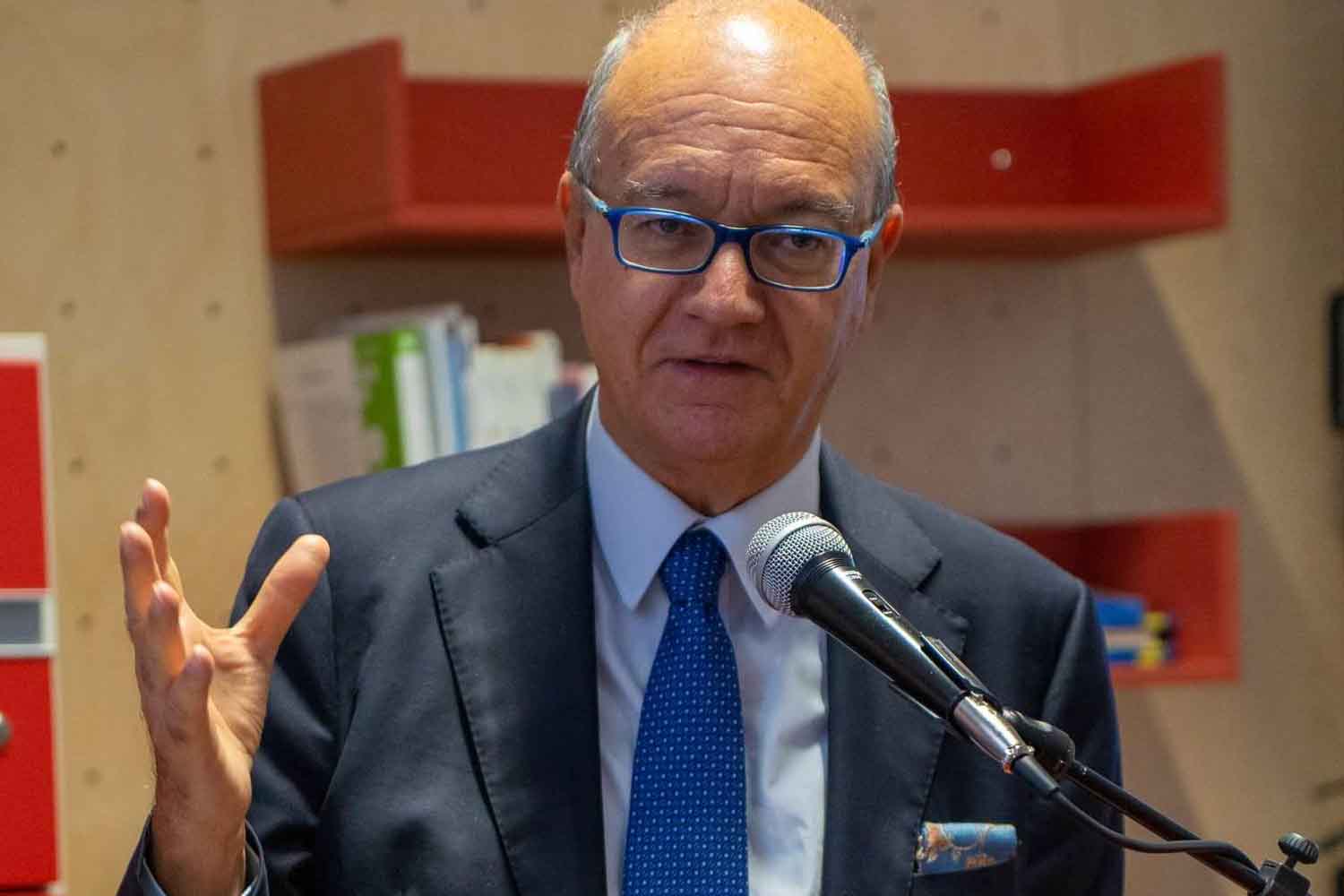
“Nonsense.” This is how Giuseppe Valditara dismissed the proposal for a compulsory psychologist at school during the conference “Building educational co-responsibility”, hosted in the Senate on 6 October 2026. The Minister of Education distanced himself from the “psychologization of all students”, supporting the need for targeted interventions for children with particular critical issues.
The good thing is that the proposal from which he dissociates himself comes from the League. It was launched by Armando Siri, national head of the party departments, while the first signatory indicated is the deputy Giorgia Latini. The project provides for two obligatory monthly hours of psychological education, initially in high schools, and the gradual entry of 18 thousand psychotherapists, then the extension to middle and elementary schools. To pay the bill, Siri proposes an additional IRES of 0.65% on large companies with more than 100 million euros in turnover.
Let’s be clear: it is a huge project and there are many things to discuss. Mandatory nature, costs, the role of families, the boundary between psychological education and clinical activity, how to access individual interviews. What doesn’t hold up is describing it as the obligation for every child to “go to therapy”: Siri presented it above all as management of emotions, listening and prevention, and there is some forcing on this. You can criticize an idea without attributing to it contents that it does not foresee.
Then there’s the precedent, which is almost comical. On 17 January 2024, Latini herself had filed the bill AC 1653 in the Chamber to establish the school psychologist “in schools of all levels”. Signatories: also Simona Loizzo, Giovanna Miele and Rossano Sasso. The proposal is still being examined by the Culture Commission. Sasso, who in the meantime moved to Futuro Nazionale, is today among the harshest critics of the new Northern League initiative. It happens.
The two texts have different approaches, of course. But the psychologist as a structural presence in schools, until two years ago, seemed presentable enough to deserve four parliamentary signatures. In the meantime something has changed. The needs of the kids, however, remained there.
At 11, one in two students already feels under pressure
Before the discussion boils down to a war over the adjective “obligatory,” let’s look at how the kids are doing. The national data comes from the HBSC surveillance coordinated by the Istituto Superiore di Sanità with the universities of Turin, Padua and Siena. In 2022, 6,388 classes were sampled in all Regions, of which 5,673 participated in the survey. The student questionnaires included in the analyzes were 89,321, relating to the age groups of 11, 13, 15 and 17 years.
Already at the age of 11, around 50% of boys and girls say they feel somewhat or very pressured by their school work. With age the percentage rises, and among girls it reaches 80% around the age of 15 and exceeds it at 17. Eleven years. The age at which you should be most concerned about missing stickers in the album.
They are subjective answers, not diagnoses. But dismissing them as “adolescent noise” requires a certain statistical imagination. The rest doesn’t get better. Also in the HBSC, less than 30% of girls aged 13 and over describe their health as “excellent”; among seventeen-year-olds the figure drops to 13%. About half of males report at least two psychosomatic symptoms more than once a week; among girls it exceeds 60% and goes beyond 80% at 15 and 17 years old. This leads to headaches, stomach aches, difficulty falling asleep, nervousness, irritability and feeling down.
Here too we are talking about reported symptoms, which can have different causes, not about medical records. However, according to the Istituto Superiore di Sanità, between 2018 and 2022 the situation worsened, especially among adolescents and older adults.
And there is an even more interesting fact. In the AIFA OsMed 2025 Report, published in August 2026, the prevalence of use of psychotropic drugs under the age of 18 reached 0.64%, i.e. approximately 6.4 minors per thousand, with an increase of 12.1% in just one year. Compared to 2016, consumption has tripled.
Be careful not to misread it: this number measures the use of medications, not overall psychological distress. The increase may also depend on an increased ability to recognize and treat certain conditions, and a prescribed drug may correspond to appropriate therapy. Furthermore, the Italian prevalence remains lower than that observed in other countries.
There remains significant growth, which the Minister of Health himself, Orazio Schillaci, has defined as structural. In February he reminded the Chamber that too often the discomfort comes to medical observation “when it is in the acute phase, too late”.
The Ministry already pays for the student psychologist
The distance between Valditara and the League mainly concerns the model. Because his Ministry has already established ListenMI, an experimental psychological support service for students in the last year of middle school and the first two years of high school.
The fund is worth 18.5 million euros per year from 2026. The service is voluntary, takes place online and parental consent is required for minors. Each voucher is worth 250 euros and covers up to five individual meetings with a psychologist. The ministerial decree explains that the objective is to prevent risk factors, support psychological well-being and intercept fragilities that require the intervention of local services.
Five voluntary meetings for some students and two hours per month for all are two very different models. Discussing which makes more sense, how much it should cost and how far school can enter the personal sphere of children is legitimate. But the idea of working on prevention is already written in the Ministry decrees. To dismiss the whole issue as “nonsense” would therefore be rather hasty.
What the research says about interventions at school
The World Health Organization has also expressed its opinion on prevention in adolescence. Its guidelines recommend universal psychosocial interventions for all adolescents, with activities on emotional regulation, stress management, relationship skills, problem solving and assertiveness.
The recommendation is strong, although WHO judges the overall certainty of the evidence to be low. Among the reasons is that universal school-based interventions can reach many children and help reduce the stigma of selective access to services. To clarify: if everyone participates in an educational activity, no one is identified as “the one who goes to the psychologist”.
This does not mean that the WHO approves the League’s proposal: it does not prescribe two hours a month with an Italian psychotherapist, nor a precise organizational model. However, it offers an uncomfortable element to slip into the word “nonsense”: universal prevention of mental health in adolescence is a health strategy studied and recommended.
Then there is a systematic review with meta-analysis from 2024: 75 studies and 40,498 students on brief mental health interventions at school. The average effects are small but statistically significant, and still detectable up to a year later. Small, I said. No magic wand, no generation healed in four lessons. The studies concern different programs, lasting a maximum of four sessions or 240 minutes in total, and do not allow us to establish what the effectiveness of the two monthly hours foreseen by the League would be. There are some measurable benefits, however.
The two hours of the League can be re-discussed, rewritten or left to gather dust in a parliamentary drawer. There remain almost 90 thousand students involved in the ISS survey, around half of the 11-year-olds who say they feel under pressure for school and the consumption of psychotropic drugs among minors has tripled since 2016. The word “nonsense” takes up much less space. The numbers, unfortunately, a little more.
