
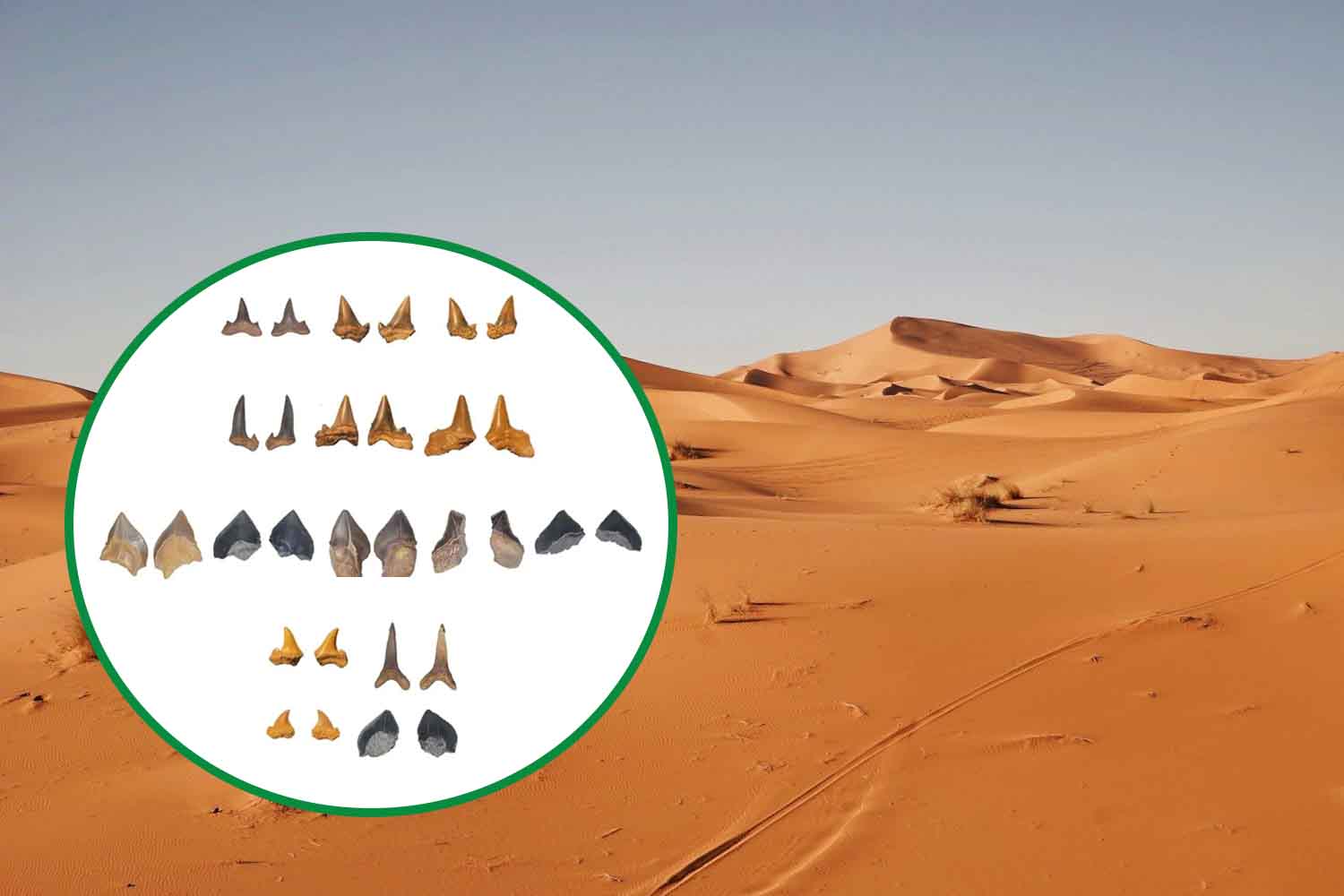
Fourteen shark teeth have resurfaced from the phosphate-rich rocks of the Abu-Tartur Plateau in Egypt’s Western Desert. Today there is sand, stone and mines around. In the Upper Cretaceous, more than 70 million years ago, they swam above those same rocks at least five species of sharks.
The fossils were studied by a team led by paleontologist Tarek Yassin of Cairo University and described in the study published in Cretaceous Research. The five species identified are added to two others already documented in the same area: Abu-Tartur therefore preserves the traces of at least seven different lamniform sharks. A fair amount of crowding for a place where today finding even just a puddle would require a lot of imagination.
Fourteen teeth and five different species
The teeth come from the Duwi Formation, a succession of sedimentary rocks formed during the Campanian, a phase of the Upper Cretaceous roughly between 84 and 72 million years ago. At the time, global sea levels were much higher and large portions of now-emerging North Africa were submerged.
The 14 finds belong to five extinct forms: Cretalamna cf. C. moroccan, Scapanorhynchus cf. S. raphiodon, Serratolamna cf. S. serrata, Squalicorax bassanii And Squalicorax pristodontus. They are all lamniforms, the same order that today includes makos, great whites, and the goblin shark, among others.
Here the apparently small acronym “cf.” does a lot of work. It means that the attribution to a specific species is considered probable on the basis of available fossils, without yet being definitive. It often happens with prehistoric sharks: the cartilaginous skeleton is preserved with much more difficulty than the teeth, which therefore become one of the main tools for reconstructing their presence and diversity.
The shapes of the teeth are different enough to also tell something about how these animals lived and fed. Some are long and narrow, suitable for grasping slippery prey; others are wider and have margins useful for cutting. Evidently, only one model of cutlery was needed.
A shark may appear in the African fossil record for the first time
The most delicate discovery concerns Scapanorhynchus cf. S. raphiodonbelonging to a lineage related to the current goblin sharks. According to the authors, the Abu-Tartur finds could represent the first known report of this form in Africa and also its most recent stratigraphically evidence.
The conditional is essential. The researchers point out that other specimens and future taxonomic revisions will be needed to make the identification more solid. Two teeth can move a paleontological map a lot, but they remain two teeth. Other species instead broaden the picture already known for Egypt. The overall result is of interest above all because it increases the known diversity of the sharks that populated this stretch of northern Africa during the Upper Cretaceous.
Where there is desert today there was a very productive sea
Those teeth above all tell about the environment that surrounded them. The Duwi Formation was deposited in a tropical sea and the phosphate rocks are compatible with waters particularly rich in nutrients and biological activity.
The authors hypothesize that in this system upwelling phenomena of nutrient-rich deep waters, the so-called, could also play a role upwelling. Once they arrived towards the surface illuminated by the Sun, those substances could feed the plankton and, in turn, small organisms, fish and increasingly larger predators.
In short, sharks occupied the top levels of a food chain that must have had a lot to offer. Remains of fish, turtles and other marine vertebrates have already been found in the same formation.
The variety of sharks also suggests an environment that is anything but uniform. Some forms are associated with deeper areas of the marine shelf, others with more open waters or relatively close to the coast. The fossils may therefore have recorded organisms from different environments along the same marine margin.
“Shark cemetery”, yes, but without the massacre
The name chosen by the researchers themselves for the study, “Egyptian shark graveyard”, works very well. Taken literally, a little less. The 14 teeth do not prove that dozens of sharks all died together in the same place due to some Cretaceous catastrophe. The phosphate deposits formed slowly and may have concentrated remains belonging to different times and to animals from different portions of the ancient marine environment.
The one preserved in Abu-Tartur is therefore a accumulation distributed over time. Precisely this characteristic allows paleontologists to observe a larger portion of the community that frequented those waters, instead of the photograph of a single particularly unlucky day for the sharks.
It is also the limit to keep in mind when faced with such small numbers: 14 teeth do not allow us to reconstruct the entire ecosystem in detail nor to establish how many individuals lived there at the same time. However, they add five pieces to a still incomplete fossil record of North Africa and bring the number of lamniform species known in the area to at least seven. Today Abu-Tartur is in the middle of the Egyptian western desert. The sea has been gone for tens of millions of years. The teeth, much more stubborn, remained.
